
Women’s College Golf Rosters, 2026-27
D1 women’s golf is 10 points more international than men’s, the Big 12 is two-thirds international, and below D1 the pattern flips
This is the women’s side of the 2026-27 roster data. The men’s piece went out last week.
The short version: D1 women’s golf is 10 points more international than men’s. And on the same teams from last season to this one, the women went up while the men dipped slightly.
Same reminder as always. “U.S.-born” and “international” come from the hometown each player lists on the roster, not from birthplace or citizenship.
The Dataset
I have 5,899 women’s players on 738 team rosters for 2026-27, all scraped from team websites in September. Here’s how many teams that is in each division, and roughly what share of the division’s programs it covers:
D1: 277 teams (essentially every program)
D2: 155 teams (84%)
D3: 182 teams (about 77%)
NAIA: 93 teams (about 63%)
NJCAA: 31 teams (about 40%)
That’s more women’s teams than I’ve had before. Back in March I left NAIA women out, because the number of schools in my data jumped around too much from one season to the next. With 93 teams this year, they’re back in.
How Women Compare With Men
Last season, D1 women’s rosters were 36% international and the men were at 28%. This season it’s 38% against 28%.
You see the same gap in the freshmen, over a longer stretch. In 2005-06, 80% of D1 women’s freshmen were U.S.-born. That was down to 65% in 2025-26, and it’s 63% this fall. The men went from 85% to 73% over the same 21 seasons.
Inside the Power-4 (2025-26 conference membership), international freshmen made up 51%, 48%, 63% and 45% of the women’s classes from 2022-23 to 2025-26. This fall it’s 59%. These groups are small, somewhere between 37 and 102 freshmen with a known hometown each season, so I wouldn’t read too much into any one year.
This Season in D1: Up Again
For year-over-year comparisons I only use teams that show up in both seasons and keep at least a quarter of their players. That leaves 210 D1 women’s teams, and on those the international share went from 35% to 37%. The men, measured the same way, went from 29% to 28%.
Across all D1 teams it’s 38% this season, and international freshmen went from 35% of D1 classes to 37%.
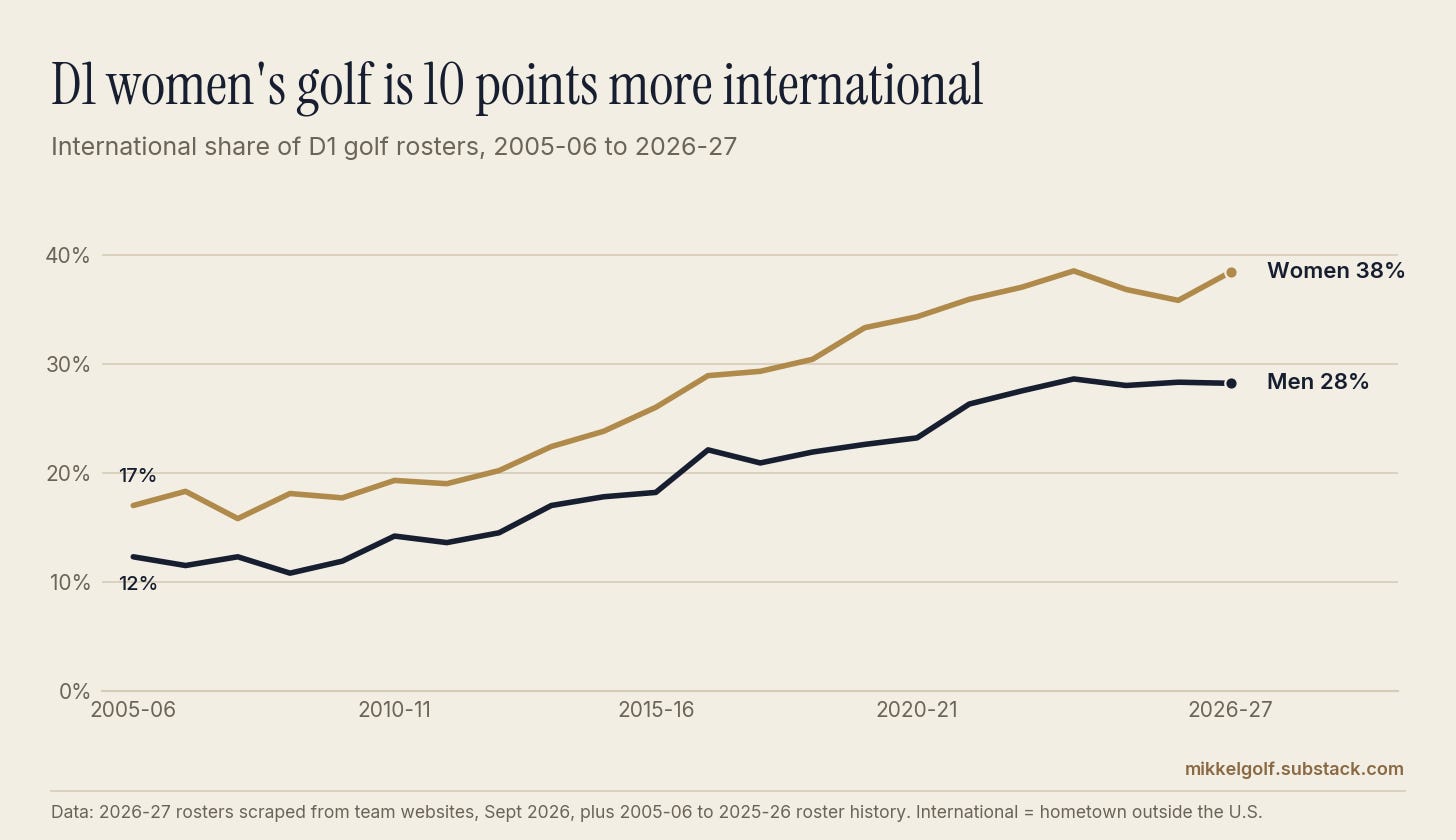
Over 21 seasons, D1 women’s rosters went from 17% international in 2005-06 to 38% now. The last four seasons are bumpier than that makes it sound, though: 38% in 2023-24, then 37%, 36%, and back up to 38%. I wouldn’t call that a steady climb. The gap to the men is what hasn’t moved. It’s been somewhere between 7 and 11 points every season since 2016-17 (10 this season).
Team by team, 88 of the 277 D1 women’s teams have more internationals than Americans this season. For the men it’s 56 of 299. At the other end, 43 women’s teams have no international players at all, compared with 66 men’s teams.
Power-4 Women’s Golf Is Majority International
54% of Power-4 women’s golfers list a hometown outside the U.S. this season. In the rest of D1 it’s 34%. The men don’t have a split like that at all (29% in the Power-4, 28% in the rest of D1).
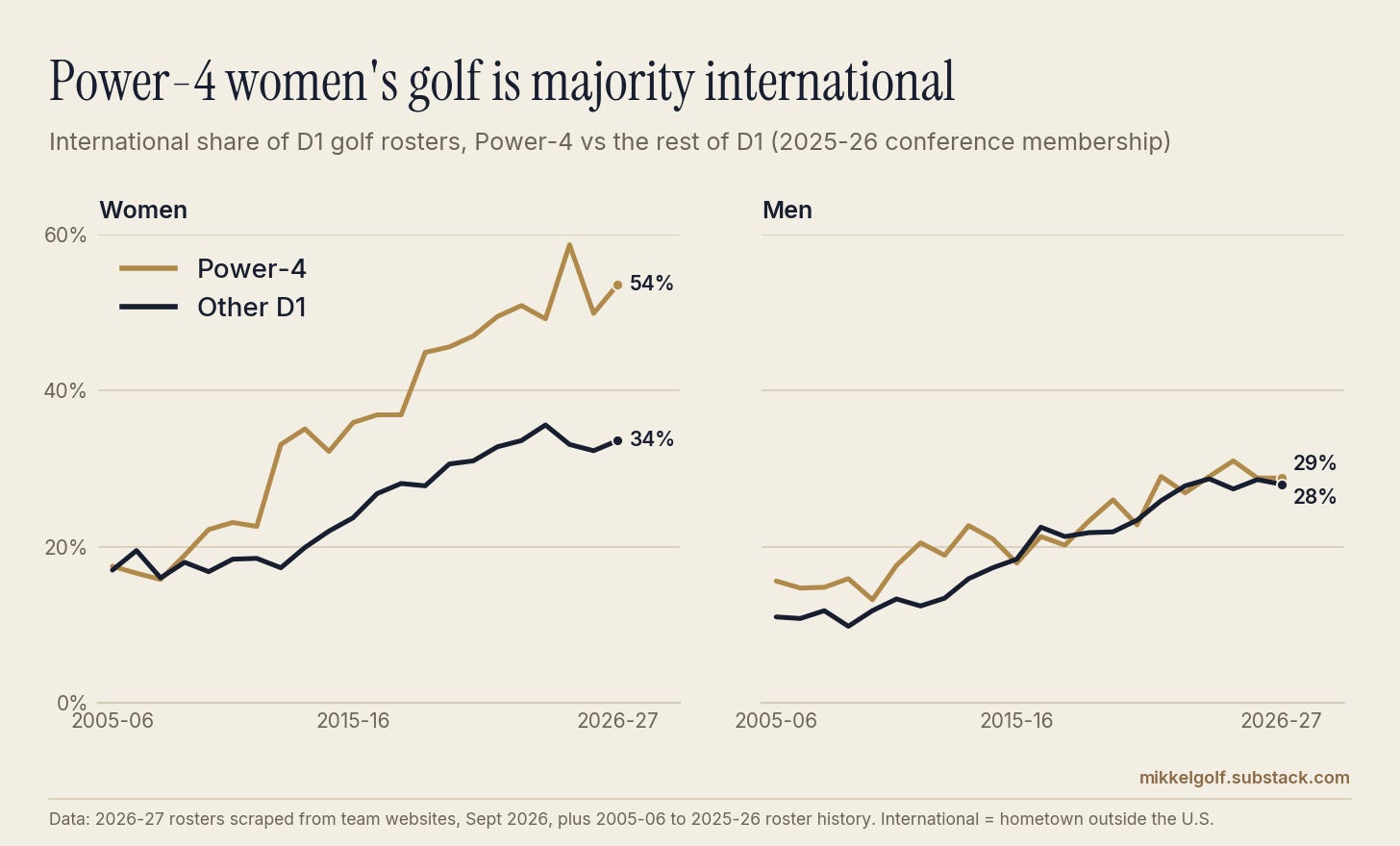
The Power-4 line pulled away from the rest of D1 around 2012-13 and kept going. The rest of D1 has gone up too, just slower.
Split it by conference and the Big 12 sticks out.
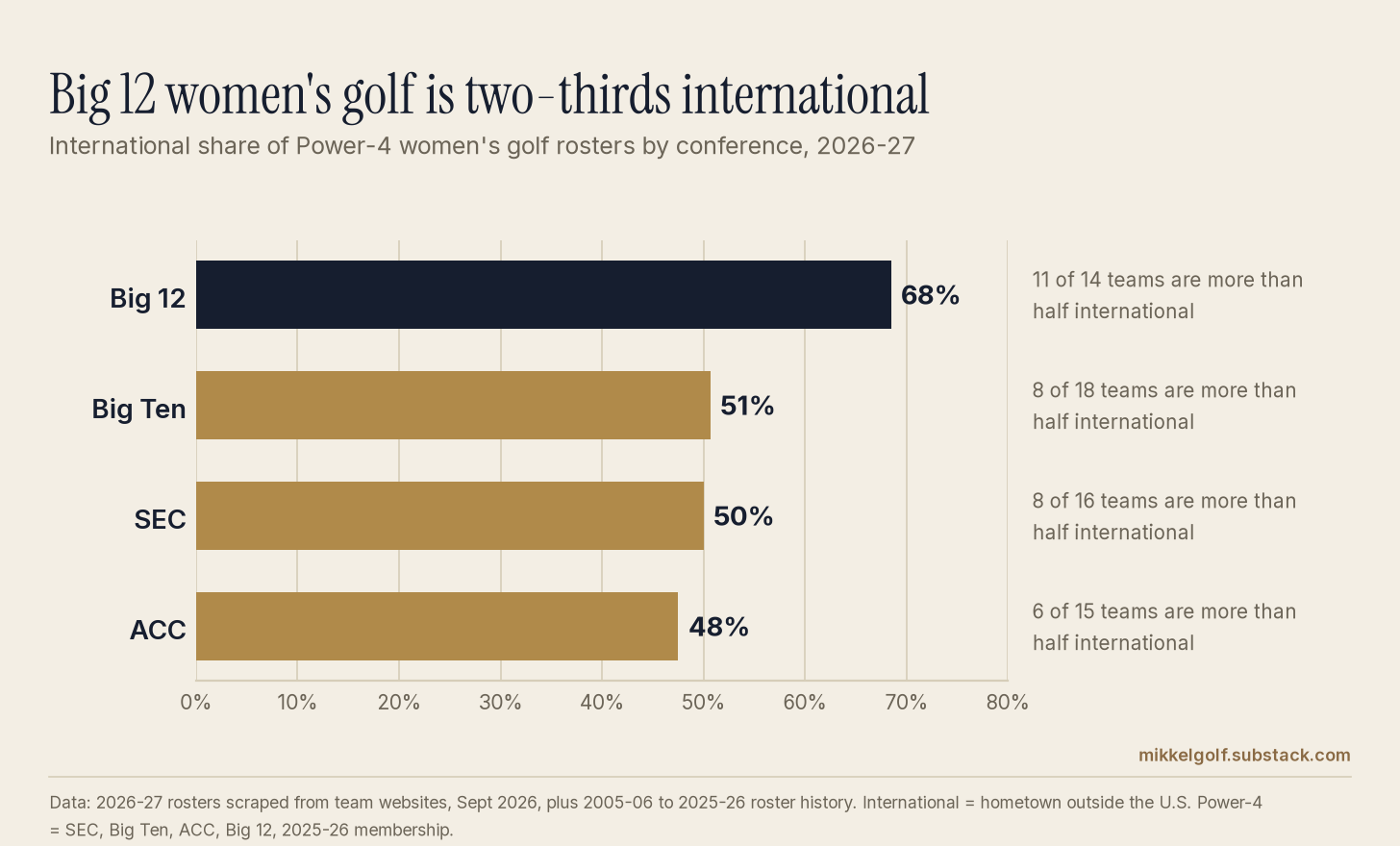
The Big 12 is 68% international this season, and 11 of its 14 women’s teams have more internationals than Americans. The other three are all right around half: the Big Ten at 51%, the SEC at 50% and the ACC at 48%. Kentucky is the only Power-4 women’s team without a single international player on its 2026-27 roster.
A few rosters are entirely, or almost entirely, international. All 7 players at Ohio State list a hometown outside the U.S. (Australia, Spain, Paraguay, England twice, China and the Czech Republic). At Kansas State it’s 8 of 9.
The Big 12 was the most international Power-4 conference for the men as well, at 36%. The women’s number is almost double that.
The Other 70%
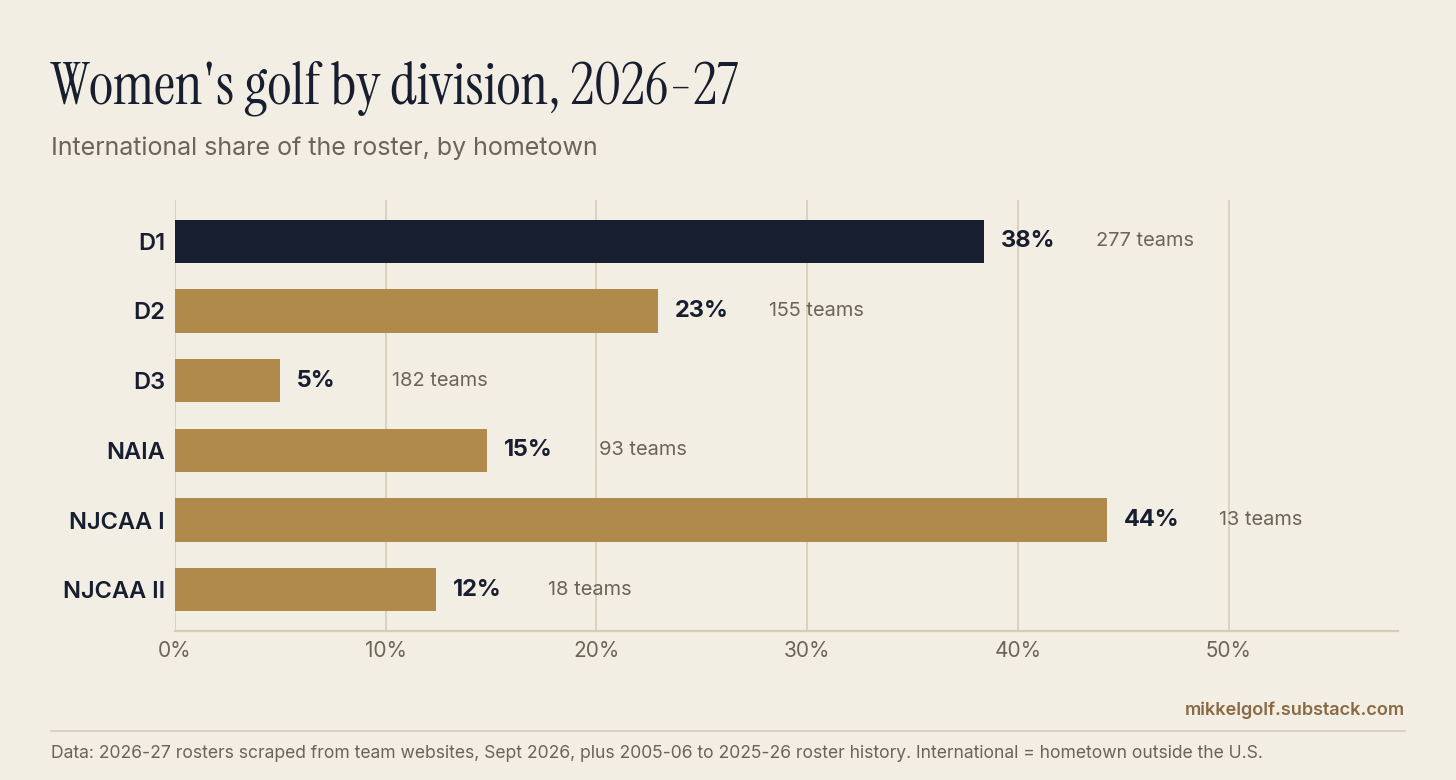
Here’s the international share of the roster and of the freshman class in each division:
D1: 38% of the roster, 37% of freshmen (277 teams)
D2: 23% and 19% (155 teams)
D3: 5% and about 5% (182 teams)
NAIA: 15% and 11% (93 teams)
NJCAA I: 44% and 42% (13 teams)
NJCAA II: 12% and 5% (18 teams)
Some notes, division by division.
D2 was 22% international in 2025-26, and it’s 23% now. On the 149 D2 teams I can match across both seasons, it went from 21% to 23%. From 2005-06 through 2007-08 it averaged about 10%, though I don’t have many schools from those years. D2 freshmen come in a bit lower than the roster this season, at 19%.
NAIA women are at 15%. That’s well below NAIA men (36%), and below D2 women. On the 50 NAIA teams I can match from last season it went from 21% to 20%, so more or less flat. This is the first year I’ve had enough NAIA women’s teams to say anything at all, so I’d treat 15% as a starting point.
NJCAA I is at 44%, but that’s 13 teams and 77 players. Directional at best.
D3 is still the most American division at 5%. On the 180 D3 teams I can match, it went from 4% to 5%.
The part I keep coming back to is that the gap between men and women flips once you leave D1. In D1, the women are 10 points more international. In D2 (23% against 26%), D3 (5% against 8%) and NAIA (15% against 36%), they’re the more American side. I don’t have a good explanation for that yet, and I’d be curious to hear from anyone coaching at those levels.
Where They Come From
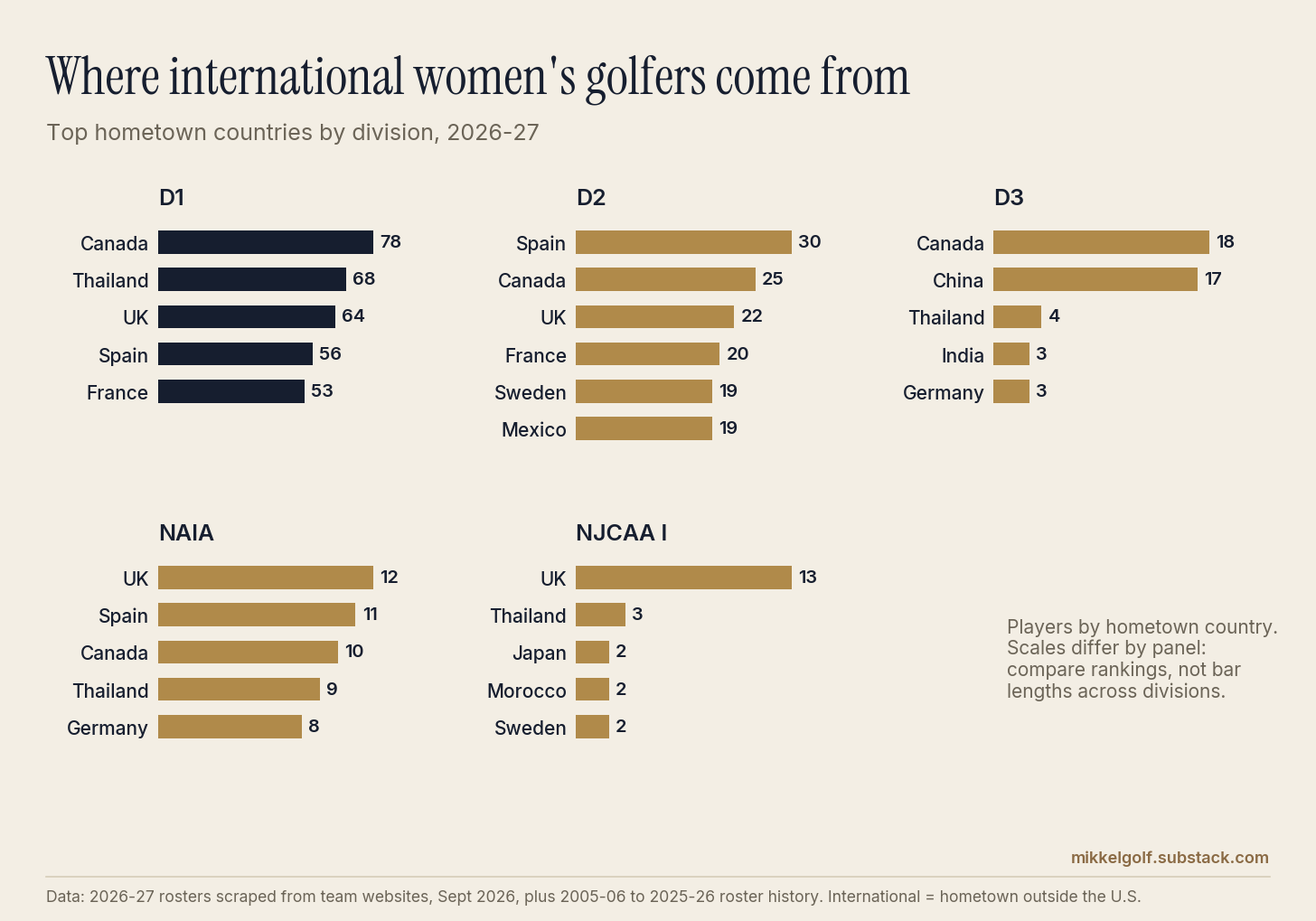
The top hometown countries this season:
D1: Canada (78), Thailand (68), United Kingdom (64), Spain (56), France (53), Sweden (51)
D2: Spain (30), Canada (25), United Kingdom (22), France (20), Sweden (19), Mexico (19)
D3: Canada (18), China (17), then no country above 4
NAIA: United Kingdom (12), Spain (11), Canada (10), Thailand (9)
NJCAA I: United Kingdom (13), then no country above 3
Thailand has moved up to second in D1 women’s golf, ten players behind Canada. In March it was third, behind Canada and the UK. On the men’s side Thailand has 24 D1 players and doesn’t make the top five. Like I wrote in March, I think the run of Thai players on the LPGA Tour over the last decade (Ariya and Moriya Jutanugarn, Patty Tavatanakit, Atthaya Thitikul) has a lot to do with it. Compare men and women, and it’s still one of the most lopsided pipelines in college golf.
D2 is the only level where Spain is on top, and D3 is the only one where China shows up near the top, with 17 players (one behind Canada).
Transfers
This season I also matched the rosters against last season’s tournament results. If a player is on a 2026-27 roster but played every one of her 2025-26 rounds for a different school, I count her as a transfer. On the 266 D1 women’s rosters I could match, that gives 164 incoming transfers. That’s 7.8% of the players, spread over 122 teams (the men are at 9.8%).
45 of them (27%) came up from D2, D3, NAIA or junior college. For the men it’s 41%.
For players moving between two ranked D1 teams, I compared where the two teams finished in Clippd’s final 2025-26 rankings. If the new team finished at least 25 places higher, I counted it as moving up. At least 25 places lower, moving down. Anything closer is sideways. That gives 44 up, 31 sideways and 33 down. Most of this happens well outside the top 25. The typical player who moved up went from a team ranked around 137 to one ranked around 47, and only 12 of the 44 went from outside the top 25 into it.
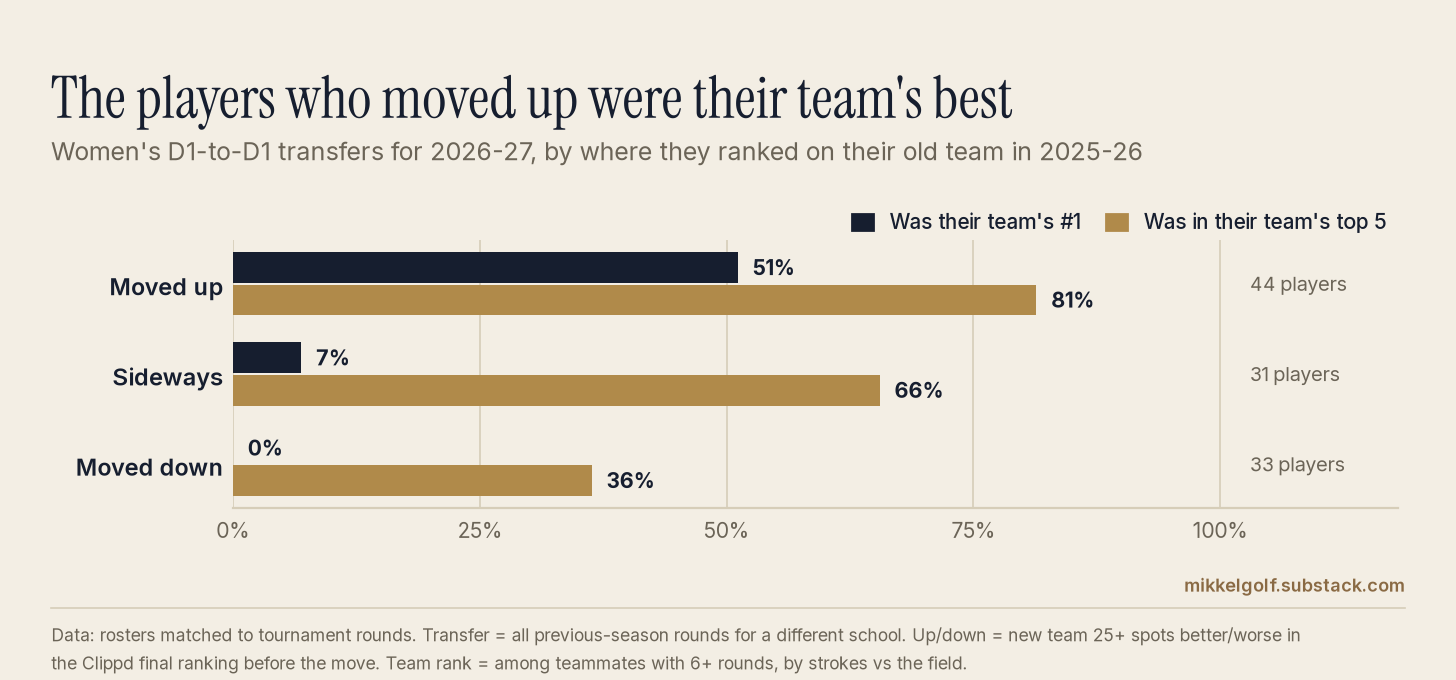
Half of the players who moved up had been their team’s #1 last season, and about four in five had been in their team’s top five. None of the 33 who moved down had been a #1 or a #2, and a third of them played fewer than six rounds.
Two things look different from the men. Women move up less often, 41% of the moves between ranked D1 teams against 53% for men. And of the 16 transfers who joined a top-25 women’s team, 6 (38%) had been their old team’s #1. On the men’s side it was 55%.
In a 2024 piece on roster management, I guessed that “maybe fewer high-performing players on the women’s side enter the transfer portal in search of a better-ranked school.” This season leans that way. The groups are small, though, so I’d call it a hint and not much more.
International players make up 47% of the incoming D1 women’s transfers, compared with 38% of D1 women overall.
Two caveats. The counts are a floor. If a player didn’t tee it up in a tournament last season (a redshirt, someone who never traveled, or a school that isn’t in my database), I can’t match her. And “team’s #1” means the best scoring relative to the field among teammates with six or more rounds. I’ll go through three seasons of transfers, and how those players did at their new schools, in a separate piece.
Summary
The men have been at about 28% international in D1 for four seasons now. The women are at 38%, up on the same teams this year, with a majority-international Power-4 and a Big 12 at 68%. Outside D1 it flips, and women’s golf is more American than men’s in D2, D3 and NAIA.
In the Team USA piece, Power-4 women’s golf was the group the bill would hit hardest. Nothing in this season’s numbers changes that.
Next week we’ll deep dive into transfers.
Data: 2026-27 women’s golf rosters scraped from team websites in September 2026 (5,899 players, 738 teams), plus historic rosters from 2005-06 to 2025-26. U.S.-born / international = hometown listed on the roster. Shares are of players with a known hometown. Freshmen = FR / first year, redshirt freshmen excluded. Year-over-year numbers use only teams with at least 25% of players returning. Power-4 = SEC, Big Ten, ACC and Big 12, 2025-26 membership.
Previous posts in this series:

Coach at Vika Golf Club in Oslo. Former NCAA Division I coach at Texas Tech, Baylor and SFA, and former Baylor golfer.
Working on your own path to college golf?
Book a 2-hour first session. We go through where you stand, which programs fit, and how to contact coaches. In Oslo or on Google Meet, parents welcome.
Related articles
- Men’s College Golf Rosters, 2026-27A new season across D1, D2, D3, NAIA and junior college, and a split inside the Power-4
- College Golf Report - Academic Workload: More Manageable Than You Think, Until It Isn'tCollege Golf Report Chapter 9
- The Other 70%, Women’s Golf International Growth Across Non-D1 Women’s College Golf
First published on the MikkelGolf newsletter on Substack.