
Shifts in Height | Women's DI Golf rosters over the past 20 years 📊
Data Deep Dive 🗃️
In the men’s version of this piece, I looked at 4,571 Division I freshmen and found a small but real height bump on Power-4 rosters. The analysis showed the shift in height was almost entirely a composition effect: more tall international recruits, not U.S. golfers suddenly sprouting an extra centimeter.
Now, let’s examine the women’s side.
If you’ve watched women’s college golf over the last two decades, it’s easy to build a story in your head:
more resources
more speed work and fitness
more international recruiting (as we explored in a recent Women’s golf post)
So… should we expect the women in 2025 to be noticeably taller than the women in 2005?
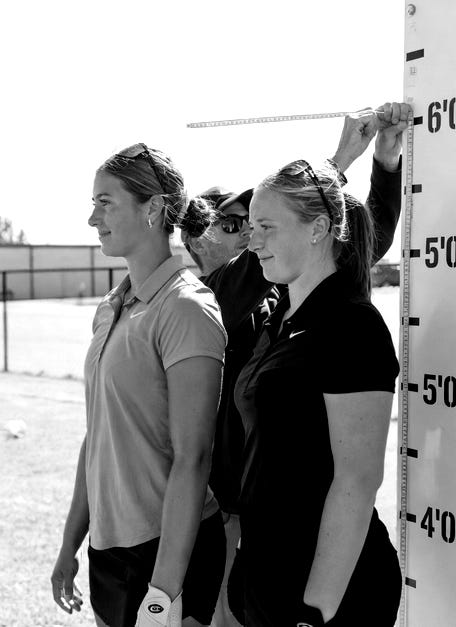
Short answer: no. Contrary to the men, the women’s height story is basically a flat line.
Let’s walk through it:
The women’s dataset
I mirrored the same approach as in the men’s piece:
scraped Division I women’s rosters from 2005–06 through 2025–26
kept rows with a listed height and converted everything to centimeters
grouped seasons into 3-year buckets to smooth out single-year noise
filtered for just incoming freshmen
That leaves 2,778 freshman roster entries with height data spread fairly evenly across the era.
Here are the 3-year buckets for all Division I programs (heights in cm):
2005–07: 167.35 (n = 141)
2008–10: 167.02 (n = 291)
2011–13: 167.54 (n = 430)
2014–16: 166.78 (n = 490)
2017–19: 167.14 (n = 549)
2020–22: 167.78 (n = 492)
2023–25: 166.59 (n = 385)
The overall weighted average across all years is ≈167.2 cm ( around 5’5¾”).
This is the first hint: those numbers are all basically on top of each other. The spread from the “tallest” bucket (2020–22) to the “shortest” bucket (2014–16) is about one centimeter.
Power-4 only
Restricting to the Power-4 conferences (ACC, Big 12, Big Ten, SEC) present in the dataset gives a smaller sample of 376 freshmen, but the same general picture:
2005–07: 168.02 (n = 20)
2008–10: 166.24 (n = 38)
2011–13: 169.31 (n = 41)
2014–16: 168.11 (n = 75)
2017–19: 168.55 (n = 84)
2020–22: 167.67 (n = 73)
2023–25: 167.81 (n = 45)
Overall weighted average: ≈168.0 cm — essentially 5’6” on the nose.
Again: some wobble, but nothing that screams “long-term trend”.
Are women’s DI golfers getting taller?
To go beyond eyeballing the table, I ran the same style of analysis as in the men’s piece: a simple weighted linear regression on those 3-year averages, using the number of players in each bucket as weights.
Think of it as fitting the best possible straight line through the seven data points and asking: “Is the slope of this line clearly different from zero?”
All Division I programs
For all 2,778 players combined, the fitted trend is:
Slope: –0.01 cm per year
Total fitted change 2005–2025: about –0.17 cm (a hair shorter)
p-value: 0.79
This means:
A slope of –0.01 cm/year is tiny. Over the full 18-year span it’s well under a quarter of a centimeter. About a fifth of your fingernail.
A p-value of 0.79 means: if there were no true trend at all, you’d see a slope this big or bigger (in either direction) about 79% of the time just from random year-to-year noise.
Statistically not significant. There is no credible linear trend in height for women across all Division I programs.
Power-4 programs only
For the Power-4 subset, the fitted line tilts slightly upward:
Slope: +0.01 cm per year
Total fitted change 2005–2025: about +0.26 cm (a quarter of your fingernail)
p-value: 0.84
Same story here:
The line points up on paper, but the slope is so small that it’s indistinguishable from zero.
With a p-value of 0.84, random noise is more than enough to explain it.
If you compare just the first and last buckets:
All DI: 167.35 cm → 166.59 cm (–0.76 cm)
Power-4: 168.02 cm → 167.81 cm (–0.21 cm)
Those raw differences are still in “rounding error” territory given how messy real-world roster data are.
Bottom line: unlike the men, there is no statistically meaningful height shift in women’s DI rosters over the last 20 years.
The composition story is flipped
On the men’s side, the key finding was:
The modest height increase on Power-4 rosters is a composition effect from globalization of recruiting, not a biological change in U.S. golfers.
International freshmen were a bit taller on average than U.S. freshmen, and their share of those rosters roughly doubled. Put more tall countries into the mix, and the team average creeps up, even if nobody inside each group gets taller over time.
(You can find that full piece here.)
On the women’s side, the composition story is much softer.
Here are the top country averages on the women’s side with a minimum of 5 freshmen (cm, with sample sizes in parentheses):
Austria: 175.26 (8)
Germany: 171.36 (43)
Sweden: 171.03 (54)
Finland: 169.33 (10)
Czech Republic: 169.16 (10)
UK: 169.03 (64)
Spain: 168.72 (47)
South Korea: 168.49 (6)
Norway: 168.44 (19)
Belgium: 168.15 (5)
Russia: 168.15 (5)
Italy: 167.92 (9)
Denmark: 167.80 (16)
Iceland: 167.64 (8)
Australia: 167.24 (32)
Canada: 167.21 (71)
No country info: 167.15 (332)
USA: 167.09 (1,691)
A few things jump out:
There are genuinely tall pockets: Austria at 175 cm, Germany and Sweden just over 171 cm.
But the big volume groups: USA, Canada, Australia, and even the “no country info” bucket (most likely a lot of U.S. born players here), all sit right around 167 cm, which is also basically the overall women’s average in this dataset.
So unlike the men, the women’s numbers don’t give us a clean “U.S. vs international” contrast. The U.S. sits almost exactly on the global mean. Some European countries are taller, some other groups are similar, and the largest chunks of the recruiting pool all cluster in the same 167–168 cm band.
For women, globalization hasn’t produced a “taller roster” effect at all. Any composition shifts by country look too small (and too balanced) to move the needle in a statistically meaningful way.
Even though women’s DI has seen a larger shift to International recruiting than Men’s golf, the height trend is flat because, structurally, the recruiting pool is flat.
Links:
- Men’s DI Golf Rosters 2025-2025 dashboard
- Women’s DI Golf Rosters 2025-2025 dashboard
- The Declining Rate of U.S.-Born Men’s DI Golfers
- Women’s Golf: The Declining Rate of U.S.-Born DI Golfers
- Shifts in Height | Division I rosters over the past 20 years 📊
- How can a recruit best get a college coach’s attention? (Recruiting)
Mikkel Bjerch-Andresen
Golf coach, data analyst, writer