
Men’s College Golf Rosters, 2026-27
A new season across D1, D2, D3, NAIA and junior college, and a split inside the Power-4
This is the men’s side of the 2026-27 college golf roster data. The women’s piece comes next week.
Last week’s article on the TEAM USA Act used this season’s rosters to look at what a 20% cap would do to college golf. This one steps back and looks at the rosters themselves. The data covers every level of men’s college golf at once: D1, D2, D3, NAIA and junior college (NJCAA).
A reminder on the labels. “U.S.-born” and “international” come from the hometown each player lists on the roster, not from birthplace or citizenship. I’ve used that field for the whole series.
The Dataset
For 2026-27, I have researched and scraped 8,231 men’s players on 761 team rosters, scraped from team websites in September. Here’s how many teams I have in each division, and what share of that division’s programs they cover:
D1: 299 teams (97% of programs)
D2: 150 teams (74%)
D3: 197 teams (68%)
NAIA: 50 teams (30%)
NJCAA: 65 teams (about half)
Behind this season sit 21 seasons of rosters going back to 2005-06 in my dataset.
Twenty-One Seasons of D1
Across 21 seasons, D1 men’s rosters went from 12% international in 2005-06 to 28% now.
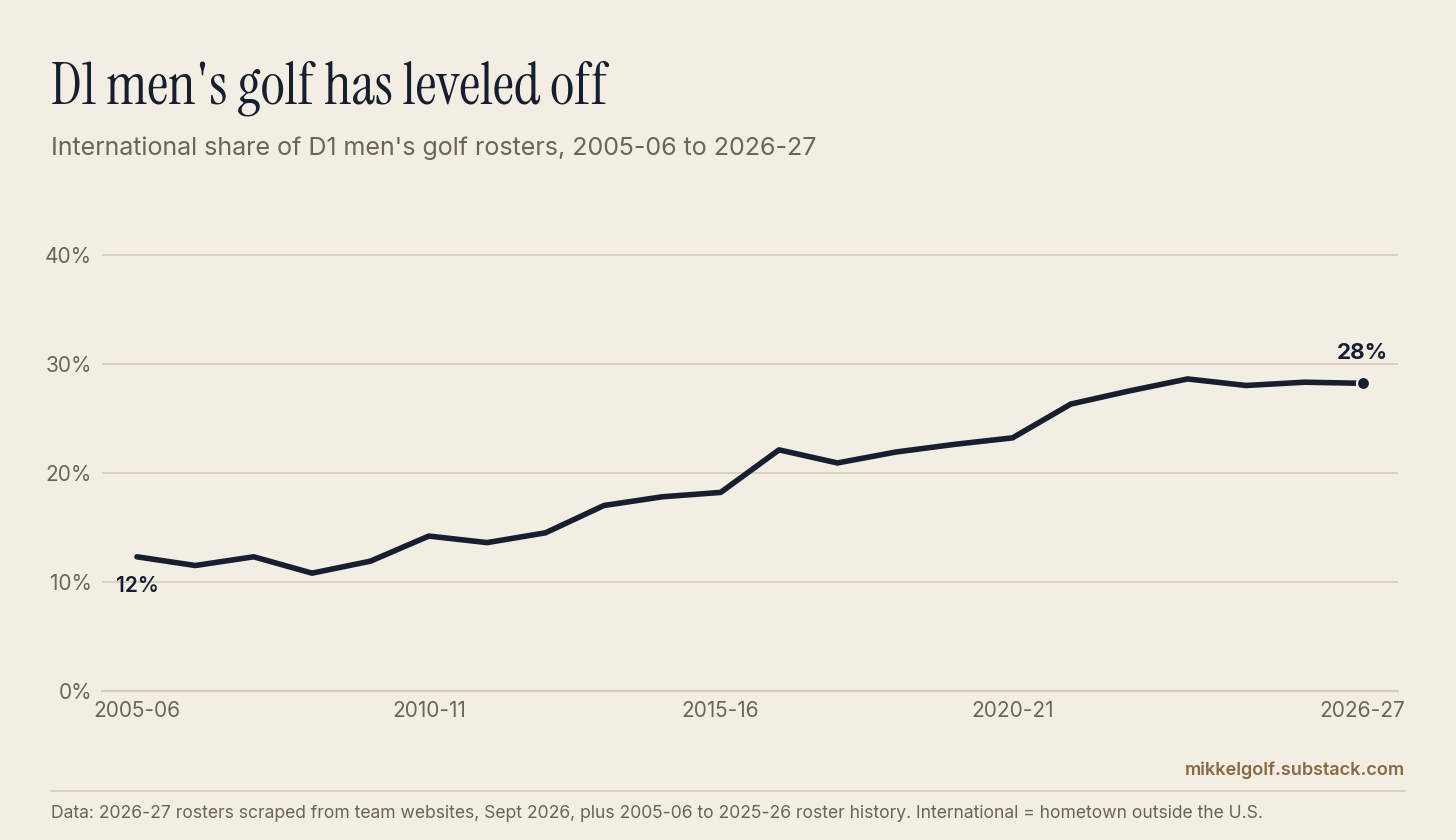
Most of that growth came before 2023-24. U.S.-born players made up 85% of D1 freshman classes in 2005-06, and 73% this season.
Inside the Power-4, using 2025-26 conference membership, international freshmen made up between 17% and 36% of each men’s signing class from 2019-20 to now, and 32% this season. These are small groups (24 to 117 freshmen with a known hometown per season), so they jump around from year to year.
D1 Has Stopped Moving
For year-over-year comparisons, I only use teams that are in the data both seasons and share at least a quarter of their players across the two rosters.
On those 221 D1 teams, the international share of the roster went from 29% last season to 28% this season, a drop of less than a point. Freshmen stayed at 27%.
The longer view says the same thing. Across all D1 teams, the roster share has been 28% or 29% for four seasons in a row, 2023-24 through 2026-27. The freshmen might even be coming down a little: 34% international in 2023-24, then 30%, 27% and 27%. The 2023-24 class is thin in my data, though (204 freshmen with a known hometown, against 591 this season), so I wouldn’t lean hard on that.
The 9-player roster limit came in for 2025-26 at most D1 schools. One season isn’t enough to say whether it changes who coaches spend a spot on, but the flat line started two seasons before the limit did.
Inside the Power-4: The Big 12 and the SEC
As a group, the Power-4 looks just like the rest of D1 this season: 29% international, against 28% for everyone else. Split it by conference and it comes apart.
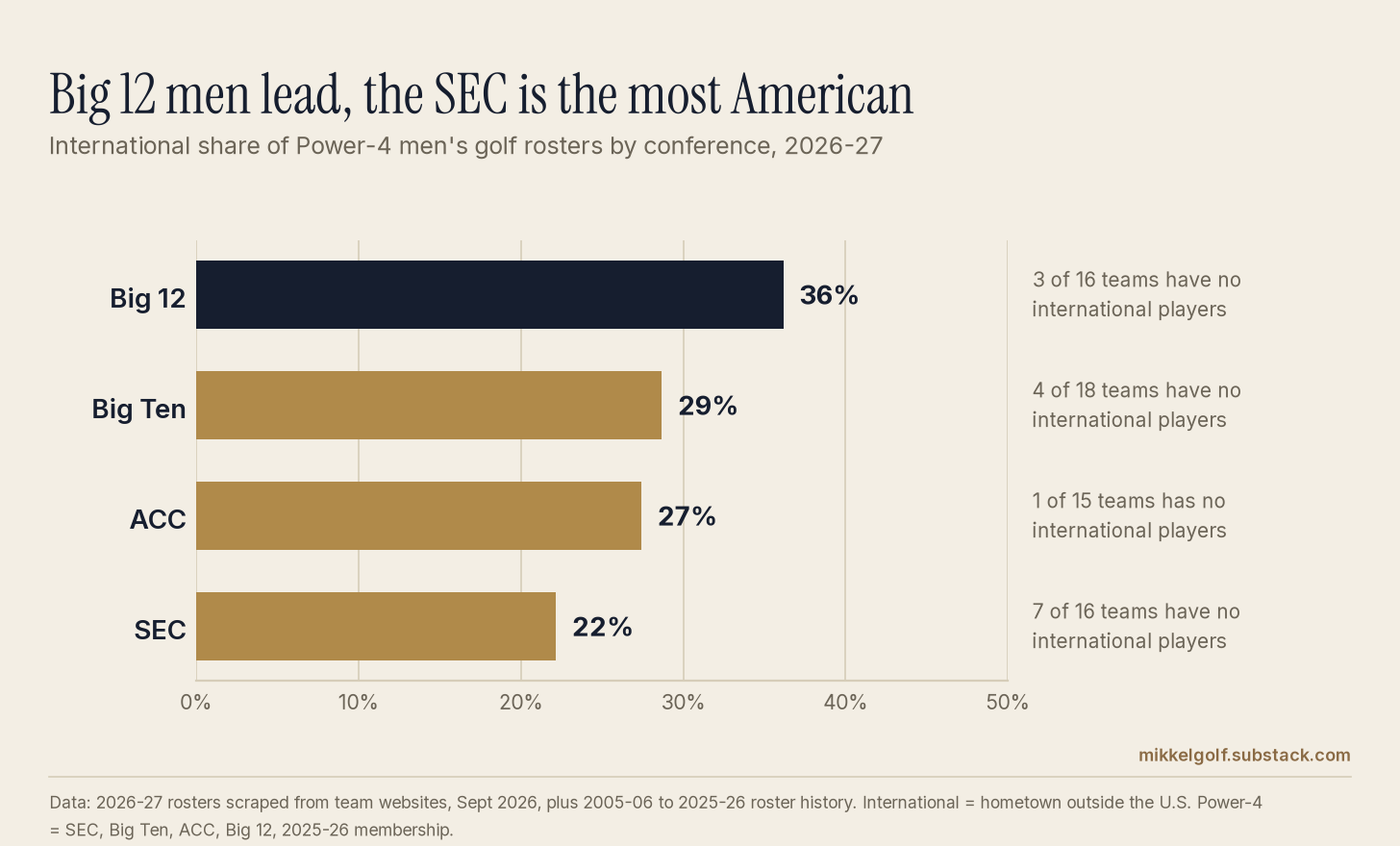
The Big 12 is 36% international. The SEC is 22%, and 7 of its 16 teams have no international players on their 2026-27 roster: Alabama, Auburn, Georgia, Kentucky, Oklahoma, Texas A&M and Vanderbilt. (Kris Kuvaas at Texas A&M is Norwegian born, but lists Houston, TX as hometown). Across the Power-4, 11 of 65 men’s teams have more internationals than Americans, and 6 of those 11 are in the Big 12.
The Other 70%, This Season
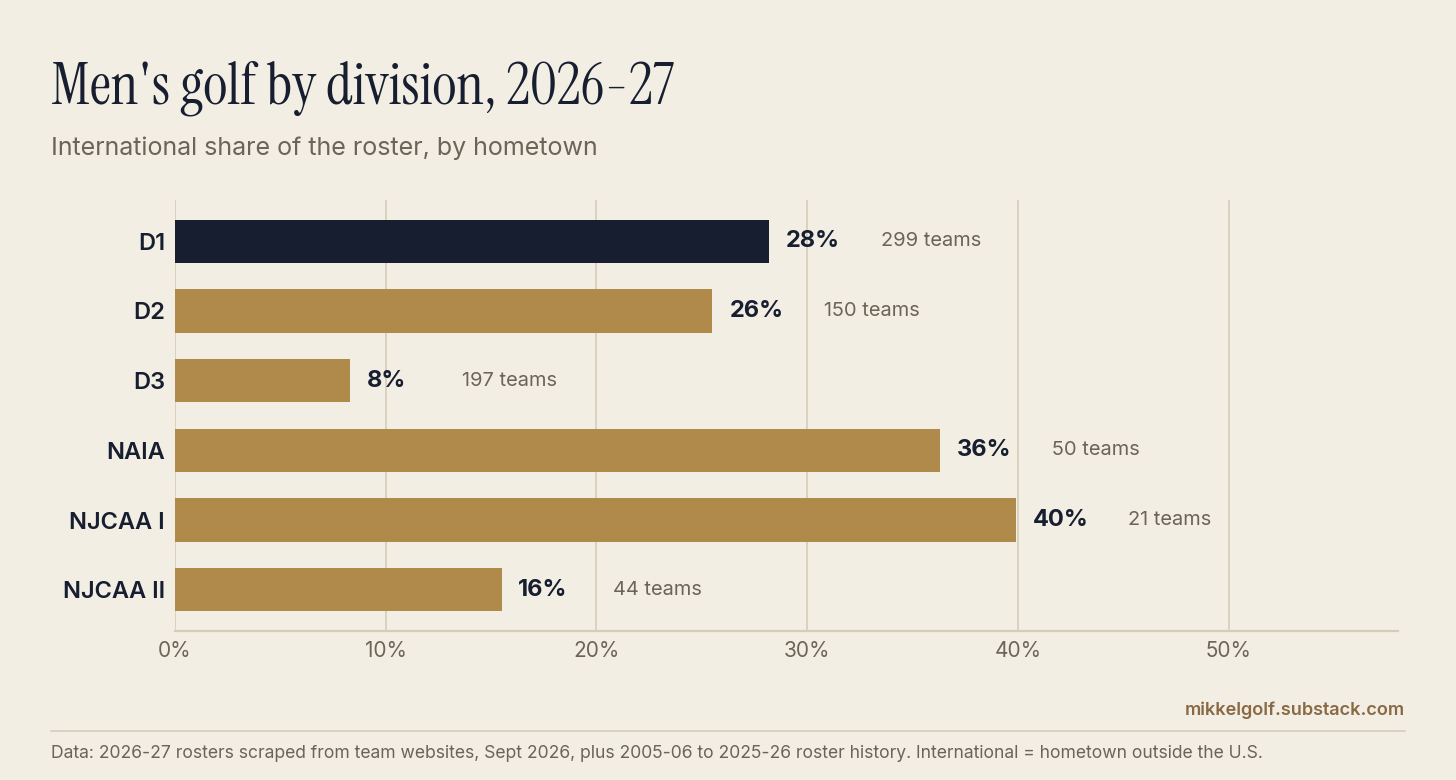
International share of the roster and of freshmen, by division:
D1: 28% of the roster, 27% of freshmen (299 teams)
D2: 26% and 25% (150 teams)
D3: 8% and 10% (197 teams)
NAIA: 36% and 37% (50 teams)
NJCAA I: 40% and 40% (21 teams)
NJCAA II: 16% and 17% (44 teams)
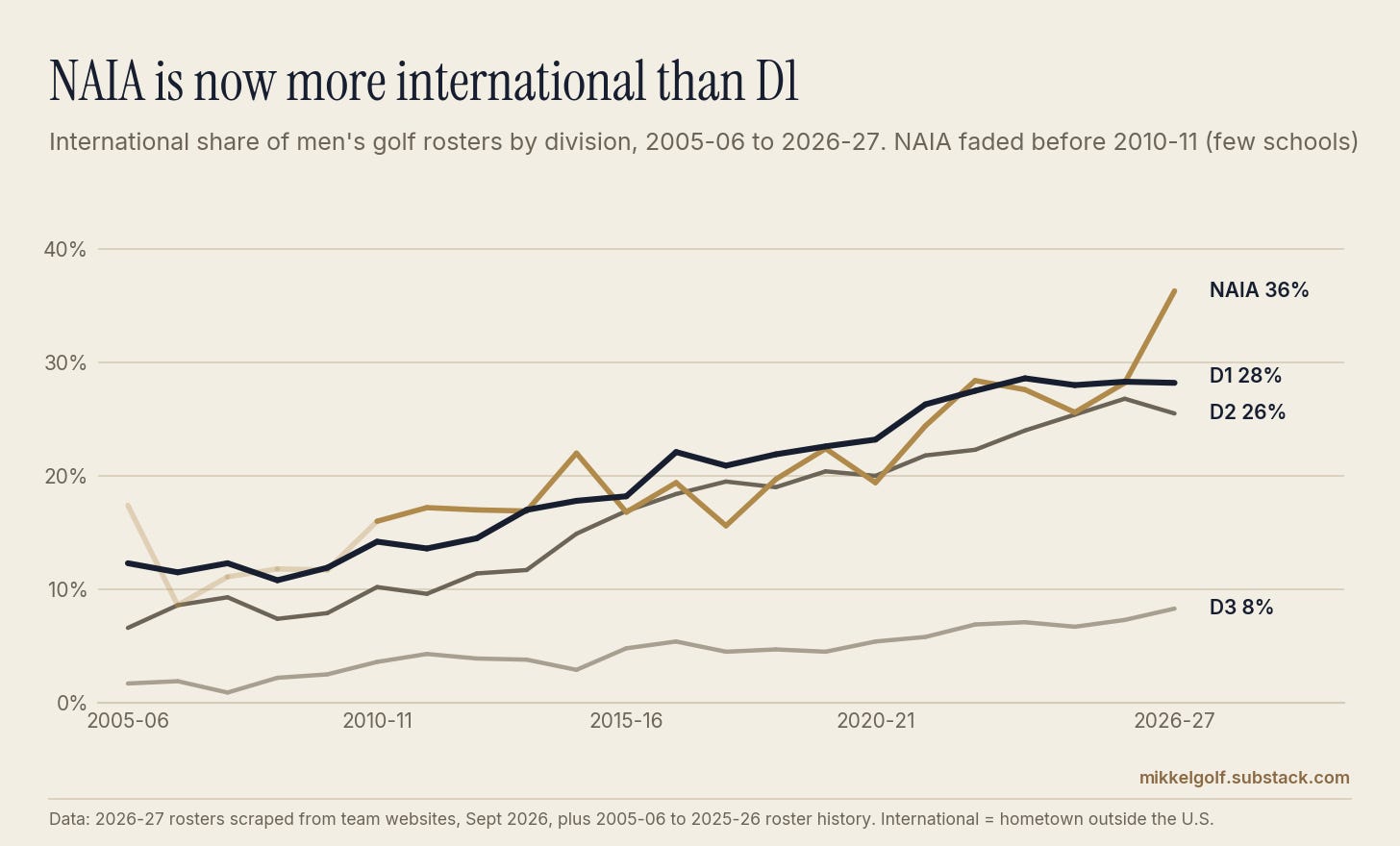
NAIA is now the most international four-year level in men’s college golf. Across all NAIA teams in the data, it went from 28% last season to 36%. That jump is partly about which teams I happen to have each season. On the 37 NAIA teams I can match across both seasons, it went from 31% to 35%. Smaller, but still up, and NAIA sits above D1 either way.
NJCAA I is at 40%, but that’s 21 teams, and it has moved between 24% and 42% since 2019-20. I’d call it directional.
D3 is still by far the most American division at 8% of the roster. D3 freshmen are at 10%, and both numbers are the highest I’ve recorded for D3. On the 186 D3 teams I can match, the roster share went from 7% to 8%.
Over the longer run, D2 averaged about 8% international across 2005-06 to 2007-08 (I average three seasons because the early years have few schools), and it was 27% in 2025-26. For NAIA, those early seasons rest on a handful of schools (274 players with a known hometown across the three), which is too thin to anchor a 20-year comparison. NAIA was 28% in 2025-26 and is 36% now.
Where They Come From
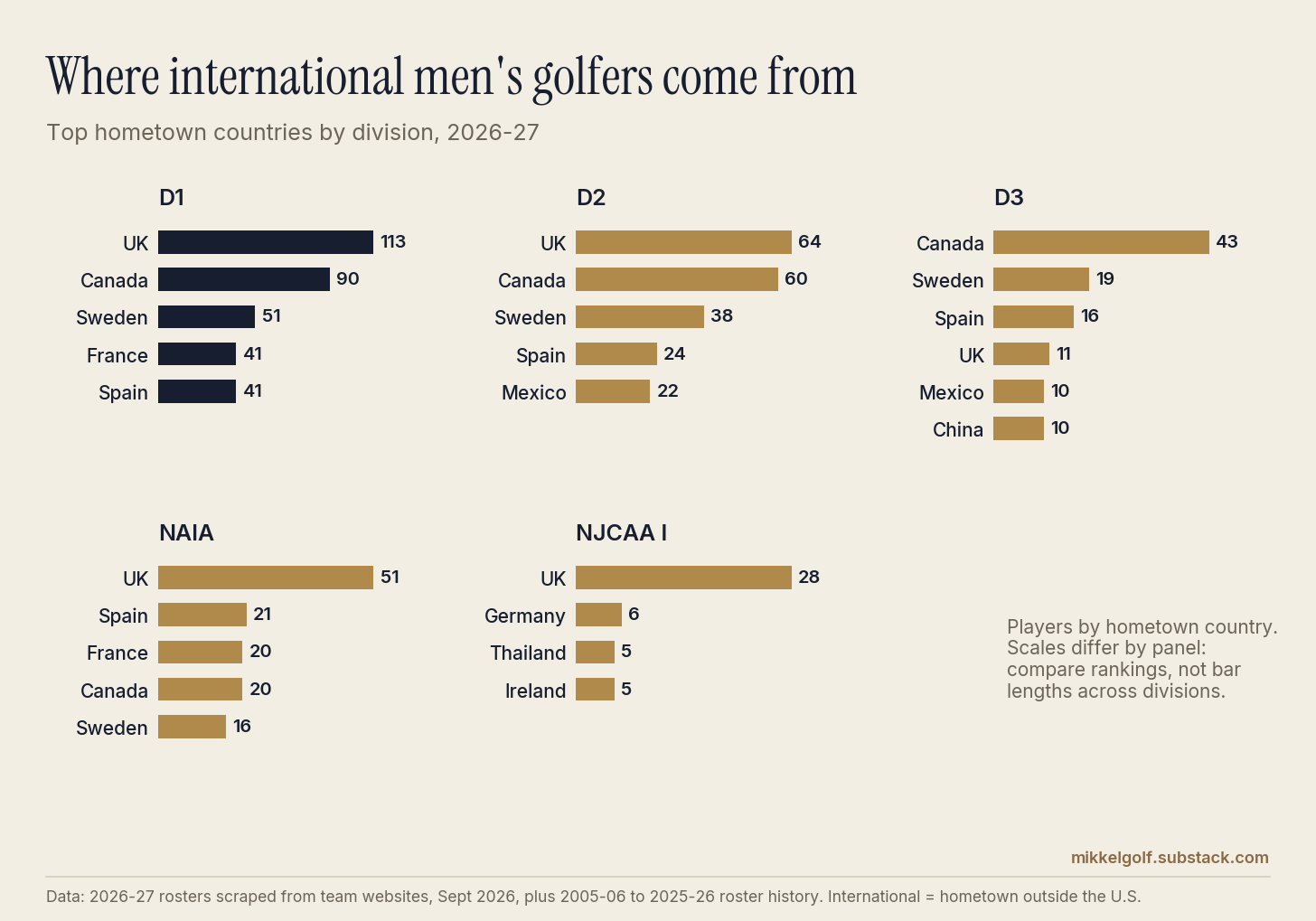
The top hometown countries for international players this season:
D1: United Kingdom (113), Canada (90), Sweden (51), France (41), Spain (41)
D2: United Kingdom (64), Canada (60), Sweden (38), Spain (24), Mexico (22)
D3: Canada (43), Sweden (19), Spain (16), United Kingdom (11), Mexico (10), China (10)
NAIA: United Kingdom (51), Spain (21), France (20), Canada (20), Sweden (16)
NJCAA I: United Kingdom (28), then no country above 6
The UK leads four of the five levels. D3 is the exception, where Canada leads, just like in March.
In March, Spain led NAIA with 29 players, ahead of the UK with 25. This season the UK has 51 and Spain 21. This is mainly a result of being able to capture more teams on my end. The NAIA teams in the data aren’t the same set from one season to the next, so I can’t say how much of that flip is real. The raw counts move with coverage, so compare the rankings within a division rather than the numbers between seasons.
Transfers
This season I also matched the rosters against last season’s tournament results. A player counts as a transfer if he’s on a 2026-27 roster but played all of his 2025-26 rounds for a different school. On the 294 D1 men’s rosters I could match, 258 players are incoming transfers. That’s 9.8% of the players, and 165 of the 294 teams added at least one.
105 of the 258 (41%) came up from D2, D3, NAIA or junior college, and 47% of those had been their team’s best player last season.
For players moving between two ranked D1 teams, I compared where the two teams finished in Clippd’s final 2025-26 rankings. If the new team finished at least 25 places higher, I counted it as moving up. If it finished at least 25 places lower, moving down. Anything closer than that is sideways. By that measure, 78 moved up, 29 moved sideways and 39 moved down.
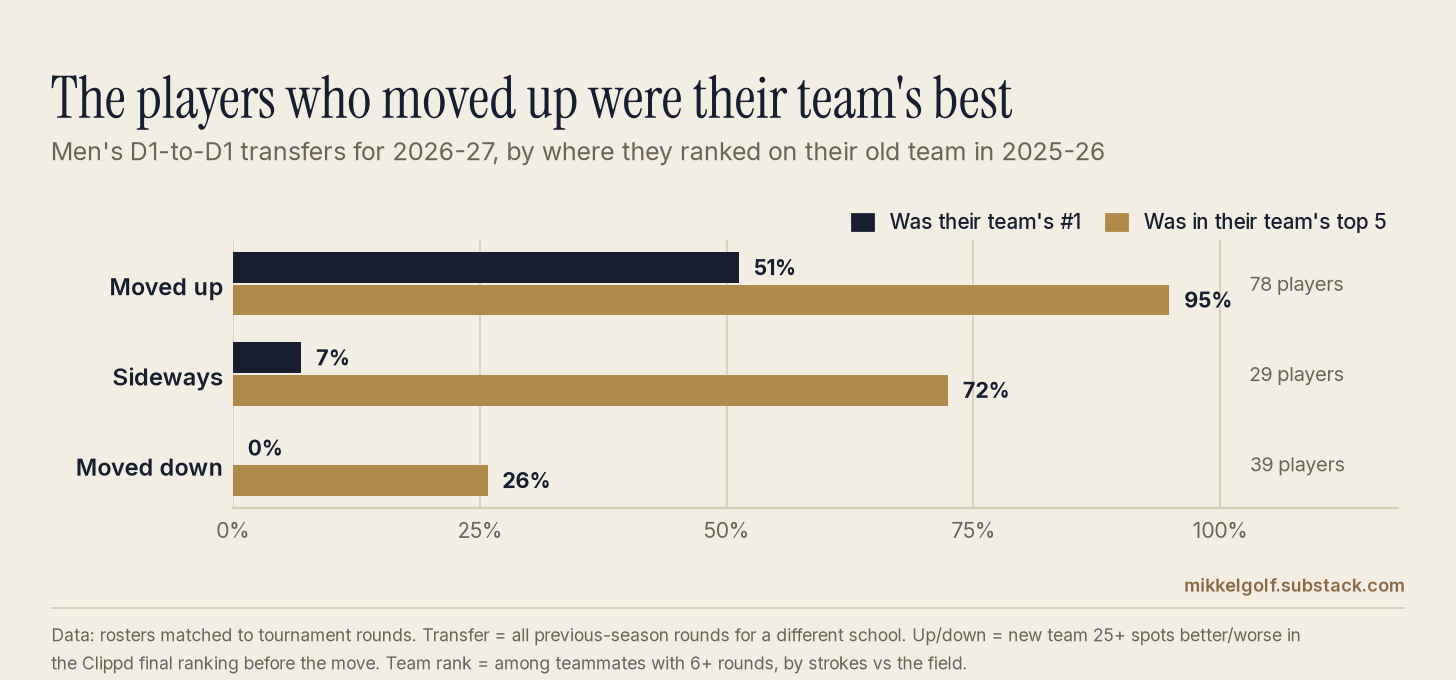
Half of the players who moved up (51%) had been their team’s #1 last season, and 95% had been in their team’s top five. None of the 39 who moved down had been their team’s #1, and their median was eight rounds for the whole season.
The 22 transfers joining a top-25 team came from teams with a median ranking of 93, and 12 of them had been their team’s #1. International players make up 33% of the incoming D1 transfers, against 28% of D1 men overall.
Two caveats. The counts are a floor: a player who didn’t play a tournament round last season (a redshirt, a player who never traveled, or a school my database doesn’t cover) can’t be matched. And “team’s #1” means the best scoring relative to the field among teammates with six or more rounds. I’ll go through three seasons of transfers, and how they did at their new school, in a separate piece.
Where This Leaves Us
D1 men’s golf has sat at about 28% international for four seasons. The growth I’ve been writing about for the past year is now showing up further down: NAIA is at 36%, and D3 freshmen are at their highest level in my data. Inside the Power-4, the Big 12 and the SEC look like they’re recruiting from different maps.
I don’t know yet whether D1 has hit a ceiling or is just pausing. If the TEAM USA Act or something like it passes, that question gets answered in Washington instead, and most D1 teams would be down to one international player.
Next week I’ll break down women’s college golf rosters this year. I also have a deep dive on transfers coming up.
Data: 2026-27 men’s golf rosters scraped from team websites in September 2026 (8,231 players, 761 teams), plus historic rosters from 2005-06 to 2025-26. U.S.-born / international = hometown listed on the roster. Shares are of players with a known hometown. Freshmen = FR / first year, redshirt freshmen excluded. Year-over-year numbers use only teams with at least 25% of players returning. Power-4 = SEC, Big Ten, ACC and Big 12, 2025-26 membership.
Previous posts in this series:

Head coach at Vika Golf Club in Oslo. Former NCAA Division I coach at Texas Tech, Baylor and SFA, and former Baylor golfer.
Working on your own path to college golf?
Book a 2-hour first session. We go through where you stand, which programs fit, and how to contact coaches. In Oslo or on Google Meet, parents welcome.
Related articles
First published on the MikkelGolf newsletter on Substack.