
Shifts in Height | Division I rosters over the past 20 years 📊
Data Deep Dive 🗃️
After recently reading about long-term biological selection in other sports, I wondered: Has college golf changed too? So I built a dataset of 4,571 Division I freshmen across 20 years. It revealed an interesting shift.
In the Sports Gene, David Epstein writes about how elite water polo players’ forearms have gotten longer over the past decades. A longer forearm lends itself to more torque for a water polo player, equaling more speed. As the sport has gotten more competitive, athletes with longer forearms have had certain advantages in the game, leading to an unintentional, long-term biological selection in water polo.
Could something similar have happened in college golf? Here’s what I found.
The Hypotheses…
Based on what I’ve seen as a college coach, my hypothesis is that men’s DI college golfers have gotten taller over the past 20 years. (We’re focusing on the men during this piece - I’ll do a separate analysis on women’s golf in a future post.)
Here are the reasons I think could be driving the height increase:
All things being equal, increased height means increased leverage, which equals increased club head speed.
The analytics revolution in golf (e.g. from Mark Broadie) has revealed a large scoring advantage from increased distance off the tee.
Increased club head speed leads to improved strokes gained off the tee, more often than not. Strokes gained off the tee is one of the drivers of elite golf. Therefore, much like the water polo example, taller athletes will “self-select” into the recruiting pool of D1 golfers as their speed improves their scoring.
Lastly, Coaches might also be more aware of the advantages of club head speed, and when choosing between two similar recruits, they might select the one with the highest speed more often (which often will be the taller one).Globalization of recruiting.
In a previous piece here on this Substack, we looked at the declining rate of U.S.-born D1 golfers on the men’s side. The increased budgets for collegiate programs, and the willingness of coaches to travel overseas to find talent, has opened the door to a wider, potentially taller talent pool.More “athletes” choosing golf.
From my coaching experience, many recruits were multi-sport athletes. Many of my colleagues preferred that profile too.
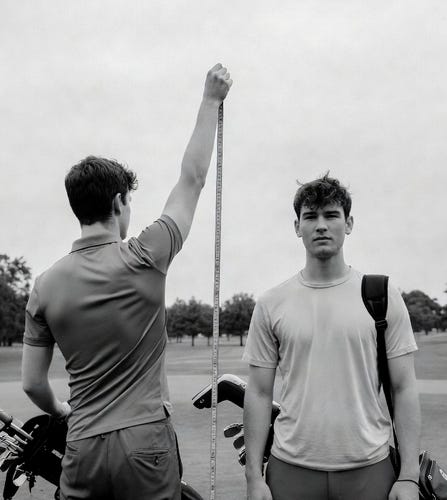
Ernie Els or Lee Trevino
Imagine you’re paired with two golfers you’ve never met before. One walks onto the tee at 6’4”, the other at 5’6”. You learn their names; Ernie and Lee. One is tall and rangy, the other compact and talks non-stop. Based on their stature alone, who do you think will shoot the lower score?
Exactly. You have no idea. Golf has never rewarded one body type. Ernie Els and Lee Trevino couldn’t look more different, yet both became major champions. Unlike basketball or swimming, there’s no obvious physical prototype that dominates.
That’s why I think any long-term change in the population of college golfers would be subtle. Not because taller automatically means better, but because the recruiting pool itself may be shifting.
The Dataset
The extensive dataset I’ve put together of D1 Men’s Golf rosters includes 4,571 freshmen with height data. The heights were collected from their roster pages available online.
From my prior experience as a player and collegiate coach, the heights reported online are often self-reported and entered into the player profiles by the SIDs. Self-reported heights are prone to inflation as studies show men overreport their heights by ~1-2 cm on average. However, if we assume that the accuracy in self-reporting hasn’t significantly changed over the past 20 years (that people report their own height as accurately now as in the past), we can look at changes over time. The standard deviations remain very consistent across the years, indicating no major shifts in noise, which gives me confidence that we’re seeing real patterns in this data.
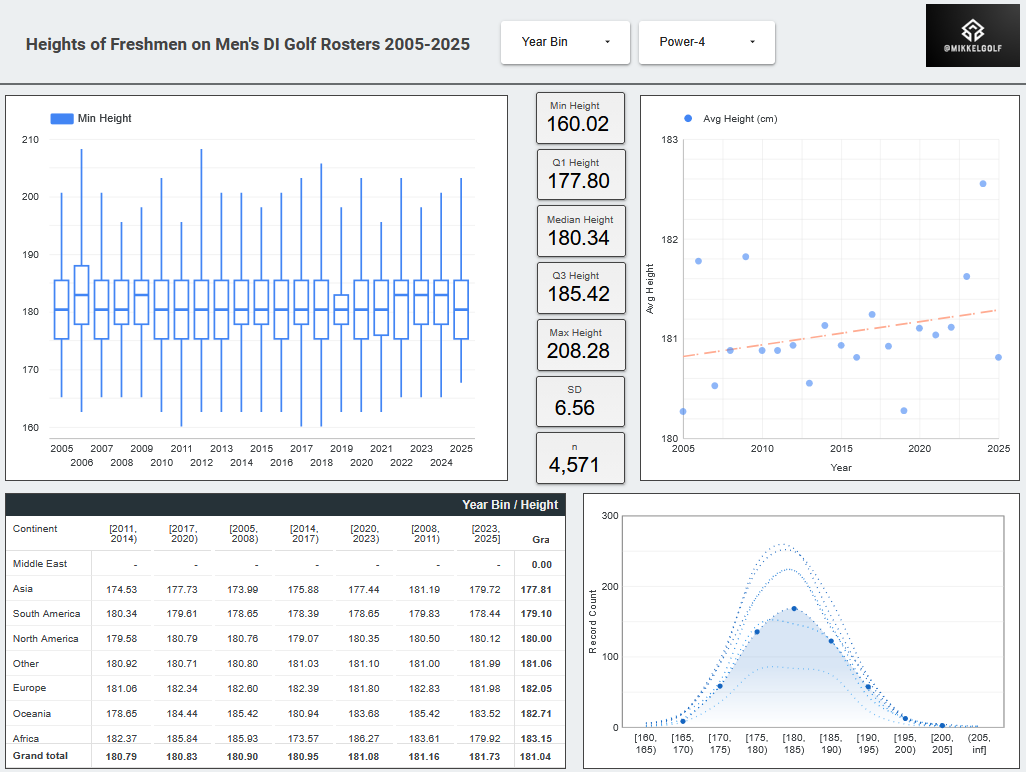
To dig deeper into whether D1 men’s golf freshmen are really getting taller, I ran a weighted linear regression on the grouped data I have. This essentially fits a trend line that accounts for sample sizes and variability across those 3-year buckets.
For all 4,571 players combined, heights ticked up by just +0.030 cm per year from 2005 to 2025, but that’s not statistically significant (p=0.220). This means the +0.52 cm total fitted rise could easily be noise from year-to-year wobbles, like a dip I observed in the early 2010s.
Filtering for just Power 4 conferences, though? That’s where it gets interesting: a sharper +0.113 cm/year climb (p=0.004), adding up to nearly +2 cm over 17.5 years, with a strong model fit (R²=0.841).

So we’re seeing significant growth on Power 4 rosters from the data we have, but aren’t we all getting taller?
To put the Power 4 height gains in perspective, the general U.S. male population (ages 20–39) has actually not grown taller over the same 20-year window. The National Health and Nutrition Examination Survey (NHANES) data show a flat-to-slightly-declining trend, with mean height dipping from 176.2 cm in 1999–2000 to 176.1 cm by 2015–2016, a net change of just -0.1 cm (or -0.006 cm/year; no significant linear trend, p=0.096).
Significance – What Is Really Happening?
The raw trend in Power 4 freshmen is clear: average height has risen from ≈180.8 cm in the late 2000s to ≈181.7–181.9 cm in the 2020s. A fitted increase of roughly +1.8–2.0 cm over 17–18 years.
But digging deeper, almost all of that increase is a composition effect, not evidence that coaches are suddenly picking taller athletes from the same pools.
When we split the Power 4 freshmen into U.S.-born and non-U.S.-born, two things become obvious:
U.S.-born freshmen (still the large majority of most rosters)
2005–2014 average: ≈180.9 cm
2020–2025 average: ≈181.3–181.7 cm → essentially flat (slope = +0.03 cm/year, not significant)
Non-U.S.-born freshmen (much smaller but fast-growing group)
2005–2014 average: ≈181.9 cm
2020–2025 average: ≈182.1 cm → also basically flat within the international group
Yet the overall Power 4 average is rising. Why? Because the share of international freshmen has roughly doubled in most Power 4 programs over this period. (From less than 20% to above 35% internationals on Power-4 rosters).
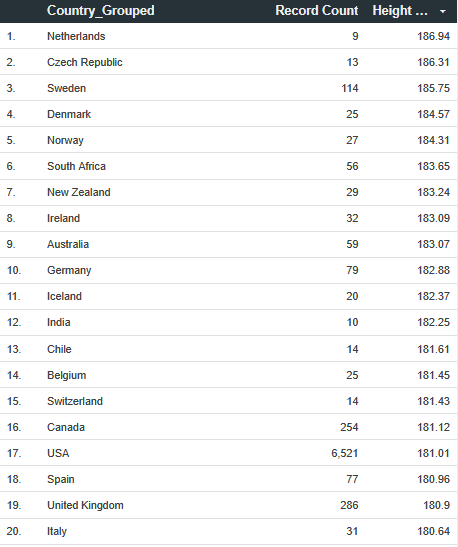
Below is a list of the top-20 countries by avg height for freshmen in the dataset (all of DI). As we can see, USA is just 17th tallest country for Men’s Freshmen on DI golf rosters:
Conclusion (For now)
The typical Power 4 freshman you see on the range today is about ¾ of an inch taller than his counterpart from 2005–2010.
But the main reason he is taller is mainly the odds being greater of him holding a non-U.S. passport. Globalization of recruiting for Power 4s is the main driver here.
Yes, the athletes within the groups (U.S. vs U.S., International vs. International) seem to be getting slightly taller, which could suggest more “athletes” and active selection of taller frames. But there’s too much noise. The real story is the composition of the rosters.
Golf will always produce Ernie Elses and Lee Trevinos in equal measure, but the pool of who gets recruited is evolving.
—
I have gathered the women’s data as well and will be publishing posts on my findings over the winter.
Please consider sharing this post if you found it useful. Thanks!
Links:
- Men’s DI Golf Rosters 2025-2025 dashboard
- The Declining Rate of U.S.-Born Men’s DI Golfers
- How can a recruit best get a college coach’s attention? (Recruiting)
Mikkel Bjerch-Andresen
Golf coach, data analyst, writer