
Transfers in college golf Deep Dive - Moving Up, Moving Down
Three seasons of D1 golf transfers: who moves, how much they play at the new school, what happens to their scoring, and who made the most of it
When I started coaching, transferring still carried a faint stigma. I wrote that in June, in The Transfer Decision, where I surveyed 133 former college golfers. 46 of them (35%) had transferred at least once, and playing time was the reason that came up most.
That’s what the players told me. I wanted to see what the results say. Who moves up? Do they play more at the new school? Do they get better?
This covers both men’s and women’s D1 golf. I had a first look at this season’s transfers in the two 2026-27 roster pieces. Here I go back two more seasons and follow the players to their new school.
How I Counted
I took three seasons of D1 rosters (2024-25, 2025-26 and 2026-27). If a player is on a D1 roster but played all of their previous-season rounds for one different school, I count them as a transfer. That gives me 541 men’s and 392 women’s D1 transfers over the three seasons.
Some terms I’ll keep coming back to:
Moved up or down: both teams are ranked D1 teams, and the new team finished at least 25 places higher (or lower) in the final Clippd ranking from the season before the move. Anything closer than 25 places is sideways.
Their team’s #1: the player with the best scoring relative to the field among teammates who played at least six rounds that season.
Into D1 from below: a player who came from D2, D3, NAIA or junior college.
The counts are a floor. If a player didn’t play a single tournament round the season before (a redshirt, someone who never made the travel team, or a school my roster-database doesn’t cover), I can’t match them. I also leave out freshmen and any name that shows up on two rosters, since that’s usually two different players with the same name.
More Transfers This Season
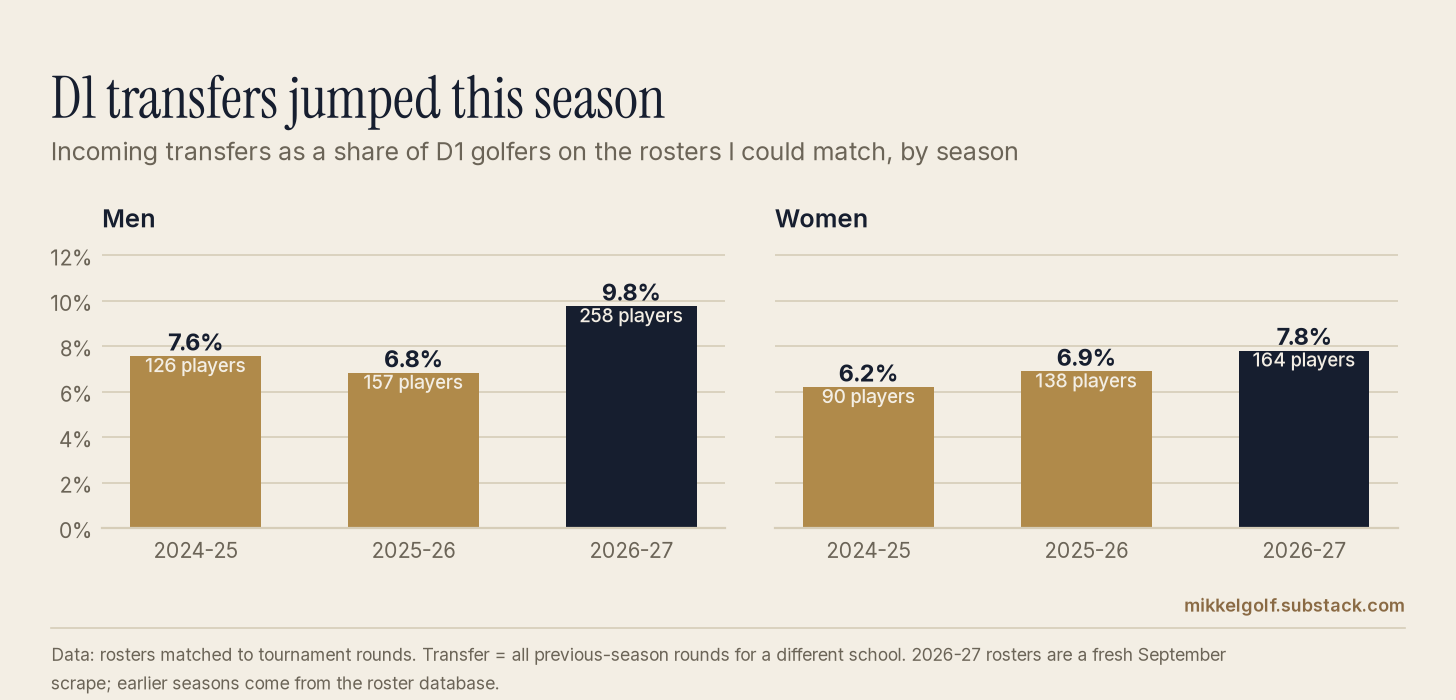
On the D1 men’s rosters I could match, 126 players were incoming transfers in 2024-25 (7.6% of the roster), 157 in 2025-26 (6.8%) and 258 this season (9.8%). For the women it’s 90 (6.2%), 138 (6.9%) and 164 (7.8%).
I wouldn’t put much weight on the size of that last jump. This season’s rosters come from a fresh scrape in September, and the two earlier seasons come from my roster database, which has fewer teams in it. Men and women still point the same way, though. A bigger slice of each D1 roster is arriving from another school.
And a lot of them aren’t coming from D1 at all. Over the three seasons, 221 of the 541 men (41%) and 124 of the 392 women (32%) came up from D2, D3, NAIA or junior college.
Who Moves Up
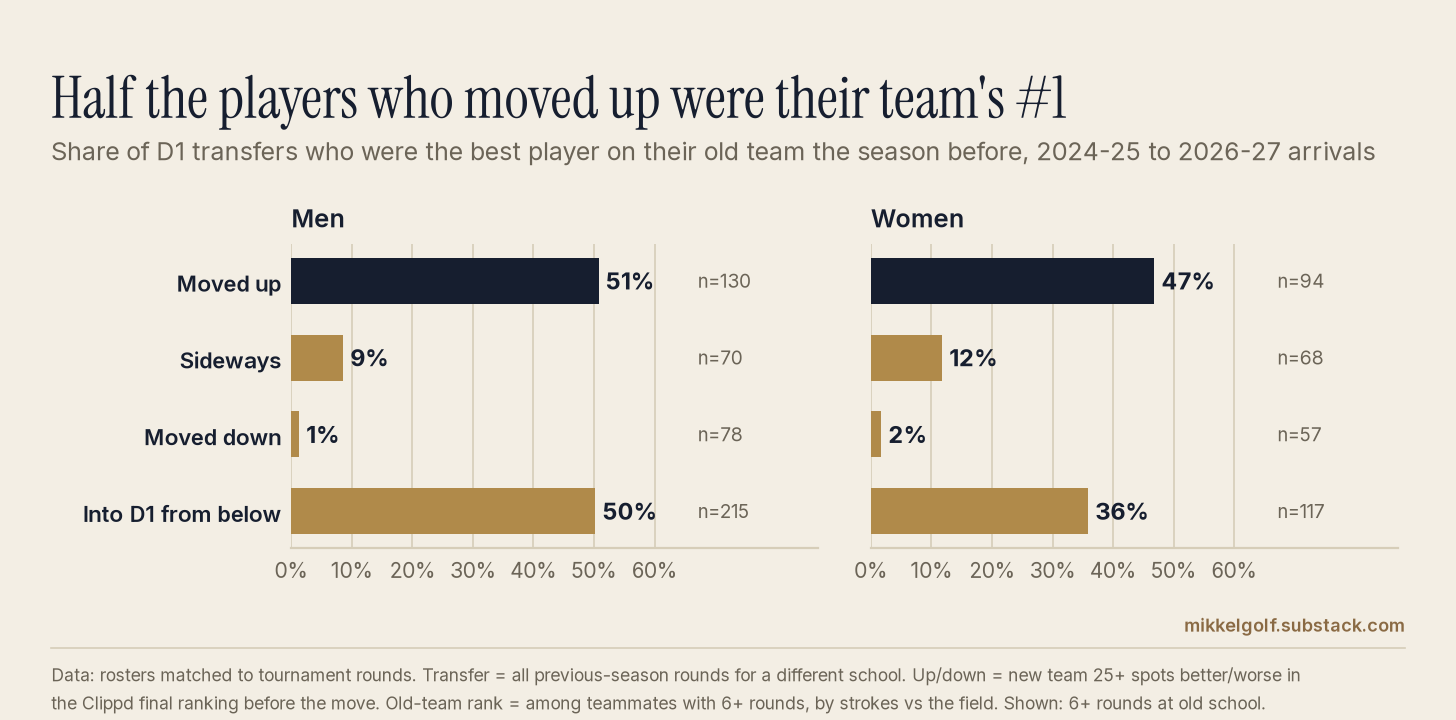
This held up in all three seasons, for men and for women. The players who moved up to a better D1 team had usually been the best player on their old one. 51% of the men who moved up had been their team’s #1, and 92% had been somewhere in the top five. For the women it’s 47% and 89%.
The players who moved down: Only 1% of the men and 2% of the women had been their team’s #1. Their median was nine rounds the season before, and about a quarter of them played fewer than six. That lines up pretty well with the survey. Most of these were players who weren’t getting into the lineup. They might have had good scoring averages in a couple of individual tournaments, for example.
Players coming up into D1 were often their team’s best player too (50% of the men, 36% of the women).
The balance between up and down moves changes a lot from year to year. Among men moving between two ranked D1 teams, 30 moved up and 39 moved down in 2025-26. This season it’s 78 up and the same 39 down. I don’t have a good explanation for that jump. The women have been closer to even every season: 30 up and 26 down in 2025-26, 44 up and 33 down this season.
Playing Time at the New School
For the players who arrived in 2024-25 and 2025-26, I can follow their first season at the new school. The typical man who moved up played 24 rounds and was in 75% of his new team’s tournaments. The typical man who moved down? Also 24 rounds, and 76% of the tournaments. So on the men’s side, dropping to a weaker team didn’t buy any extra playing time on average, compared to the ones who moved up.
For the women it did. The typical woman who moved down played in 92% of her new team’s tournaments, against 80% for the ones who moved up. Only 4% of the women who moved down played fewer than six rounds. For women who moved up it was 10%, and for men who moved up 15%.
Who Becomes the #1
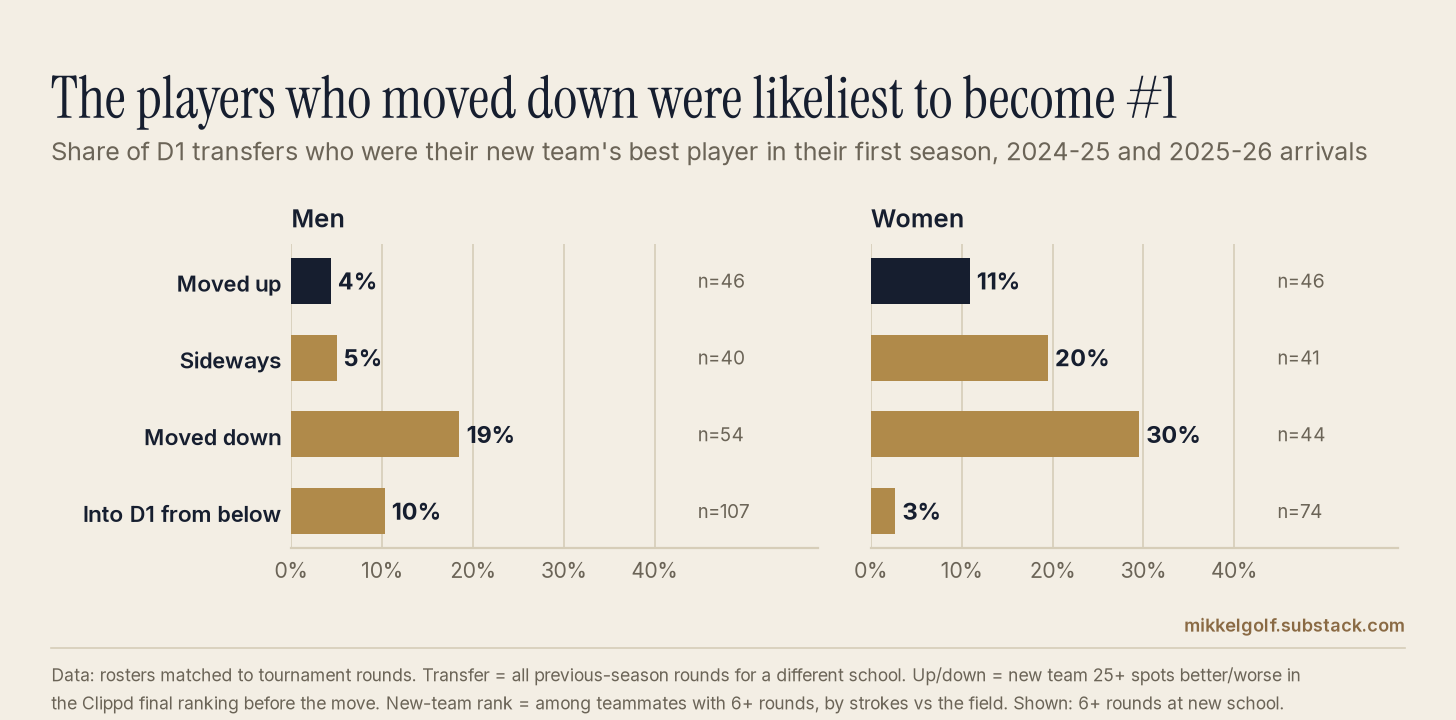
Being the best player on a weaker team very rarely made someone the best player on a better one. 24 men had been their team’s #1 and then moved up. One of them was the #1 at the new school the following season, and ten were in the top three. On the women’s side it’s 21 players, one #1 and five in the top three.
For comparison, returning players who had been their team’s #1 stayed #1 about half the time the following season (148 of 310 men, 174 of 337 women). So the drop for the players moving up is a lot bigger than the normal shuffle from one year to the next.
Moving down went the other way. 19% of the men and 30% of the women who moved down were their new team’s #1 in their first season. Most of them had been at or near the bottom of their old team’s regulars, or had barely played at all.
What Happened to Their Scoring
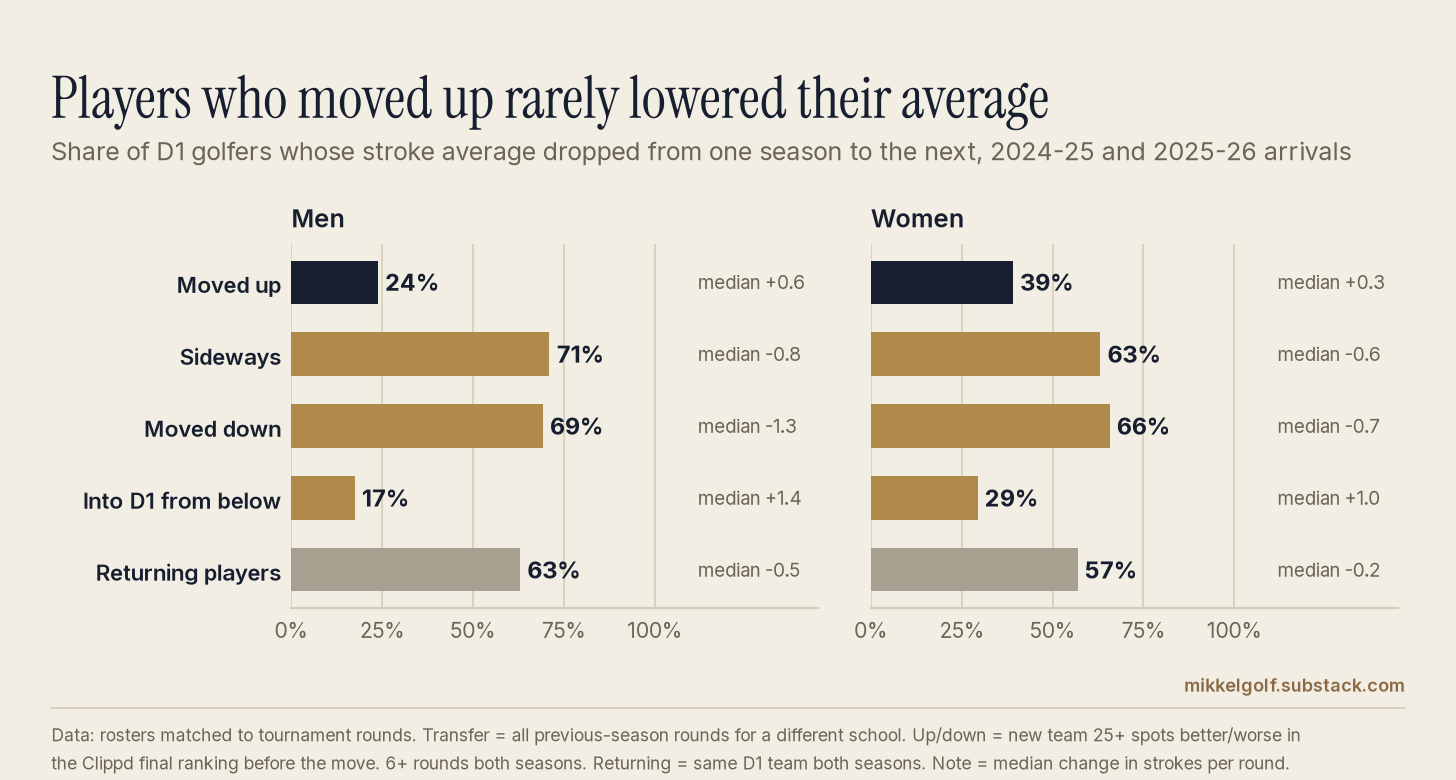
I compared each player’s stroke average from their last season at the old school with their first season at the new one, for everyone with at least six rounds in both. Normally players get a bit better from one year to the next. Among D1 players who stayed on the same team, 63% of the men and 57% of the women lowered their stroke average (by a median of about half a shot for the men and a quarter of a shot for the women).
The players who moved up went the other way. Only 24% of the men lowered their average, and the median went up 0.6 strokes. For the women it’s 39%, with a median rise of 0.3. Coming up into D1 from below was the biggest jump of all, 1.4 strokes for men and 1.0 for women.
Players who moved down improved more than the ones who stayed put. 69% of the men lowered their average, by a median of 1.3 strokes, and 66% of the women did, by 0.7.
Stroke average depends a lot on where you play. A better team plays a harder schedule, often on harder courses, so some of that 0.6 is the schedule and not the player. Relative to the field, the players who moved up lost ground too, but their fields also got stronger at the same time. I can’t fully pull those two apart with this data. What I can say is that for most players, moving up didn’t come with lower scores. At least not in year one.
The groups also get small once I split them like this (35 to 46 players per group for each gender), so I’d treat the exact numbers as rough. The direction is the same for men and women.
The Transfers Who Made the Most of It
Averages hide the players who made the move work, so here are some of the standouts from the last two seasons. The awards and results come from the schools’ and conferences’ own releases.
Eastern Michigan women. Janae and Jasmine Leovao came from Long Beach State, Baiyok Sukterm came from Lindsey Wilson (NAIA), and Savannah de Bock had come from Georgia a season earlier. The program had never been to an NCAA Regional. In May it reached the NCAA Championship for the first time, made match play as the No. 5 seed, beat No. 4 Texas 3-1 and lost to Stanford in the semifinals. Janae Leovao won twice, beat the eventual individual champion Farah O’Keefe 5&4 in match play, and became the program’s first All-American (EMU).
Moved up, sideways or into D1, and won.
Ethan Fang (Cal to Oklahoma State, 2024-25). Part of Oklahoma State’s 2025 NCAA title team, then won The Amateur Championship, the first American to win it since 2007, and made the U.S. Walker Cup team (ESPN).
Luke Potter (Arizona State to Texas, 2024-25). Golfweek second-team All-American in 2026, medalist at the Bryan Regional, and fifth in PGA Tour University, which earned him Korn Ferry Tour membership (Texas).
Adam Bresnu (Odessa College to Texas Tech, 2025-26). NJCAA national player of the year the season before, then Golfweek and PING third-team All-American and first-team All-Big 12 in his first D1 season (Texas Tech).
Charlie Box (Hutchinson CC to Eastern Michigan men, 2025-26). Won the 2025 NJCAA Division I individual title, then was MAC Golfer of the Year with a school-record 71.6 average (EMU).
Kristian Bressum (Saint Mary’s to East Tennessee State, 2024-25). His new team had finished 56 places higher. SoCon Player of the Year in his first season (ETSU).
Francesca Fiorellini (UCLA to LSU, 2025-26). In August 2025 I wrote that she’d had an up-and-down freshman year at UCLA. At LSU she led the team with a 72.09 average, including a school-record 63 (LSU).
Yurang Li (Illinois to Baylor, 2025-26). Two wins, a 72.89 average and a Baylor program-record round of 65 (Baylor).
Grace Kilcrease (Tulsa to Oklahoma State, 2024-25). Won the Carmel Cup in her Oklahoma State debut and was an honorable mention All-American that season (Oklahoma State).
Taylor Kehoe (Alabama to Michigan State, 2024-25). Two-time All-Big Ten, and her 72.50 career average at Michigan State is the best in program history among players with at least 60 rounds (Michigan State).
Moved down and became the #1. These four fit the pattern from the charts. By my numbers none of them had been their old team’s best player, and all four became the best on the new one. Samuels and Prieto actually had the weakest scoring of the regulars at Ole Miss and Arizona State, two top-10 teams at the time.
Patton Samuels (Ole Miss to Austin Peay, 2024-25). Won his first start for Austin Peay and was the 2025 ASUN Golfer of the Year (Austin Peay).
Caroline Patterson (Tennessee to UNC Asheville, 2024-25). Big South Newcomer of the Year, then the program’s first Big South individual champion in 2026 and a top-25 finish at the Chapel Hill Regional (Big South).
Matthis Lefèvre (Arkansas to Stetson, 2025-26). Three wins and a 70.9 average (Stetson).
Nicholas Prieto (Arizona State to Wake Forest, 2025-26). Won his first event for Wake Forest and made the PING All-Region team (Wake Forest).
Three Seasons of Transfers
The players who move up were usually the best on their old team. In year one at the new school they mostly play, but they rarely become the #1, and most of them don’t lower their stroke average. The players who move down had usually played very little, and a fair number of them turn into the player their new team is built around.
I don’t think either direction is the right one. Fang and Potter went to teams at least as strong as the ones they left and won at the highest level. Eastern Michigan got to the national semifinals with players who left bigger programs or came up from the NAIA. What the data does say is that a better team is a harder place to be the #1, and most players making that move should probably expect a season of adjusting.
For most of these players I only have one season of scoring after the move, so year two is the obvious next question. Does the player who moved up catch up in the second season, or does the gap stay? I’ll definitely keep looking into this…
Data: D1 men’s and women’s golf rosters for 2024-25, 2025-26 and 2026-27 (2026-27 scraped from team websites in September 2026), matched to every tournament round in my scoring database from 2023-24 to 2025-26. Transfer = on a D1 roster, with all previous-season rounds for one different school; freshmen and names on two rosters excluded. Rankings: Clippd final team rankings of the season before the move. Team rank = rank among teammates with at least six rounds, by strokes relative to the field. Awards and results for named players are from school and conference releases, linked in the text.
Previous posts in this series:

Coach at Vika Golf Club in Oslo. Former NCAA Division I coach at Texas Tech, Baylor and SFA, and former Baylor golfer.
Working on your own path to college golf?
Book a 2-hour first session. We go through where you stand, which programs fit, and how to contact coaches. In Oslo or on Google Meet, parents welcome.
Related articles
First published on the MikkelGolf newsletter on Substack.