
One International Player - Team USA Act
A bill in Congress would cap international athletes at 20% of a college roster. Let’s look at the impact.
A Substack reader got in touch last week and asked what I think about the TEAM USA Act. Honestly, I haven’t made up my mind. What I do have is roster data from every level of college golf, going back 21 seasons, plus a new scrape of this season’s rosters that I finished last week. So before I decide what I think, I wanted to see what the bill would actually do to college rosters. The impacts would be massive.
What the Bill Says
The bill’s full name is the “Training and Education for American Members in University Sports and Athletics Act,” shortened to the TEAM USA Act. Rep. Tim Walberg (R-Michigan), chair of the House Education and Workforce Committee, and Sen. Jon Husted (R-Ohio) announced it on September 14. Two days later, a House subcommittee held a hearing titled “Who Gets The Scholarship? How The Global Shift In College Sports Affects Americans.”
To take part in federal student aid programs under Title IV (Pell Grants, federal student loans), a school would have to make sure that on every varsity team:
“no more than 20 percent of the student athletes on the official roster of such varsity sports team are international student athletes, or, in the case of such a varsity sports team with fewer than 10 student athletes, no more than 1 international student athlete is on such roster”
Schools would also have to report the international percentage for each team every year. The rule would start on July 1, 2029, for the 2029-30 academic year. The text I read doesn’t mention any grandfather clause for players already on rosters.
In practice, here’s what the cap works out to:
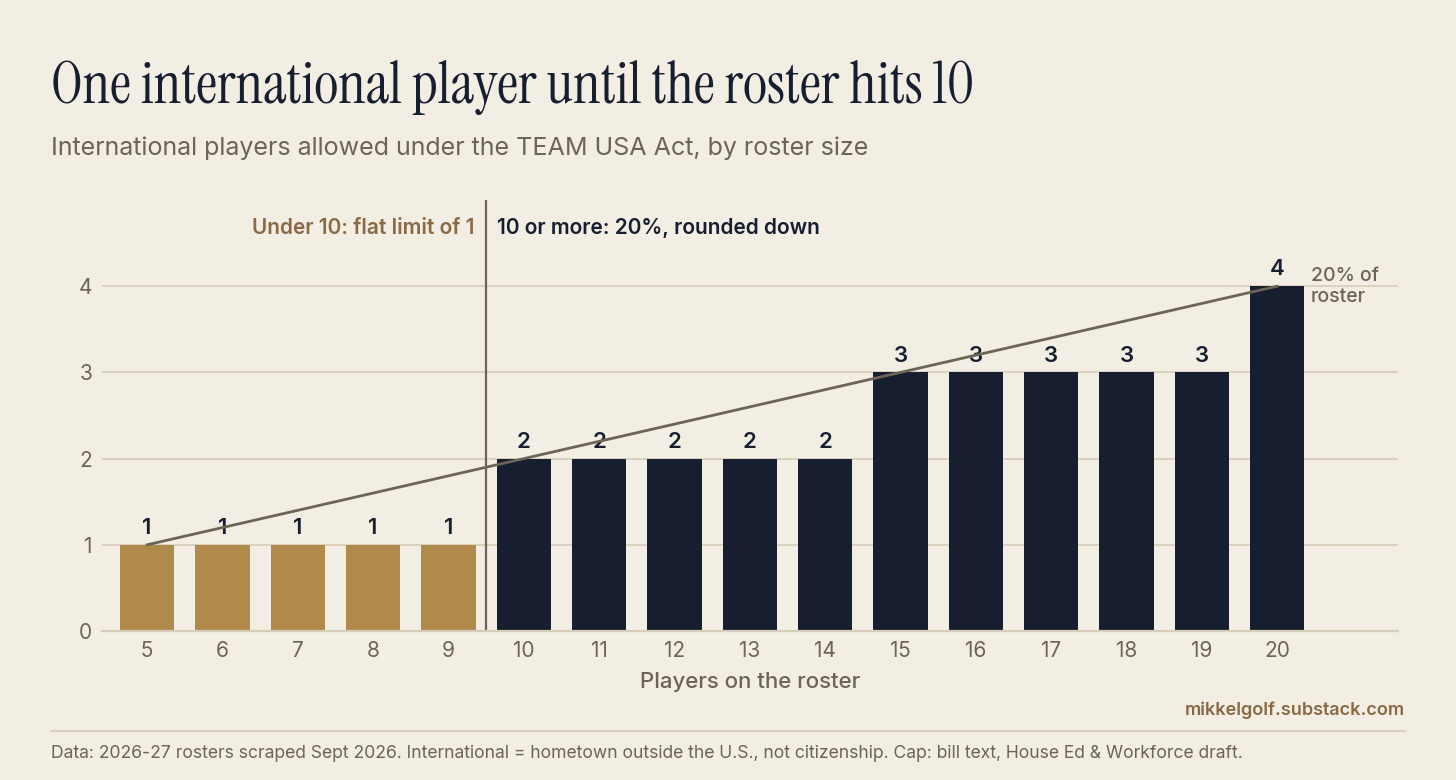
5 to 9 players: 1 international
10 to 14 players: 2
15 to 19 players: 3
20 players: 4
The jump from 9 to 10 players would be very significant for golf.
Who counts as “international” is also very specific. It’s any athlete who isn’t a U.S. national or a green card holder. It also covers anyone who “is receiving, or has received” athletic money from a foreign Olympic or Paralympic committee, which could include a U.S. citizen.
Both sponsors were direct about the goal. Husted said: “If the U.S. Congress is being asked to ‘save college sports’ we should save it for American student-athletes.” Walberg said that “America has built the strongest collegiate athletic system in the world, and we should make sure it continues to develop the next generation of American students and American Olympians.”
At the hearing, Patrick McEnroe, the former Davis Cup captain, argued for a 20 percent cap. Rep. Alma Adams (D-North Carolina), the ranking Democrat, argued that international students bring perspectives and skills to U.S. higher education, and she raised the visa threats international students are facing right now. Ohio, Idaho and Oklahoma have all seen similar state bills, and according to Inside Higher Ed, none of them has passed.
What My Data Measures
The bill counts citizenship. My data counts hometown.
Every college roster lists where a player is from, and that’s the field I scrape. So in this piece, “international” means international by hometown: a player whose listed hometown is outside the United States. (I count U.S. territories like Puerto Rico as domestic, since people born there are U.S. nationals under the bill.)
This will miscount some players in both directions. An American who grew up in London and lists London is international in my data but not under the bill. A player with a green card who lists a hometown abroad is the same case. It can also go the other way: an international player who lists a U.S. high school or academy as their hometown shows up as American in my data but would count as international under the bill.
I don’t know which way the errors net out. So take every number below as close, not exact.
20% Becomes One
The bill would not land on the rosters we have today. It would land on the rosters of 2029, and those will look different, because of the House settlement.
The settlement brought roster limits to Division I. NCAA Bylaw 17.2 caps men’s and women’s golf at 9 players, and men’s and women’s tennis at 10. Right now plenty of D1 golf teams still carry 10, 11 or 12 players. That’s because of an exemption. Players who were on a 2024-25 roster, or were recruited before April 7, 2025, for the 2025-26 roster, don’t count toward the limit if the school named them as a “Designated Student-Athlete.” The exemption lasts as long as the player has eligibility. By 2029-30, the only ones who could still be around are players from the 2025 freshman class using a fifth year. For practical purposes, a golf team at a school under the limit will have 9 players at most.
Now put that next to the bill. A roster of 9 is fewer than 10, so the 20% rule never applies. The team is allowed one international player. Not 20% of the roster, not two if the numbers round the right way. One.
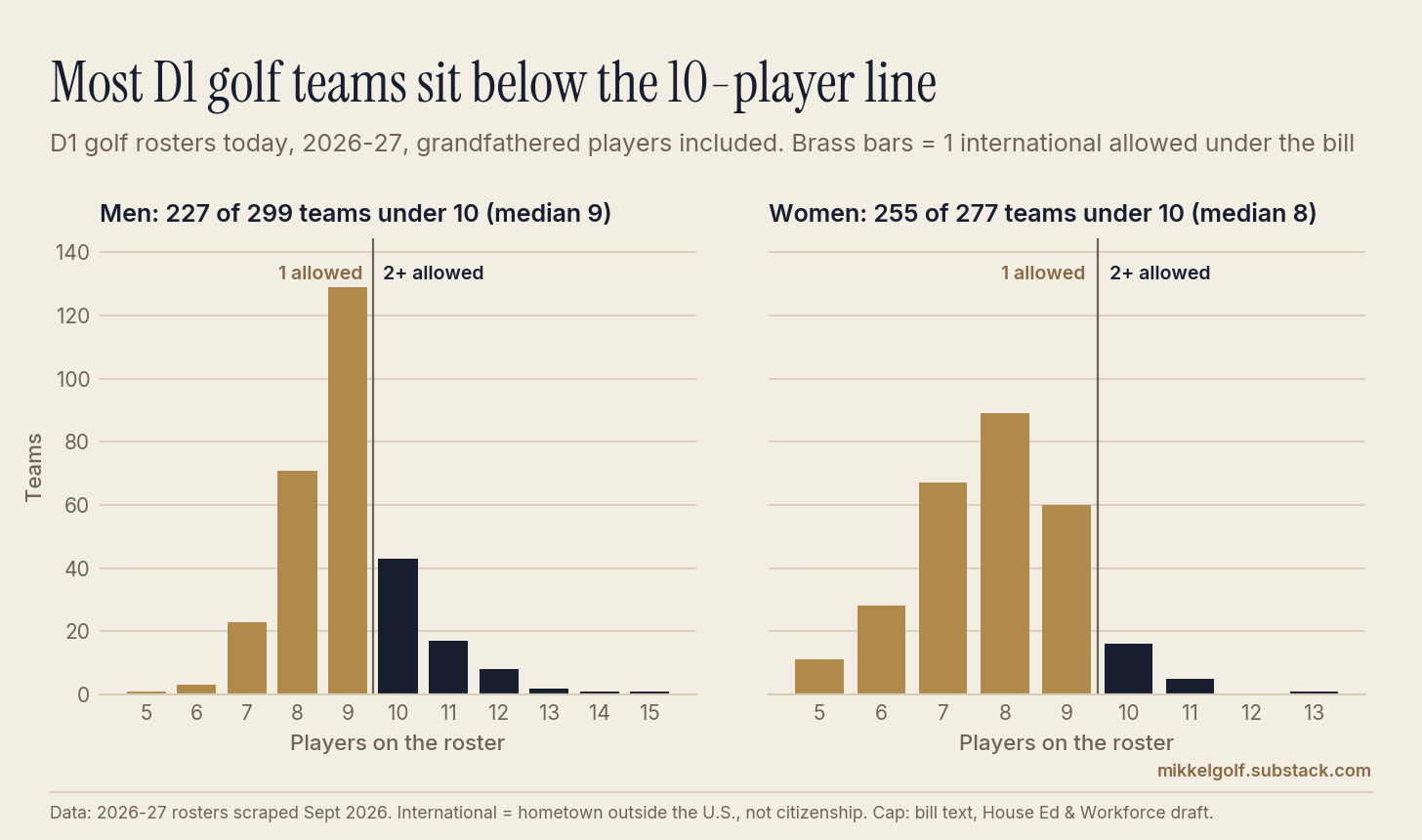
This season’s rosters already sit close to that line, even with the grandfathered players still on them:
The median D1 men’s golf roster is 9 players. 227 of the 299 D1 men’s teams in my data have fewer than 10.
The median D1 women’s golf roster is 8 players. 255 of 277 teams have fewer than 10.
The Schools That Opted Out
The roster limits came as part of a deal. The Power-4 conferences (SEC, Big Ten, ACC and Big 12) were in by default. Every other D1 school got to choose: opt in, share revenue with athletes and accept the roster limits, or stay out and keep the old scholarship rules. Most opted in. For 2025-26, 54 schools stayed out. That includes the whole Ivy League and the whole Patriot League, most of the Northeast Conference, and a handful of schools in the Big Sky, ASUN, Big South and a few other conferences.
At those schools the NCAA sets no cap on roster size, so a golf team can still carry 10 or more players and earn a second international spot under the bill. For them, the bill works the way its headline suggests: 20% of whatever roster the coach chooses to carry.
So in what follows, I treat D1 in two parts. Schools under the roster limit get the 2029 version of the rule: 1 international for golf, and at most 2 for tennis. Opted-out schools, and every school outside D1, get the bill applied to the roster they posted this fall.
How Many Teams Would Be Over the Cap in 2029
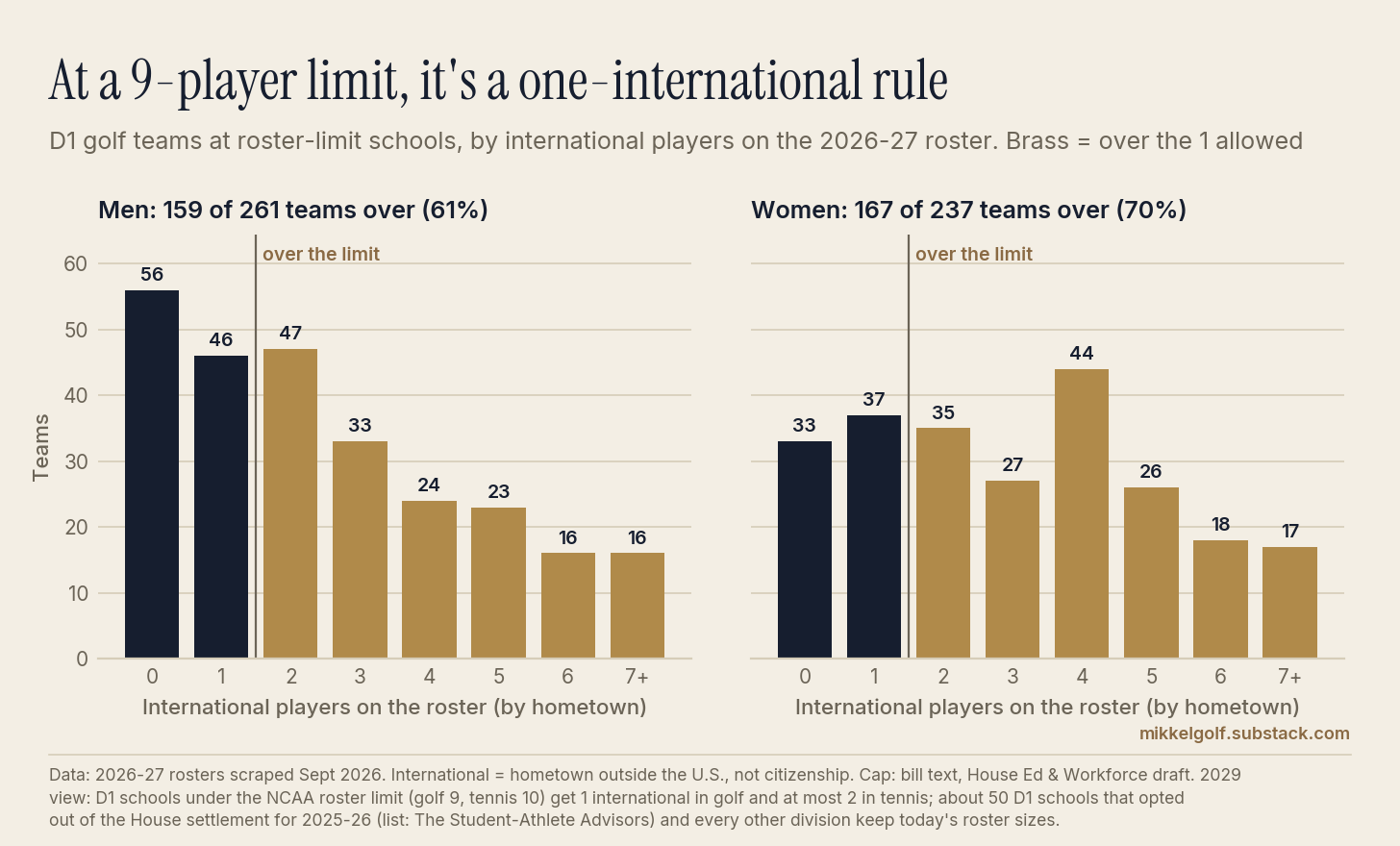
I took the number of international players on each 2026-27 roster and looked at whether that team would be over the cap under the 2029 rules. It’s a snapshot of today’s recruiting measured against tomorrow’s limit.
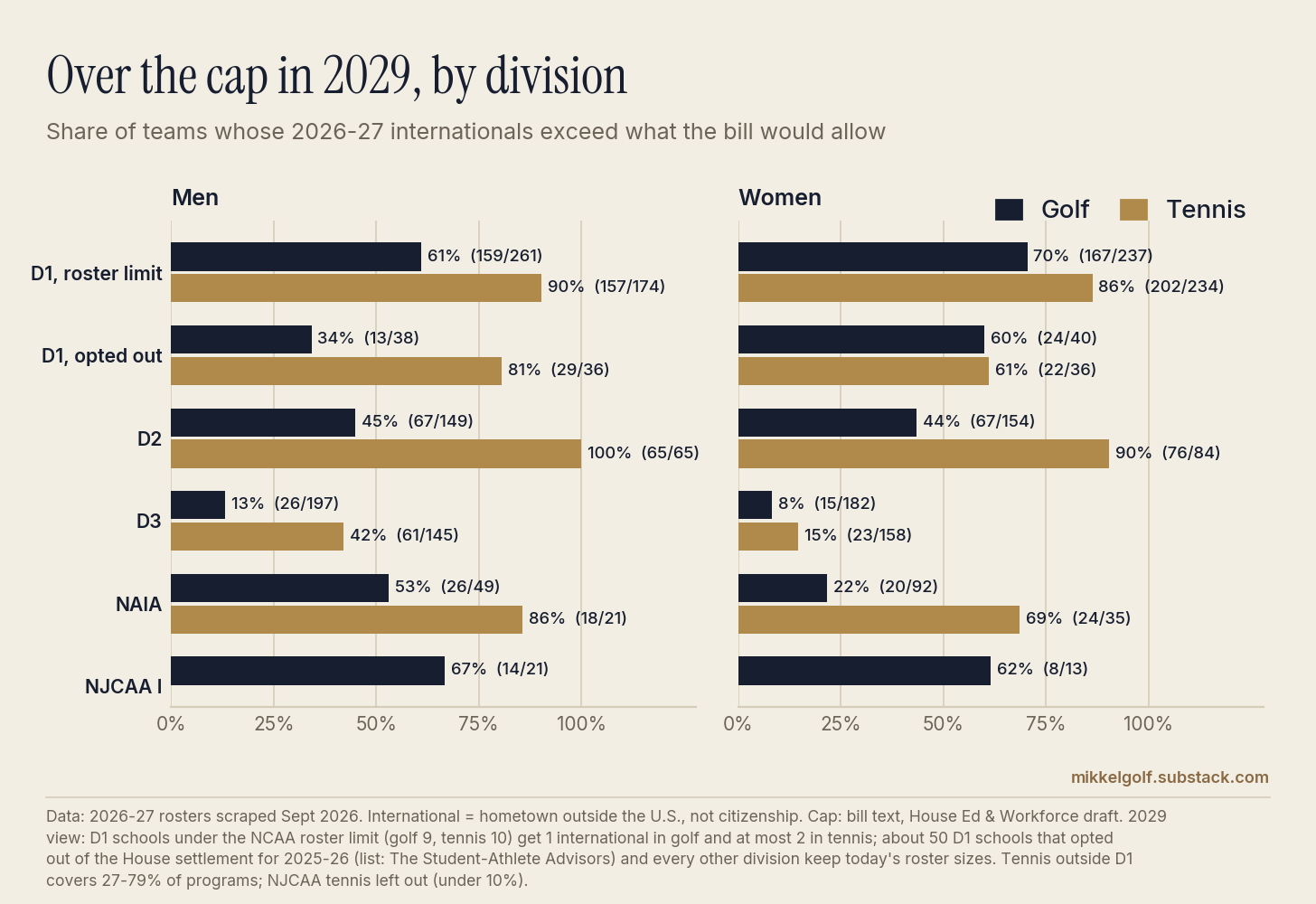
D1 men’s golf, roster-limit schools: 159 of 261 teams (61%) have more than one international.
D1 women’s golf, roster-limit schools: 167 of 237 teams (70%) have more than one.
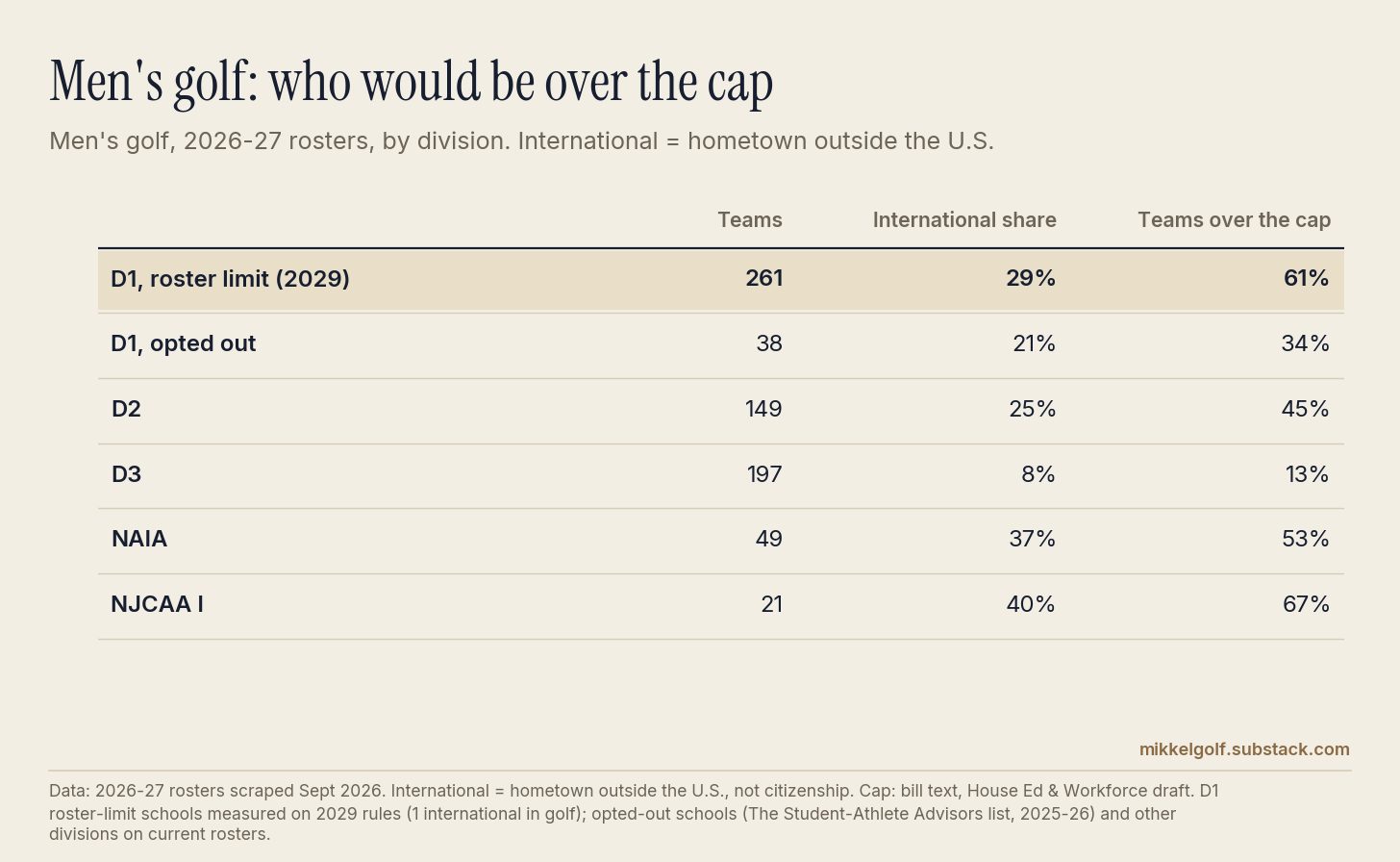
D1, opted-out schools: 13 of 38 men’s golf teams (34%) and 24 of 40 women’s teams (60%) would be over the cap on their current rosters.
Further, 112 men’s teams and 132 women’s teams at roster-limit schools have three or more internationals, which puts them at least two over.
Outside D1 there are no NCAA roster limits, so the bill applies to the rosters as posted. Golf splits by whether a division offers athletic scholarships:
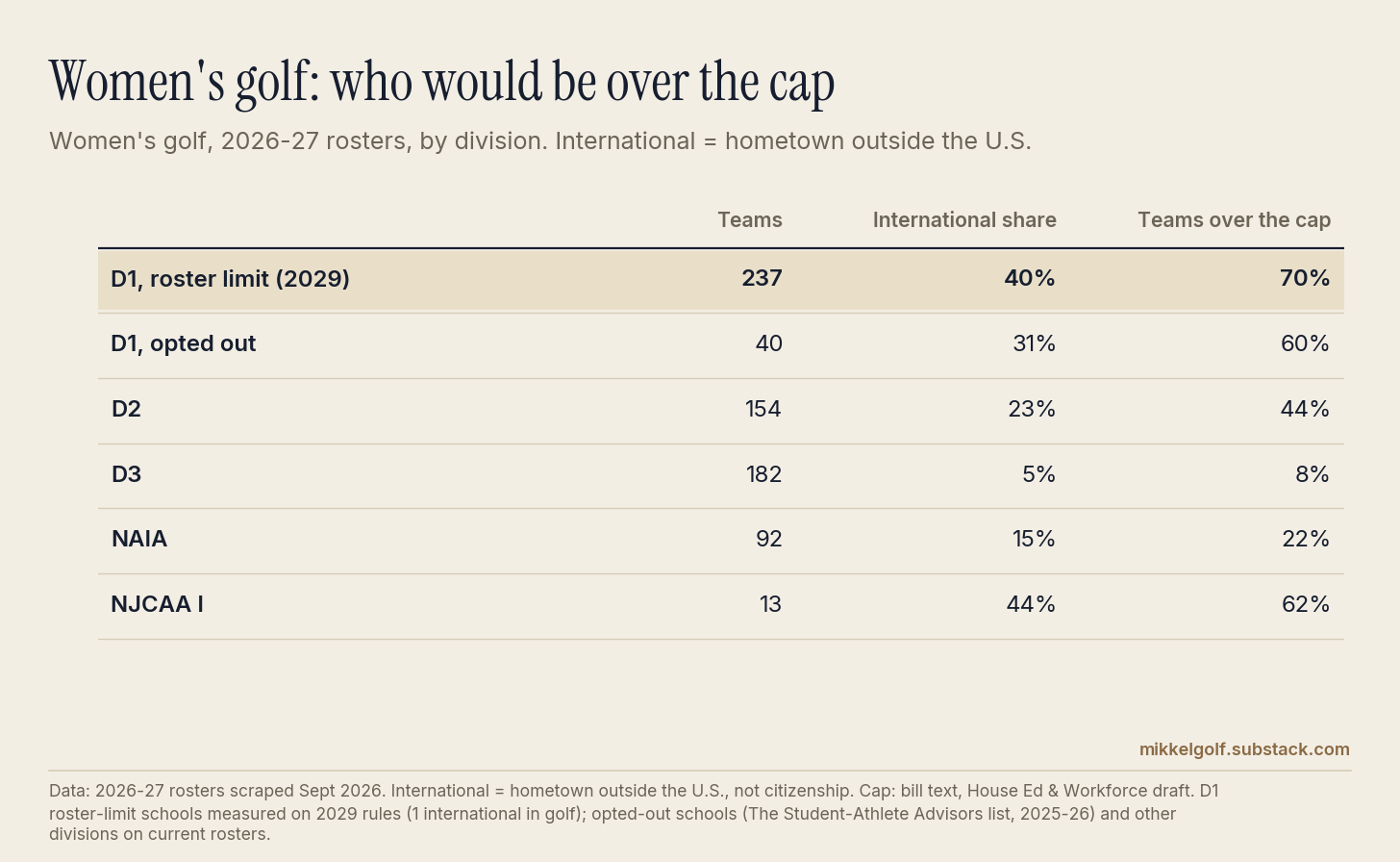
How Many Players
I also counted how many international players sit above each team’s allowance.
Across D1 golf, there are 1,570 international players by hometown on this season’s rosters. Measured against the 2029 rules, 1,091 of them (69%) are above their team’s allowance: 506 men and 585 women.
That would be a massive the distance between how D1 golf recruits today and what the bill would allow.
Who It Hits Hardest: Power-4 Women’s Golf
When I split the roster-limit schools into Power-4 (using 2025-26 conference membership) and the rest of D1, one group stood out.
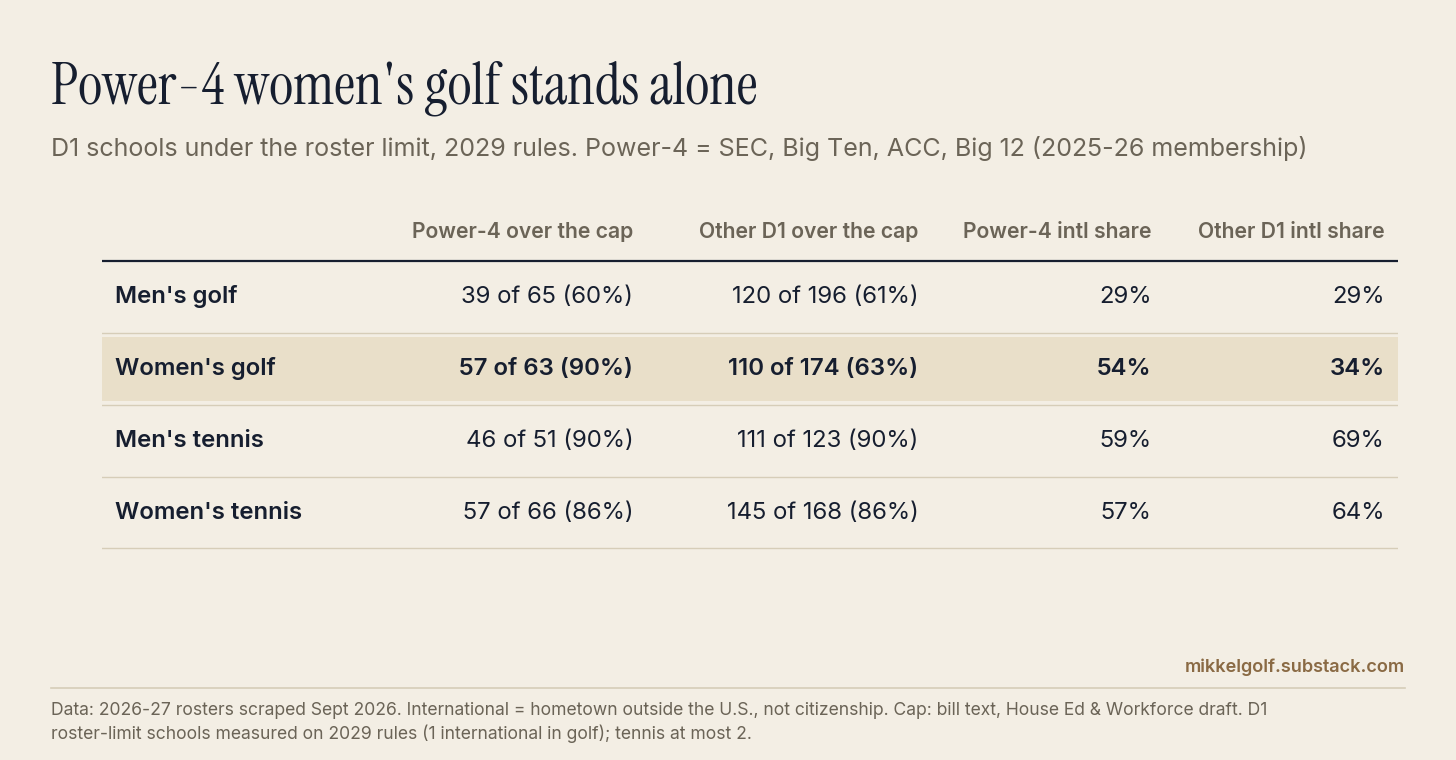
Power-4 women’s golf is majority international by hometown this season, and 9 of 10 of those teams have more than the one international the bill would allow. Only 6 of the 63 are at one or none. In men’s golf, there’s no gap at all between the Power-4 and the rest of D1 in this 2026/27 season.
How We Got Here
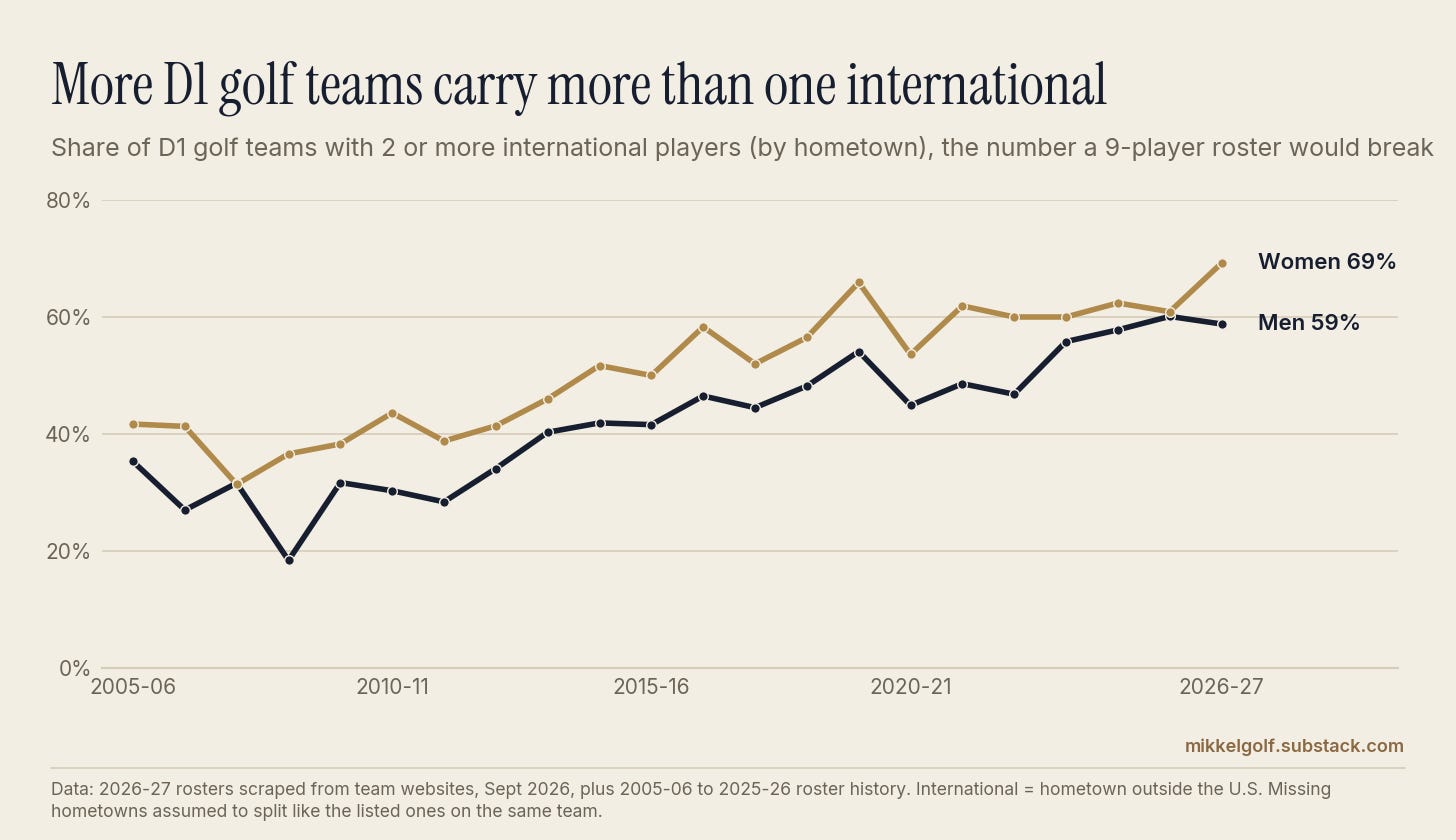
I also went back through 21 seasons of D1 rosters and counted how many teams would have been “over” the international share, retrospectively.
Men: about 31% of D1 teams from 2010-11 through 2012-13. 58% in 2024-25, 60% in 2025-26 and 59% this season.
Women: about 41% from 2010-11 through 2012-13. 62% in 2024-25, 61% in 2025-26 and 69% this season.
A note on how I counted. Not every roster lists a hometown for every player. When I first wrote about men’s rosters, I compared my dataset to the NCAA Participation Report and had hometown data for roughly 60% of D1 men’s golfers each year from 2010 to 2025. On the women’s side, the coverage stabilizes around 2010 as well. The assumption I made then, and make here, is that the players with a listed hometown are representative of the ones without. So a team with a missing hometown is counted by the split of the players it does list: a 9-player team with 8 listed hometowns, 2 of them abroad, counts as having 2 internationals. The seasons before 2010 rest on fewer schools, so read the left edge of the chart loosely. The jump for women this season may also be partly teams I didn’t have last year. I haven’t checked that for this measure yet.
The share of international players has risen too. On a corrected basis, D1 men’s golf rosters went from about 12% international by hometown in 2005-06 to 28% now, and women’s from about 17% to 38%.
Looking only at the same women’s teams in both seasons, the international share rose by about 2.5 points this year.
Tennis: The Extreme End
Tennis is the same story, only bigger. This season, D1 men’s tennis rosters are 63% international by hometown and women’s are 58%. Only 9 of 210 D1 men’s teams in my data have no international players, and the median D1 men’s team has 6.
The tennis roster limit is 10, which means a tennis team at a roster-limit school can reach the 20% rule and keep 2 international players, but only if it carries the full 10. At 9, it’s back to one. The median tennis roster at those schools this season is 9, for both men and women. So the “at most 2” I’ve used for tennis is the generous version.
Even so: 157 of 174 men’s tennis teams (90%) and 202 of 234 women’s teams (86%) at roster-limit schools would be over.
A few caveats
Most of this has come up above already, but here it is in one place:
Hometown isn’t citizenship. See the note above.
The opt-out list is one season old. Which schools sit outside the roster limits in 2029 may not match 2025-26, and that decides whether a team gets one international or 20%.
Coverage. I have 2026-27 rosters for 97% of D1 golf programs, but only 61% of D1 men’s tennis programs and 79% of women’s. Outside D1, golf coverage runs from 68% to 91% by division, and junior college is about half.
2029 is relatively far away. Almost everyone on today’s rosters will be gone by 2029-30, and rosters will change whether the bill passes or not.
Coaches will adjust, but golf coaches at roster-limit schools have little room to. They can’t carry a 10th player to earn a second spot. The only fix is recruiting fewer internationals. Tennis coaches can go to 10 and get two. At the opted-out schools, carrying a 10th golfer would help a little: if every one of their golf teams under 10 did it, teams over the cap would drop from 13 to 8 for men and from 24 to 15 for women.
The bill might not pass, or might change. All the named sponsors are Republicans, and the lead Democrat at the hearing argued against it. I haven’t found any reporting that estimates its chances.
Where I Land
What the data supports if you’re for a cap:
D1 rosters have gone from roughly 1 in 8 international players (men) and 1 in 6 (women) in 2005-06 to more than 1 in 4 and more than 1 in 3. In Power-4 women’s golf, it’s more than half.
The growth is in the divisions that offer athletic scholarships (D1, D2 and NAIA). D3, which doesn’t, stays at 8% for men and 5% for women.
What the data supports if you’re against this cap:
For most of D1 golf, the 20% in the headline never applies. The roster limit of 9 turns it into a one-player rule, which is a lot stricter than 20% sounds, and stricter at a roster-limit school than at an Ivy League school that opted out.
Measured against the 2029 rules, more than two-thirds of the international players in D1 golf today are above their team’s allowance. D2 and NAIA men’s teams would be over the cap nearly as often as D1 (45% and 53%, against 61% at roster-limit schools), so the bill reaches well beyond the top programs.
Whether this bill passes or not, I don’t think the debate about international athletes in college sports is going away.
The best juniors in the world want to play college golf and college tennis. Right now there aren’t enough American juniors at that level to fill every roster spot with the players coaches want. Coaches are hired to win, and every one of them is trying to build the most talented roster they can. The hometown data is what you get when hundreds of coaches make that same decision.
Still, I understand the frustration, and there’s one part of the argument I find hard to wave away. At a public university, a lot of the money behind these programs comes from American taxpayers. It’s fair to ask whether that money should be paying to develop athletes from other countries. The bill itself uses federal student aid to enforce the cap, so the people who wrote it clearly see it as a money question too. I don’t think the answer is obvious.
What I don’t agree with is the idea that these are American spots by default, just because the school is in America. A roster spot gets earned. It would certainly be a tough spot to be in if I were still a collegiate coach.
What are your thoughts?
Data: 2026-27 rosters scraped from team websites in September 2026 (14,130 golf and 9,977 tennis player entries after QA, across all NCAA divisions, NAIA and NJCAA), plus 21 seasons of historic roster data (2005-06 to 2025-26). “International” means the listed hometown is outside the U.S. 2029 view: D1 schools under the NCAA roster limit allowed 1 international in golf and at most 2 in tennis; opted-out schools (The Student-Athlete Advisors list, 2025-26) and all other divisions measured on current rosters. Bill text: House Education & Workforce Committee discussion draft, dated September 4, 2026.
Previous posts in this series:
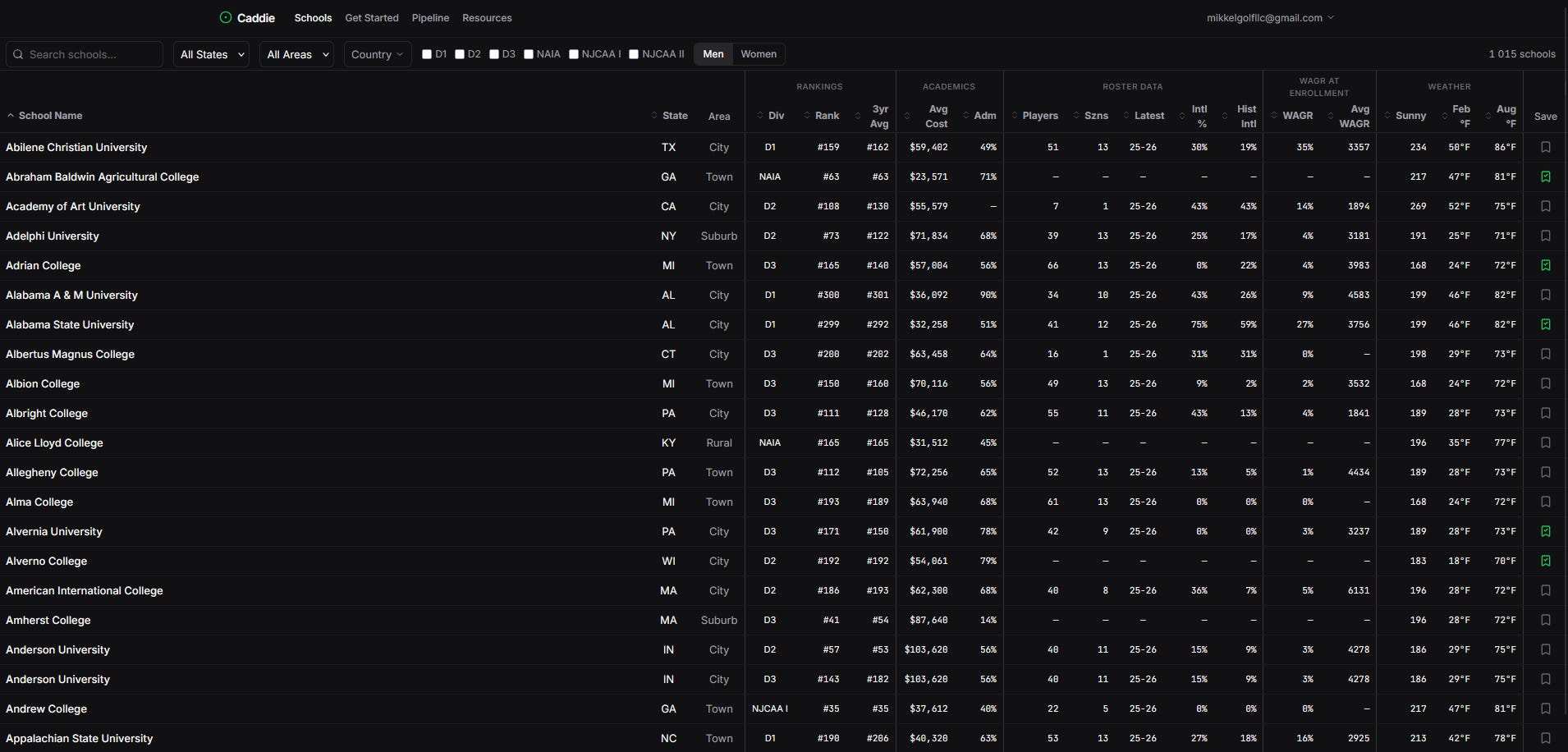
If you’re a family navigating the recruiting process right now, I built CADDIE:
A complete recruiting system for you to own your recruitment - reviewed by me.

Head coach at Vika Golf Club in Oslo. Former NCAA Division I coach at Texas Tech, Baylor and SFA, and former Baylor golfer.
Working on your own path to college golf?
Book a 2-hour first session. We go through where you stand, which programs fit, and how to contact coaches. In Oslo or on Google Meet, parents welcome.
Related articles
First published on the MikkelGolf newsletter on Substack.