
Qualifying: The Job Interview You Repeat Every Week
College Golf Report Chapter 7
Chapter 7 of The College Golf Report. The part of college golf that defines the freshman experience, and the one this survey shows hits women golfers hardest.

• • •
In junior golf, you pick your tournaments. In college golf, your tournaments pick you - but only if you earn your spot. Every week you’re competing against your own teammates for a seat in the van.
I asked 133 former college golfers how prepared they felt for qualifying. Here is what they said.
The Numbers
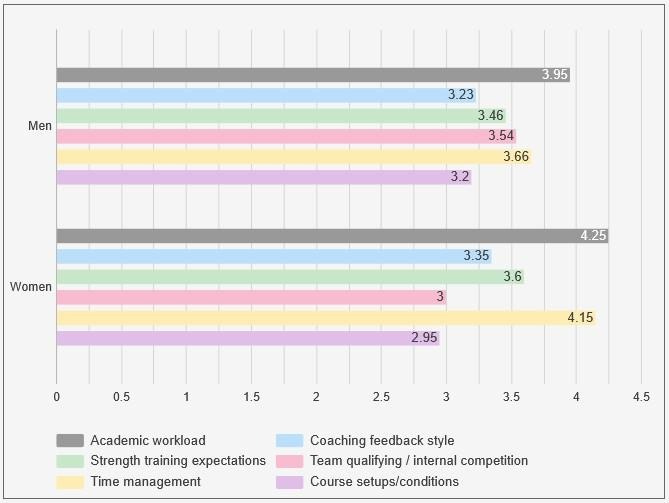
Survey adjustment factors, men vs women. Qualifying is the largest gender gap in the survey.
Of the 133 respondents, 112 rated how prepared they felt for team qualifying and internal competition on a 1 to 5 scale.
Men: 3.71 / 5
Women: 3.35 / 5
Men were more likely to feel ready for the weekly interview. The subgroup that had the toughest adjustment was domestic women.
Without over-generalizing, I think internationals as a group found qualifying easier to adjust to because they were more likely to be impact players from day one. When someone is recruited from overseas, the program usually expects them to play right away. More internationals than locals are in the lineup the day they arrive on campus.
The gender gap could be reflecting the depth of junior golf. Women playing college golf are more likely to have been the best player from their area, with less competition for that spot during their junior days. Junior golf tournaments, both in the U.S. and internationally, have smaller fields on the women’s side. For a lot of women in our survey, qualifying may be the first time they’re tested against peers of similar ability.
What It Was Like

Reviewing a scorecard after a qualifying round.
The numbers tell you the size of the adjustment. The open-ended responses tell you what it actually felt like.
The most repeated theme was exhaustion:
“I think the burnout of having to qualify for every tournament hurt my game because I wasn’t able to spend time practicing. By the time I got to a tournament I was worn out because I had just qualified for multiple days.”
This is the bit a junior doesn’t see from the outside. By the time you tee it up Thursday at the actual tournament, you’ve already played the most pressure-loaded rounds of your week against the people who know your bag best. The qualifier was your prep.
Another respondent put the same idea in a single line:
“Qualifying comes fast and you have to be ready to post a number after class and lift.”
Qualifying is the only competitive round in golf where you have to perform on a full schedule of school work, weight room, and team obligations. You don’t get to walk in fresh.
What Hurt
A few patterns came up again and again when I asked what hurt their games most.
One missed qualifier could lock you out of a whole season:
“The main thing that hurt me was when I failed to qualify for my first tournament. I had not learned that lesson and I ended up not traveling for the entire spring season, which made me play a lot less tournament rounds.”
One bad week, one whole spring on the bench. That’s the season coaches form their picture of who you are. The route back from one bad week is narrower than it looks from the outside.
The confidence side of it came up just as often. From one player:
“Confidence went down when I was missing tournaments freshman year.”
Another, on the same theme:
“Not making teams and therefore not playing tournaments. If you’re not on the traveling roster it’s hard to get pressure tournament reps in.”
There’s the bind. You need tournament reps to get better. You need to qualify to get tournament reps. Fall behind early and the climb back gets steeper.
A few players responded to the pressure by trying to change their games on the fly. It almost never went well:
“Chasing distance too quickly. I was a short hitter and felt like I was losing too many shots to qualify week in and week out because of it. So I chased distance and did not give enough attention to other aspects of the game such as short game and distance control.”
Qualifying exposes the parts of your game you weren’t ready to be honest about.
What They Learned
Not every quote was a horror story. Some respondents wrote about lessons that came specifically from qualifying.
A respondent from Chapter 4’s “what would you do differently” question put the program-fit version of the lesson plainly:
“I would make sure I would be one of the top players and going to make the team rather than trying to qualify and be the 6th guy at tournaments. Going to a D2 school would’ve been a much better fit for me.”
Pick the program where you have a clear path to the line-up. The math of qualifying every week as the 6th or 7th player is brutal. Some players survive it and grow. Others spend three years grinding for travel slots they rarely earn and graduate without the tournament reps that would have made the next step possible.
Another respondent had the opposite experience - a moment of confidence that came in the middle of qualifying:
“There were coaches and others who suggested that my game was too ‘one-dimensional’ as I mainly stuck to the same shot. When I got to college, the team captain pointed out after some qualifying rounds that I ‘hit the same shot every time, it’s absolutely brilliant’. That changed my perspective and gave me some much needed confidence.”
That is a thing only a qualifying environment can give you. A senior who has watched you play under pressure for three rounds telling you the thing you’d been told was a flaw is actually your edge. Qualifying gets a bad name in the survey, but it is also where players got the kind of feedback they couldn’t have gotten in junior golf.
• • •
Subscribe for free to get the next chapter (Time Management: The 18-Hour Days of College Golf) on Wednesday morning, and the rest of the series in your inbox.
• • •
A Coach’s Perspective
As a former coach, I loved qualifying. For almost every player, qualifying was extremely healthy and developmental for their games. I saw it as the biggest developmental tool we had as coaches.
The rest of this article is for paid subscribers
Read the full article on Substack with a paid subscription.
Continue on Substack
Coach at Vika Golf Club in Oslo. Former NCAA Division I coach at Texas Tech, Baylor and SFA, and former Baylor golfer.
Working on your own path to college golf?
Book a 2-hour first session. We go through where you stand, which programs fit, and how to contact coaches. In Oslo or on Google Meet, parents welcome.
Related articles
First published on the MikkelGolf newsletter on Substack.