
The Two Biggest First-Year Shocks in College Golf
Course Setups and Coaching Feedback
This is Chapter 1 of the College Golf Report - a 16-chapter series based on a survey of 133 former college golfers. Each week, I'll publish a new chapter here on Substack. The full report is available at https://mikkelgolf.com/resources.

This past December, I published a survey for former collegiate golfers. The goal was to create a large bank of experiences and advice aimed at the junior golfer.
More than 100 former players submitted the survey where the majority of questions were open-ended/short answer type questions. The respondents really elaborated on their college golf experiences. The information provided has been invaluable. The 30 open-ended questions produced a total of:
• Characters: 193,904
• Words: 35,683
• Sentences: 3,959(Thank you to everyone who participated!)
The Two Biggest First-Year Shocks in College Golf: Course Setups and Coaching Feedback
Almost a quarter of college golfers arrive on campus completely unprepared for their coach‘s feedback style. International men have it worst: nearly a third felt blindsided by how their coaches communicated with them.
In the survey, participants were asked several quantitative questions regarding their preparedness for college golf. Across six preparedness items on a 1 to 5 scale. In terms of what the athletes felt the least prepared for, the story differs between men and women, and U.S.-Born vs. International:
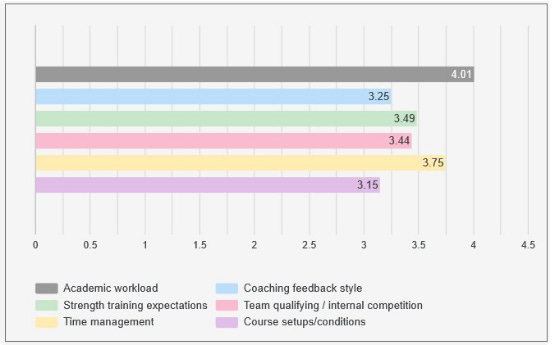
The men felt least prepared for the Course setups/conditions they faced in college golf, and the Coaching feedback style they would receive from their college coaches.
Women were also the least prepared for the Course setups/conditions they faced, but struggled more with Team qualifying and the internal competition they faced.
When we filter for where the players are from, the picture gets even clearer:
We see two large differences in responses here. International players felt vastly more prepared than U.S.-Born players for the course setups and conditions they faced in collegiate golf. This could be due to a high number of them coming through National Teams with extensive amateur-level experience. However, they were considerably less prepared for the coaching style they would receive.
As there were more men than women who completed the survey, the weighted average of all respondents leaves us with the following averages:
An interesting aspect here is the difference in responses between Course setups/conditions and Coaching feedback style (the two lowest preparedness scores). The average scores are quite similar, but they are built up by vastly different responses:
• Course setups/conditions is centered on “3.”
• Distribution: 1 = 3.8%, 2 = 19.0%, 3 = 42.9%, 4 = 24.8%, 5 = 9.5%.
• Midpoint share (3s): 42.9%.
• Tails (1–2 & 4–5): 57.1%.
• Variance: 0.942.
• Coaching feedback style is more polarized.
• Distribution: 1 = 6.7%, 2 = 17.1%, 3 = 33.3%, 4 = 26.7%, 5 = 16.2%.
• Midpoint share (3s): 33.3% (lower than setups).
• Tails (1–2 & 4–5): 66.7% (higher than setups).
• Variance: 1.271 (higher dispersion).
So what does this difference tell us?
1s and 5s versus mostly 3s:
A large proportion of former players felt mildly unprepared for the course setups and conditions they would face in collegiate golf. We’ve seen how International players felt more prepared than U.S.-Born players, but very few overall answered that they felt “Very well prepared” for the course setups and conditions they would face in college. In fact, only 10 respondents in the entire survey answered 5 to this question (9 men, 1 woman - 6 internationals, 4 domestic).
In short, most players felt slightly under-prepared for college golf course set-ups and conditions.
The coaching feedback question is more polarizing, though. There were more athletes who reported they were “Very unprepared” or “Very well prepared” for the coaching feedback style they would receive from their coaches.
This is both unsurprising and eye-opening, in my opinion. It’s unsurprising as this question is about human interaction. From my own experience as both a collegiate player and a coach, there are certain players you just gel with - and others that you don’t.
However, the fact that a quarter of former college golfers were “very under-prepared” or “under-prepared” for their coaches’ feedback style is alarmingly high. The recruiting process should be about finding the right fit - and one of your main jobs is to uncover how the coach will deliver feedback to you. This survey reveals the magnitude of this pain point for both players and coaches - and should be a focal point in your recruitment.
Finally, almost a third of international men rated Coaching feedback style 1 or 2 (31.8%). The mismatch in expectations between International players and their coaches is larger than domestic players. This too is unsurprising given internationals usually know less about college golf, and spend less time connecting with coaches and current/former players during the recruiting process. However, I’d argue it’s almost totally avoidable.
How to Apply This Information
Preparing for coaching feedback style:
• Spend time getting to know your coaches during the recruitment.
• Get a strong sense of their coaching feedback style. Ask plenty of questions about how they like to coach individually. Good questions here might be:
• How do you evaluate tournaments with players?
• What have you seen in the players who have improved the most on your team?
• What have you seen in the players who haven’t improved?
• What’s something a player has taught you?
• How would you coach me if I struggled with my game?
• Ask current and former players about their coaches.
• Find articles and/or podcast appearances from the coaches who are recruiting you.
Preparing for course setups/conditions:
• Simulate tough conditions from time to time.
• At home, play the back tees. Play a game of irons only. Play worst ball. Play drawbacks on the greens.
• When applicable, test the waters in amateur level tournaments in the year or two before starting school.
• Attend a college tournament in person if you can.
• Play the ball down - always.
• Players reference struggling with their short-game and wedges quite a bit. Adjusting to new grasses is a common theme. Don’t play the ball off a tee your entire junior golf career.
Course setups/conditions:
“The difficulty of courses. I grew up in Iowa on a public track… most tournament experiences were local at public courses in Iowa.”
“How to play a golf course like a professional. Course management, shot shaping, positioning.”
“Course management, missing in the wrong spots hurts your score more in college golf than in junior golf.”
“Maybe play more international tournaments… money was limited and the support from the national was marginal.”
“Getting used to the course conditions and creating a routine.”
“Play as much tournament golf as possible. Do not chase rankings. Learn to compete and trust the process.”
Coaching feedback style:
“Make sure you ask the current players about the coaches and their styles.”
“Never rush with making decisions and fact check everything a coach might tell you.”
“Listen to yourself. Being ‘coachable’ is appreciated, but if you know something is wrong, listen to yourself as well.”
“The coaches are always watching. Hold your head up.”
“Don’t stress. The right fit will come to you.”
“Coaching style and lack of freedom or independence in golf practice.”
“Managing team expectations vs individual performance.”
This is Chapter 1 of 16. Next week: Open-Ended Recruiting Advice from 133 Former College Golfers - the ten themes that came up over and over again when we asked them what they wish they'd known.
The full College Golf Report - all 16 chapters, 47,000 words, with charts and data breakdowns - is available at (https://mikkelgolf.com/resources) for $29.95.
—
If you're a family navigating the recruiting process right now, I also built CADDIE:
A complete recruiting system for you to own your recruitment - reviewed by me.

Coach at Vika Golf Club in Oslo. Former NCAA Division I coach at Texas Tech, Baylor and SFA, and former Baylor golfer.
Working on your own path to college golf?
Book a 2-hour first session. We go through where you stand, which programs fit, and how to contact coaches. In Oslo or on Google Meet, parents welcome.
Related articles
First published on the MikkelGolf newsletter on Substack.