
The PGA Tour Winners Who Never Won in College
5 Years of Tour Winners, contd.
If you played college golf and you want to win on the PGA Tour, you almost always won at least once in college.
In our five-season sample:
97 PGA Tour winners played college golf
87 of them won at least one college event
10 did not
That is 10.3% of the college-golf group. Rare, but not mythical.
As shown in our first post, for players with a future goal of winning on the PGA Tour, it is nearly a prerequisite to win at the college level. However, skeptics would be right to point out that there are some PGA Tour winners who did NOT win in college. This article digs deeper into their college careers and the patterns that emerge when you look past the "zero wins" line on the resume.
The list
Here are the PGA Tour winners from the past five seasons, who played college golf, and left with zero college wins:
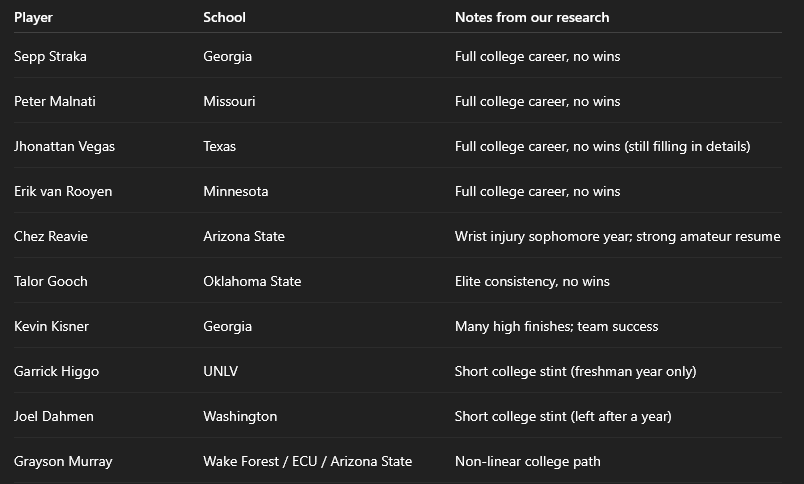
At first glance, seeing that 10 players played college golf without winning seems like a high number. However, when we examine the data more closely, we see that many of these non-winners in college had either extenuating circumstances or careers that indicated they would do very well in professional golf.
The first seven names (Straka, Malnati, Vegas, van Rooyen, Reavie, Gooch, Kisner) are the players who played their entire eligibility out (4 years) without winning in college. The rest have some version of: short stint, transfers, or a different competitive structure.
First Pattern: "No Wins" Does Not Mean "No Contention"
This is the most obvious commonality. The winless college Tour winners were not anonymous in college. They are typically players with some combination of:
A lot of top-10s and top-5s
Team success on stacked rosters
High-end amateur markers (USGA events, major starts, elite junior resumes)
A clear upward trajectory
A win is a binary outcome. Contending is not. Most (if not all) of these players were high-level amateur players who got in contention a fair share.
Second pattern: “Team context” matters
A recurring theme here is being surrounded by elite teammates and elite schedules.
Three examples that jump out immediately:
Kevin Kisner (Georgia)
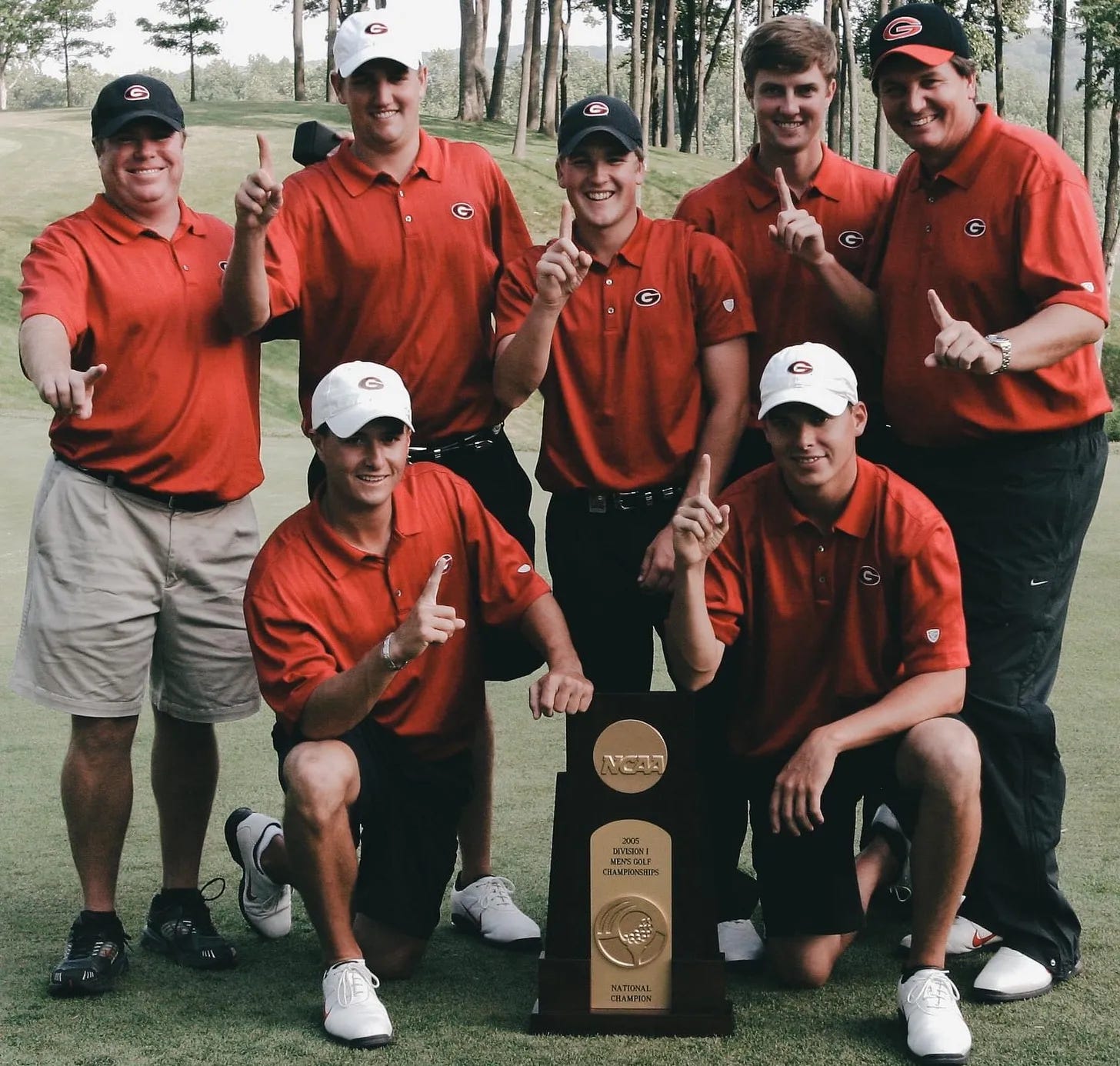
Kisner famously quipped that he “probably couldn’t win” at quite a few Tour stops, but he keeps showing up because, “they give away a lot of money for 20th.” Similarly, while his college career may not have included a win, he did have 14 top-10s to show for it and was named an All-American in each of his four years.
Most notably, he was a key member of Georgia’s 2005 national championship team alongside teammates Brendon Todd and Chris Kirk. That profile is not “could not win.” That profile is “was always in the mix, on a team that was always in the mix.” Even in the midst of a personal slump, the Kisners of college golf are often leaders on their team in other ways. And when they do break through that difficult time, it often provides a spark to the rest of the team, such as Kisner’s opening round 65 that helped the Georgia Bulldogs capture the 2005 NCAA team championship.
Talor Gooch (Oklahoma State)
Another display of remarkable consistency is the collegiate campaign compiled by Talor Gooch, whose finishes include 26 top-20s, 15 top-10s, and 9 top-5s. Most impressive, however, is his postseason resume, which proves that being clutch in team golf isn't just about the ability to win individually.
In the competitive Big 12 conference, he helped the Cowboys by finishing in the top 5 twice in the conference championship. Remarkably, as a freshman Talor came third in regionals, helping Oklahoma State win their region. Gooch bettered that regional finish with a T2 finish in the NCAA Columbia Regional his senior season.
Again, not a “missing pieces” resume. More like a “won everything except the trophy” resume.
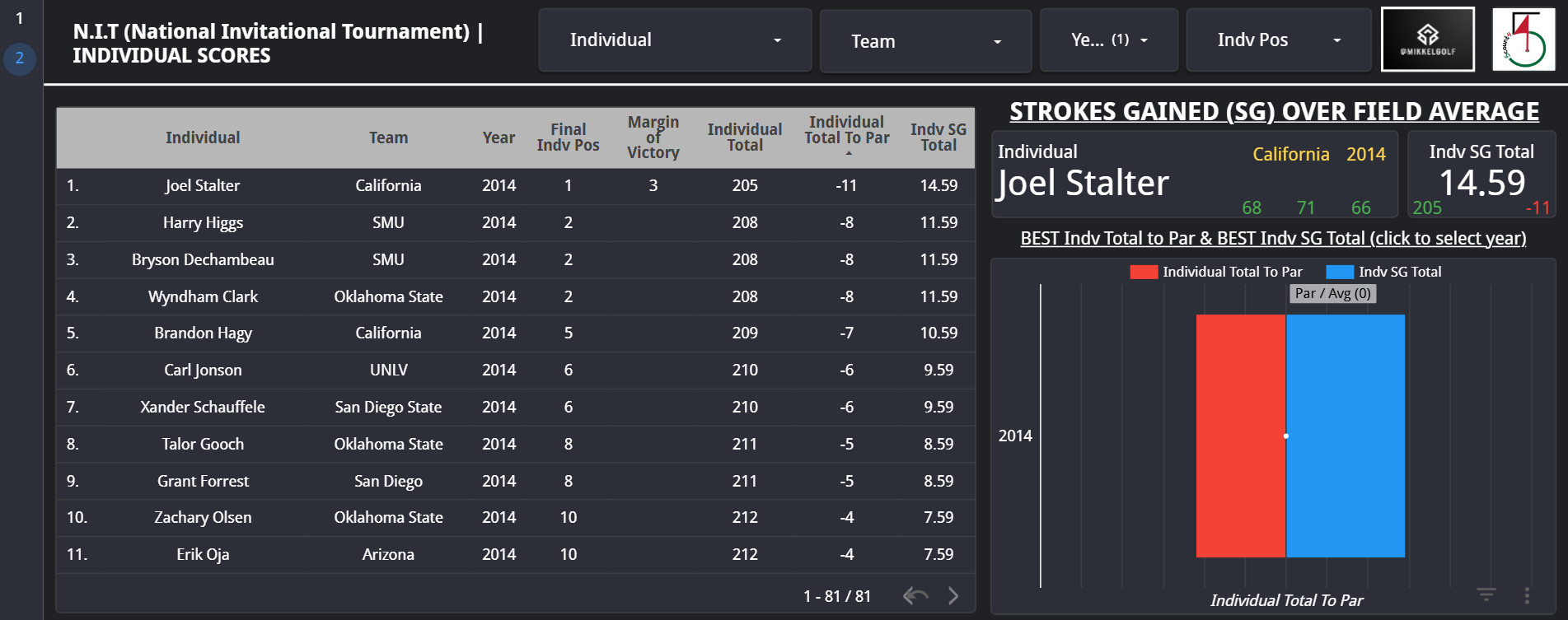
If you want to turn this into advice: when people say “just win,” they rarely acknowledge how many college starts happen in fields where the top 10 is basically a future pro tour. Want a small example? Check out this top 10 from the 2014 National Invitational Tournament (N.I.T.) hosted by Arizona at Tucson National where Gooch finished T8 behind such names as Bryson DeChambeau, Harry Higgs, Wyndham Clark, and Xander Schauffele.
Chez Reavie (Arizona State)
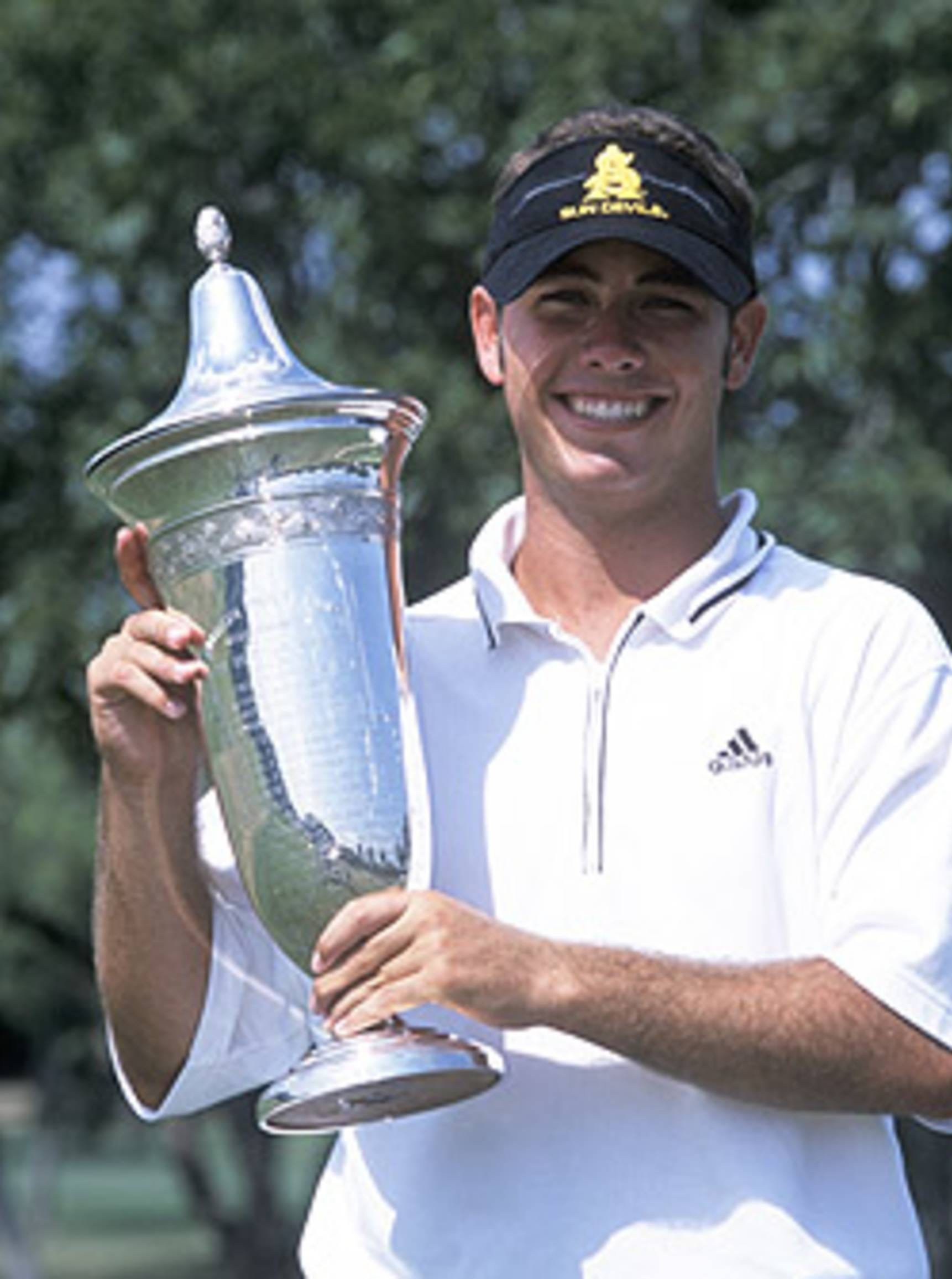
His college career was one of the most impressive we saw from the winners and non-winners alike. Chez managed to rack up 22 top-10s, win a USGA event, and play in both the U.S. Open and Masters. The only thing he didn’t do was get his picture taken with a trophy.
Additionally, he was named an All-American three times, and two of his top-10s came in NCAA Nationals. The resume is not defined by college trophies but by USGA pedigree and major championship experience.
Injury context matters here too. A wrist injury his sophomore year affected his development timeline. If you want one word: durability. He lasted long enough for his game to mature.
Third Pattern: They Usually Learn to Win Later Than the Typical Tour Winner
This group is not the “freshman wins twice, turns pro, wins immediately” archetype.
This is more often:
Late physical development and/or overcomes injury
Late performance development
A few years of professional apprenticeship
Then a breakthrough
That does not make it easier. It just explains the profile.
Gooch, Kisner, and Reavie all prove that having a successful college career seems to be a prerequisite to success as a professional, certainly to winning on Tour.
The “Final Four”: Modest College Success, Tour Wins Anyway
That said, there still remains a sliver of hope, the 4 out of 97, with modest collegiate success who went on to win on Tour. For those later in their college years who read this and are still determined to make it as a pro, they would do well to study the development of the following players.
Peter Malnati (Missouri)
“When I was first out of college, I had no idea if I was good enough. Even though I did improve for my junior and senior years in college, I was never a world-beater. I was never seriously one of the top college golfers.” (Peter Malnati in the Columbia Tribune (2013))
The first three years of college, Malnati averaged 76.2, 76.3, and 74.1, hardly the mark of a future winner on Tour. Unsurprisingly, he was not only never an All-American, Peter wasn’t even an All-Conference player in his college days.
Instead, what we should study is his transition from a junior to a senior in which he lowered his scoring average by roughly 4 strokes per round. In the fall of his senior year, Malnati finished in the top 7 in five of his six events and won a professional event (as an amateur). He compiled 5 top-5s, 9 top-10s, and 15-plus top-20s over his college career.
This is the classic “steady competitor” college profile. The difference between “no wins” and “one win” can literally be one Sunday.
The start to his pro career was far from glamorous as it took four years of mini-tour golf before he secured temporary status on the Korn Ferry Tour. Perhaps surprisingly, he won in his first year, which catapulted him on the money list and earned him a PGA Tour card. Unfortunately, he not only lost that card but failed to remain on the Korn Ferry Tour as well.
While he is still yet to make a cut in a major, or ever be inside the top 50 on OWGR, Malnati has won twice on Tour, nine years apart. Described after his victory at the 2024 Valspar as “golf’s everyman,” Malnati proved that if you can hang around long enough you might eventually find yourself in the winner’s circle.
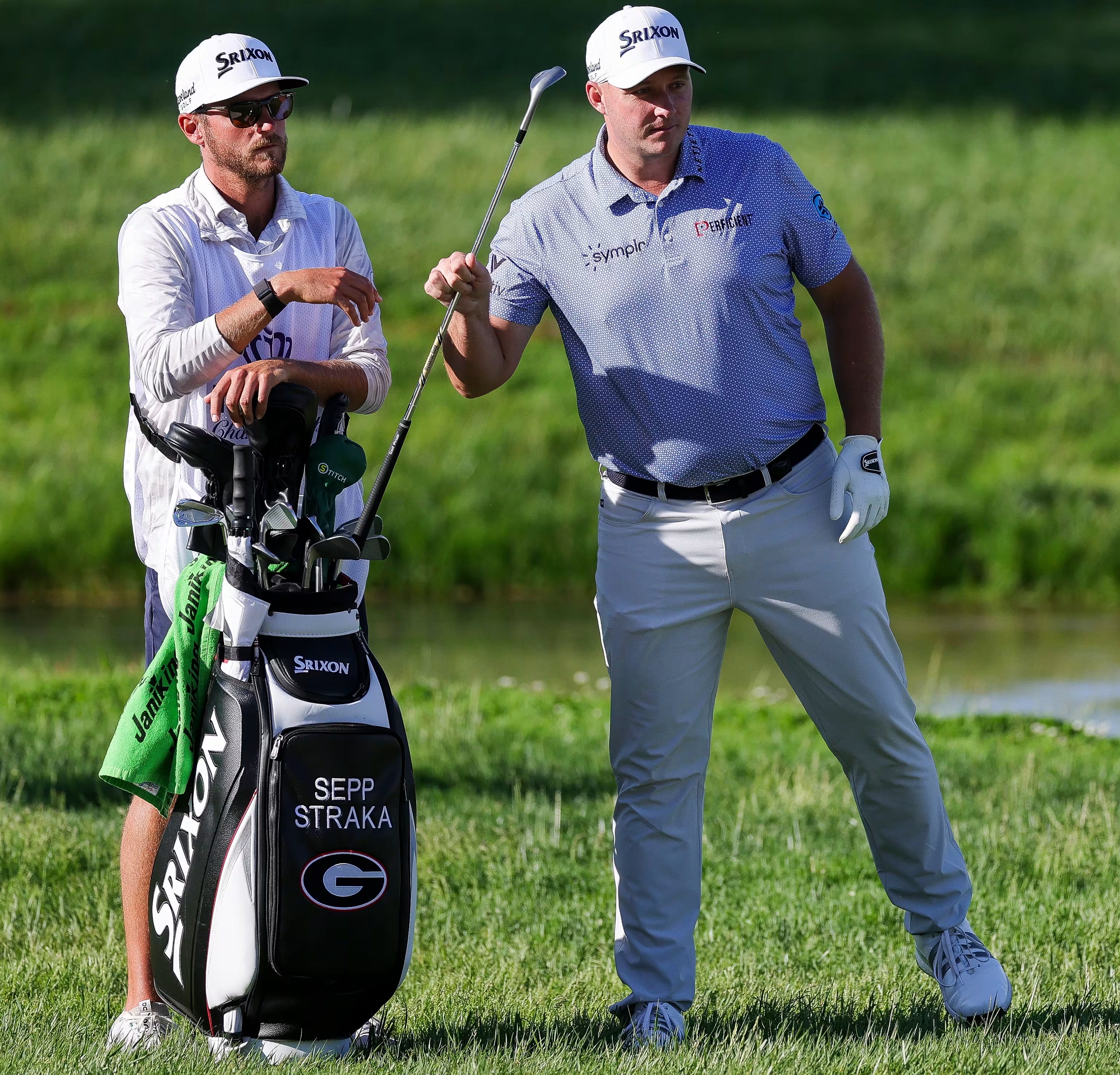
Sepp Straka (Georgia)
“Sepp Straka plays with quiet confidence and unshakable consistency — a late-blooming powerhouse who thrives under pressure and continues to climb the global ranks.”
— Justin Rose
Straka nearly quit after his sophomore year at the University of Georgia, but finished with a strong senior profile which included helping the Bulldogs win the 2016 SEC championship.
This is the mental side of development. Some players do not show their final form until their early to mid 20s. After turning pro in 2016 at the age of 23, Straka made a steady march from the Korn Ferry Tour (then the Web.com Tour) - winning in 2018 and finished T3 in that tour’s championship - up through the PGA Tour. His consistency, including a T2 finish at the 2023 Open Championship, earned him a spot on the 2023 and 2025 European Rider Cup teams. The first Austrian to win on the PGA Tour, Straka is now considered a breakout European star who still sports the large Georgia “G” logo on his bag.
Jhonattan Vegas (Texas)
Vegas overcame adversity to even get to play college golf. A win at the National Amateur Championship in Maracaibo, Venezuela helped prepare him for more success his senior season.
Even though he didn’t win in college, he saw steady improvement across the board each season, including lowering his scoring average by nearly a full point each year at the University of Texas. Several times throughout his junior and senior seasons, Vegas led the team as the highest place Longhorn finisher in a tournament, even if those didn’t earn him medalist honors. At the conclusion of his final season (2006-07), Jhonattan advanced all the way to the semifinals of the U.S. Amateur, falling to eventual champion Colt Knost (SMU).
Jhonattan Vegas’s career arc fits the theme: elite athlete, strong college program, then professional breakthrough. His DataGolf profile shows a similar steady progression as Straka’s.
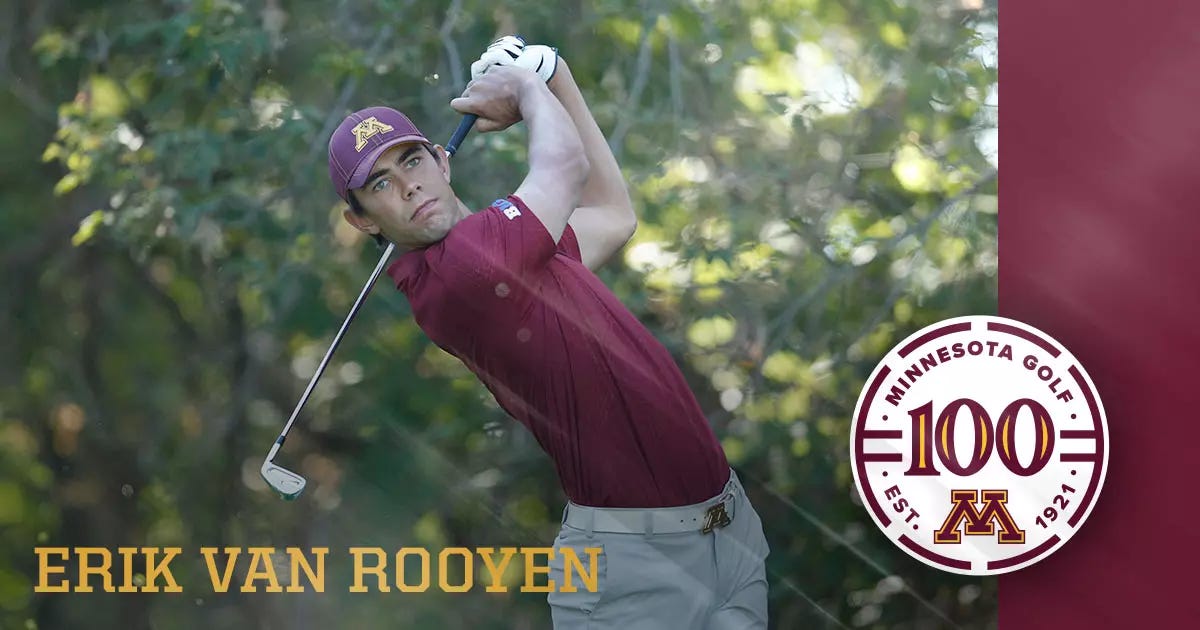
Erik van Rooyen (Minnesota)
Van Rooyen played basically everything for four years, was not a freshman star, and his freshman scoring average was rough. Yet his career arc still resulted in a PGA Tour win.
He was consistently in the lineup freshman through senior season, led the Minnesota Gophers in stroke average, and appears frequently in the program record book.
The anti-highlight-reel resume that still becomes a Tour win. If you want a theme: keep playing.
That story is not “wins do not matter.” It is “development curves vary.” For van Rooyen, that curve took him through the Sunshine Tour in his native South Africa, the European Challenge Tour, the European Tour, and eventually a win at the PGA Tour Barracuda Championship.
The “Short College Stint” Subgroup
It is worth separating out the guys who did not do the full four-year path because it changes the interpretation. In the extenuating circumstances bucket, there are three players that did not graduate: Joel Dahmen, Garrick Higgo, and Grayson Murray.
Garrick Higgo (UNLV)
Higgo played only his freshman year. A very small sample.
He believed so strongly in himself that he decided to move back to South Africa to get started on his pro career. In his own words:
“I enjoyed college, but I was itching to get out on tour. After one year, I left UNLV to turn pro and moved back to South Africa to play on the Big Easy Tour, a developmental tour. In my first event, I missed the cut, but I didn’t question myself or my decision. I wanted to be a pro no matter what. In my second event, I won.”
The talent was always there. He beat Cole Hammer in the round of 16 at the U.S. Junior Amateur in 2017 before losing on the 17th hole of the semifinals to Matthew Wolff. He got the attention of UNLV, but he lasted only two semesters before returning home.
“I didn’t play that well,” he said with a soft smile. “I knew if I was at home, I knew where I could get my game. And I wasn’t going to get there at UNLV. I don’t mean it that way. I loved it there. I just don’t think it was the right fit for me.”
Joel Dahmen (Washington)
Dahmen left after a year. His story involves a different type of journey: late maturation, long climb, then wins. His path was significantly impacted by dealing with his mother’s cancer and then later his own testicular cancer diagnosis.
Grayson Murray
Murray had a non-linear college path. Tragically, he passed away in May 2024. This comprehensive Golf Digest piece on Grayson is incredibly well written.
He had an illustrious junior career which included becoming the second youngest player to ever make the cut in a Korn Ferry event, playing in the U.S. Open while in college, and winning Junior Worlds three years in a row, a feat only matched by Tiger Woods.
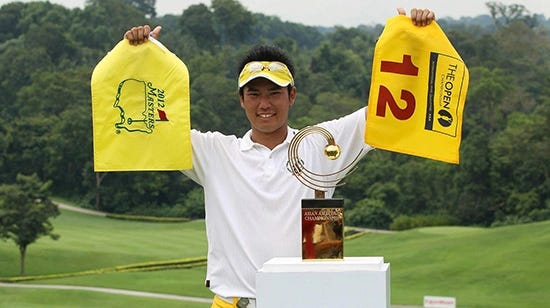
Hideki Matsuyama
Matsuyama’s college structure was outside the NCAA, making it hard to compare 1:1 with a U.S. four-year college resume.
However, his amateur accomplishments were remarkable. He won the Japan Open in October 2010, then broke through at the Asia-Pacific Amateur Championship that same month, becoming the first Japanese amateur to qualify for the Masters Tournament. He repeated that Asia-Pacific Amateur victory in October 2011, proving he could win outside of native Japan. In back-to-back weeks in August 2011, he won the World Universiade Championship and Japan Collegiate Championship.
So What Do These “Exceptions” Have in Common?
These players have had wildly different stories. It’s challenging drawing a cohesive story or a rule-of-thumb that’s applicable to these players. They’ve grown up in different parts of the world, started college with vastly different skillsets, and some dealt with incredible adversity throughout their early adulthood.
However, if we had to put it in one sentence: They replaced “collegiate wins” with other proof.
Usually one or more of:
Repeated high finishes
Elite amateur markers (USGA wins, major amateur titles)
Playing and producing in major events or elite fields
Development trajectory which sometimes include international success before the PGA Tour
Overcoming adversity in life outside of golf
What unites these players is not their lack of college wins, but what they carried instead. The college win predicts Tour success not because trophies are magic, but because winning requires proving yourself under pressure in elite competition. These 10 players proved themselves through other channels.
Their paths were longer. Their timelines slower. But they accumulated the same proof, just differently. For most of these players, that meant consistent top-10s, elite amateur credentials, or clear improvement trajectories.

Other Links:
- How Much Did Recent Tour Winner Win in College?
- The Declining Rate of U.S.-Born Men’s DI Golfers
- Women’s Golf: The Declining Rate of U.S.-Born DI Golfers
- Shifts in Height | Division I rosters over the past 20 years 📊
- How can a recruit best get a college coach’s attention? (Recruiting)
Mikkel Bjerch-Andresen
Golf coach, data analyst, writer