
The Olympic Medal Count and What It Has to Do With Golf
Norway’s Youth Sports Model
For the past three weeks I’ve been the most annoying person in my household. Every morning I avoided my phone like it was the plague. Family and colleagues knew what not to discuss with me during the day…
I needed to watch all of the Olympics at night, uninterrupted, with zero spoilers!
If you’ve followed this Substack you know my background as a collegiate and professional golfer, and as a former college golf coach. But I grew up skiing, playing soccer, and doing biathlon (still the best television sport out there). I went all-in on golf at fourteen.
My interest in winter sports has always been there - through Norwegian blood and a childhood spent more on skis than on a golf course. The Winter Olympics is therefore still my Super Bowl.
And this year, they delivered.
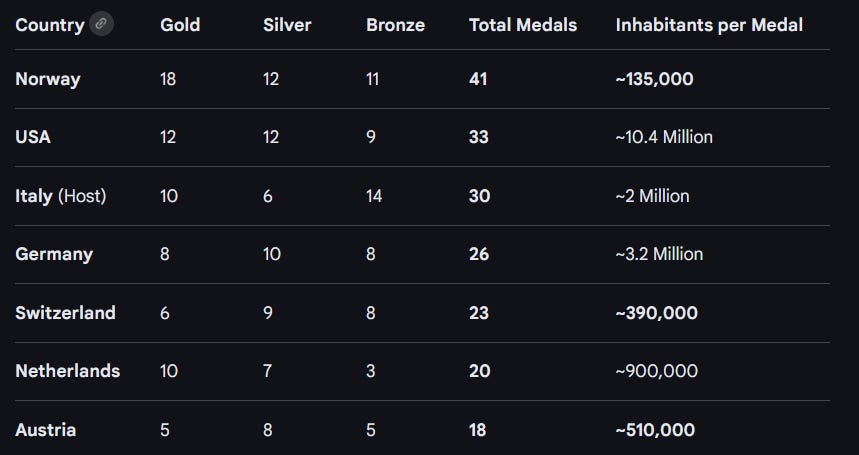
Norway finished with 41 total medals and 18 golds, both single-Olympics records. When you look at medals per capita, it is not even close. That number deserves a small caveat though - Norway is a winter country, and in cross-country skiing a single athlete can enter everything from the sprint to the 50km. It’s not like a runner in the Summer Olympics can win both the 100m and the marathon. Klæbo’s six gold medals inflate the count in ways other nations simply cannot match.
That said, Norway is a great sporting nation well beyond snow. Karsten Warholm demolished the 400-meter hurdles world record in Tokyo. Jakob Ingebrigtsen is one of the best middle-distance runners in history. Viktor Hovland is a household name on the PGA Tour. Casper Ruud reached world number two in tennis. Erling Haaland set the Premier League single-season goals record. Not bad for a country of roughly 5 million people in a cold climate.
What about golf
So during the Olympics I got a handful of messages from people in the States, all circling the same question. A former booster asked whether it is actually true that Norway doesn’t keep score in youth sports until kids are thirteen. A college golf coach asked about specific traditions in Norwegian youth skiing culture - “Heard the slopes are closed to adults one day per year, that’s awesome!”. An ex-teammate from Baylor messaged me “Your country is killing it” - followed by: “How are you doing it?”
Obviously, I have a unique vantage point on it. I have been a player in both Norway and the US, a coach in both countries, and now a parent raising young kids in both countries as well. Player, coach, parent.
What “Idrettsglede” Actually Looks Like
During the Games, Steve Magness, a well-known performance coach and author, posted a thread on X that went pretty viral. He summarized Norway’s youth sports policies - participation trophies for all, no scorekeeping until 13, no national travel competitions, no posting youth results online. He pointed to research on over 6,000 athletes showing that those who reached world-class had more multi-sport participation, started their primary sport later, and initially progressed slower than their specialized peers. The early specialists got there first, then stalled. The late developers took longer, then didn’t stop.
His framing was sharp, and I think it was mostly right. But I want to add some texture from someone who actually grew up inside this system.
Norway’s youth sports policy is built on a document called the Children’s Rights in Sport, introduced in 1987 and updated in 2007 by NIF, the Norwegian Confederation of Sports. The key stuff is enforceable policy. No official scorekeeping until thirteen. No national travel competitions. No online result postings (you can actually be fined for this). The slogan is “Idrettsglede for alle.” Joy of Sport for All.
From the inside, that is exactly what it felt like growing up. Coaches in most sports are volunteers. Costs are low, heavily subsidized by the national lottery. There are no travel teams recruiting ten-year-olds away from their neighborhood clubs. The participation rate in organized youth sports sits around 93 percent. Norway cannot afford the American model of burning through nine kids to find one who survives. They keep everyone in as long as possible and let kids figure out on their own what they love.
For me that meant spending my childhood playing soccer, skiing, cross-country, and biathlon without being particularly elite at any of them. My best sport was probably cross country skiing, followed by biathlon. When I went all-in on golf at fourteen, I was a 26 handicap. In Norwegian youth sport, nobody cared. That was the point.
I see this playing out again now with my own kids. One of the most popular activities for young children in Norway is allidrett - a multi-sport program where kids rotate through different physical activities rather than specializing in anything. It’s targeted at 4 to 8 year olds, I would say - and it’s just about getting in the gym and having fun with motor skills. That was the first thing I enrolled my four-year-old in when we moved here in 2023.
He can already hit a golf ball quite well, which is natural when you have been swinging a club once a week since you could walk and been around great players your whole life (from my days as a college coach). But I believe in the transfer of skills, and the most important thing for me - for my own kids and frankly for all my athletes - is that the enjoyment of sport is the foundation. That does not mean it has to be laughing and fun every second. Elite sport is as much about character development and learning to work hard and endure difficult stretches. But enjoyment has to be the base. During the youth years you are just trying to have fun, be a kid, and grow your foundation - motor skills, endurance - and the capacity to absorb more training later on.
Some of you have read my earlier post on David Epstein’s Range, where I filtered his ideas about specialization through a golf lens. Norway’s entire youth model is, somewhat unintentionally, a national-scale experiment in what Epstein describes. And I am a small data point myself. From a 26 handicap, to a Baylor scholarship and a couple of years representing Team Norway, in five years. I always attributed that to work ethic, and I still think that was the engine. But I came into golf with a real physical base from three other sports. The aerobic capacity from cross-country and biathlon was not nothing. Tactical patterns from soccer transferred in intangible ways. My body already knew how to compete quite well.
When Things Get Serious
So when does Norway shift gears? From my viewpoint, around high school, which starts at sixteen. This is when the sports school system kicks in. Most serious young athletes attend a toppidrett high school - schools like NTG or WANG Toppidrett, where I coach golf in Oslo - that combine full academic education with 340 to 500 hours of sport-specific training per year. Viktor Hovland came through this system. Most of our skiers do, too. Swedish golfers have a similar setup. The golf kids I coach now are sixteen, seventeen, eighteen - and the ones who played other sports before committing to golf tend to be more athletic, more coachable, and honestly more motivated. They chose golf. That’s just my observation.
Nobody funneled them into it at age eight. The idea is to produce prepared athletes. Not kids who have been grinding one skill since they were eight. Fully developed people who had a low-pressure childhood that kept the love of sport alive, followed by structure when it actually matters.
Anyways… Enough ramblings. What’s on TV now that the Olympics are over??
Mikkel Bjerch-Andresen
Golf coach, data analyst, writer