
How Much Did Recent PGA Tour Winners Win in College? --> The most common path
5 Years of Tour Winners
Every college golfer with pro ambitions eventually asks some version of this:
What does “on track” actually look like?
Not “can I shoot 69 once.” More like: what did the guys who are currently winning on the PGA Tour actually do when they were in school?
The Quick Answer:
~80% played college golf.
~90% of those won at least once.
Median wins: 3.
Most won by sophomore year.
Michael Schaloum, Associate Head Coach at Grand Canyon University, David Tenneson, author of 5 Count 4 here on Substack, and myself have put together a database in order to help you answer this question.
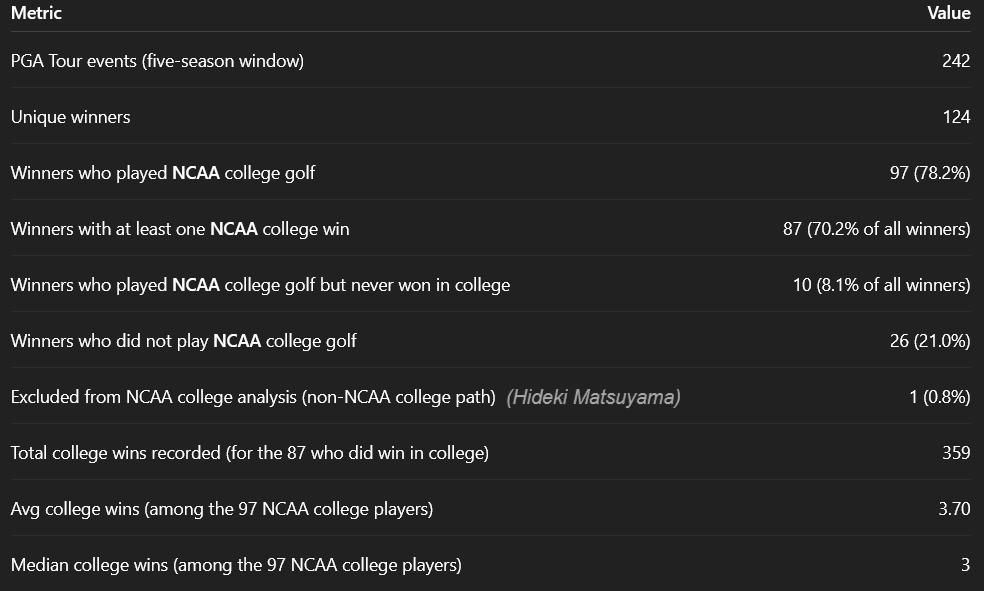
We pulled 242 PGA Tour events across a five-season window (every PGA Tour win from the past five seasons), then tracked down the college resumes for each unique PGA Tour winner. The goal was to get some context to how much the current PGA Tour winners won in college.
What we built is a simple barometer focused on wins. In this post, we’ll look at the most common path taken through college (in terms of winning) for these tour winners.
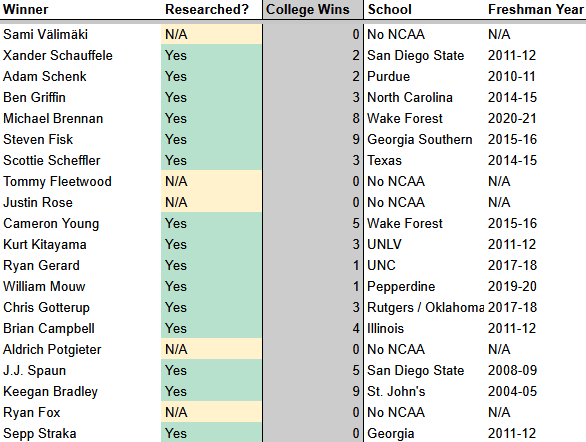
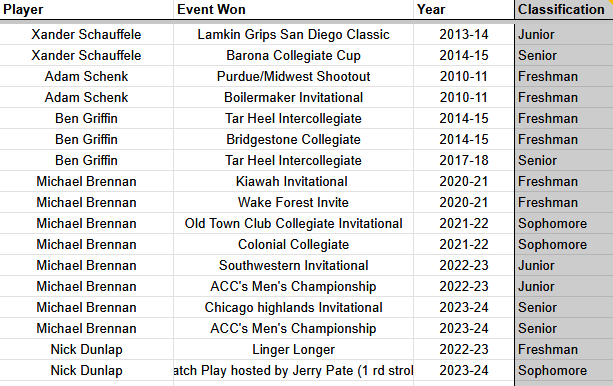
The complete dataset, in one table
If you’re a college golfer reading this, the headline is simple:
Most PGA Tour winners went to college, and most of the ones who went to college won at least once while they were there.
Of the 10 PGA Tour winners who did not win in college, only 7 actually graduated. The other 3 left school early. We will dig into these 10 players in the next post.
“Normal” for a tour winner is to have played collegiate golf, and have been a winner at that level. Probably not surprising to many. However, let’s explore more of what “normal” looks like:
What “normal” looks like for a Tour winner who played college golf
Let’s talk about the 97 winners in our sample who played college golf. Here’s how many college wins they had:
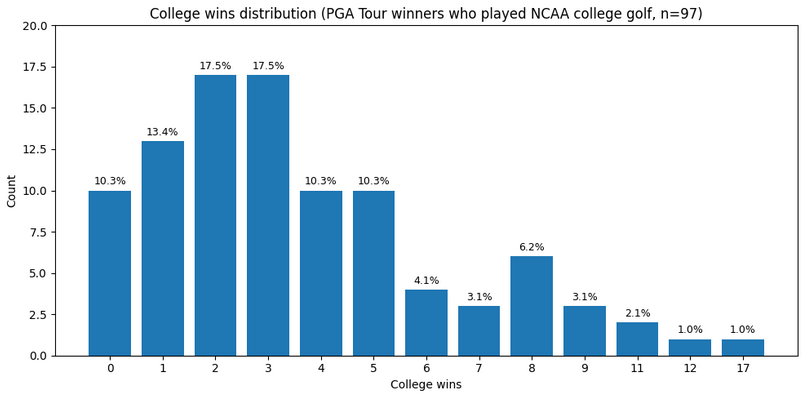
A few takeaways that are useful as a “reality check”:
Winning in college is almost the rule, not the exception.
87 of 97 college golfers (89.7%) won at least one event.Once you win once, you usually win again.
Of the 87 who won in college, 74 (85.1%) won at least twice.The median is 3. The center of the distribution is 2 to 5.
This is important because the conversation often gets hijacked by outliers. Yes, there are college careers where it feels like the player wins every other week. However, most college careers that turn into PGA Tour wins included somewhere between 2 and 5 individual wins.
When did they win?
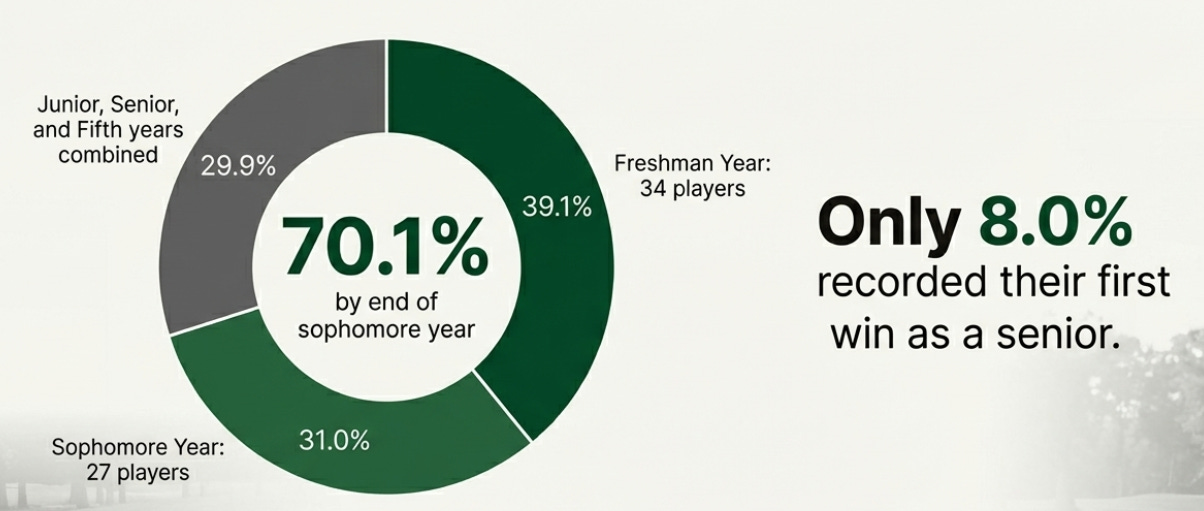
We also tracked when these winners got their first college win.
Among the 87 players in our sample who won in college:
First college win as a freshman: 34 (39.1%)
First college win by the end of sophomore year: 61 (70.1%)
In other words: seven out of ten had already proven they could close in college by sophomore year.
That does not mean you have no chance if you are not a freshman phenom. It does mean that the “PGA Tour winner” profile leans heavily toward players who learned to win early. The win timing suggests many were impact players early—either immediate lineup guys or fast risers.
At the other end:
First college win as a senior: 7 (8.0%)
First college win in a fifth year: 2 (2.3%)
Players who learned how to win late exist. They are just less common.
The “one win” club is larger than people think
There are 13 winners in this sample who had exactly one college win. That group includes names like:
Matt Fitzpatrick (Northwestern)
Cameron Champ (Texas A&M)
Davis Riley (Alabama)
Patton Kizzire (Auburn)
Robert Streb (Kansas State)
Although some of these players stayed less than four years, the large one-win group shows us there is no simple “you need 6 wins to make it” story here. There’s more context than that. Some players left school early, others played top-tier tournaments in great fields every week. Others again had close calls but remained winless for a long time.

What this should mean for a current college golfer
If you are trying to use this as a personal benchmark, here is the most honest takeaway when we look at winning:
If your pro goal is to win on the PGA Tour, your “most common” pathway includes winning in college.
It usually includes winning more than once.
It often includes learning to win early.
Parting Thoughts
As we are a group of three contributing to this post, we all have our different takes on this data. Here’s a paragraph from each of us:
Coach Schaloum
Hopefully this research project can be of value for junior golfers, collegiate players, and members of their support team. As goals are set and progress is evaluated, it can be worth remembering that winning in college is essentially a prerequisite for winning on TOUR. Of course, of the 124 winners we researched, there are 7 college graduates that did not win in college, but, as you will see in an upcoming post, a few of them had jaw-dropping careers while in school. While having double digit wins at the D1 level is also extremely rare, the goal should be to collect a few wins before moving on to the next level. Similarly, for players considering what level to play at - or those thinking of transferring to another school - use this information as you make your decisions. Have you won at your current level? Are you going to be a top-3 player at your school or fighting for playing time?
At the risk of being too forward, having a goal to turn pro after graduating college is virtually meaningless. The real goal is to have a successful professional career where you can support yourself and your family - likely on the European Tour or PGA TOUR. Without that being a realistic prospect, your 20’s may be better spent productively establishing a career and saving for later years. This data can be used as a roadmap for players that are serious about doing what it takes in college to become successful professionals.
David
One of the key takeaways for me was seeing that in order to win at the highest levels, players often first need to learn how to win. It’s never too late to learn, of course, but it obviously becomes more difficult at each stage. Having the confidence of knowing that you have done something before can often be the key difference in succeeding down the stretch at the next level.
It’s also important to never lose sight of the fact that in order to win a collegiate event, you have to first be in the field. Treating qualifiers as a true tournament can be one way of practicing how to win and tapping into the core truth: success begets success.
Mikkel
If I was a betting man, and my domain was to forecast future tour winners, I wouldn’t ignore this data. Most future tour winners are playing college golf right now, and they are likely winning. I would follow college golf leaderboards week in and week out. If I saw a player win multiple times before their junior year, I might place some money there.
However, although I think individual wins can tell us quite a bit about a player’s college career, there’s a lot of nuance we’re ignoring in this study. There are tons of quality players who play on tough rosters, and don’t break into the win column. So as a betting man, I would naturally dig deeper than just the win column.
Another aspect I’d be interested in is looking at players who won a lot in college but have not become successful tour players. For example, there are probably quite a few players who won multiple times before their junior years that we’ve never heard of. We’ve talked about this as a group, and we’d love to look into this - it’s just a bit too expansive of a project right now.
Next post: the 10 PGA Tour winners in our dataset who never won a college event, and what their careers had in common instead.

Other Links:
- Men’s DI Golf Rosters 2025-2025 dashboard
- Women’s DI Golf Rosters 2025-2025 dashboard
- The Declining Rate of U.S.-Born Men’s DI Golfers
- Women’s Golf: The Declining Rate of U.S.-Born DI Golfers
- Shifts in Height | Division I rosters over the past 20 years 📊
- How can a recruit best get a college coach’s attention? (Recruiting)

Mikkel Bjerch-Andresen
Golf coach, data analyst, writer