
Golfed: Range by David Epstein
I recently read David Epstein’s Range, and like everything else, I couldn’t help but golf it, filtering its ideas through my playing and coaching lens. This time, of the thousands of puzzle pieces left unsolved in our favorite game - a few actually fell into place for me while reading this book. So here’s the Substack piece where I golf the things that stood out to me from David Epstein’s Range.

David has a multidisciplinary background. He’s an ex middle-distance runner, who studied science, ended up as a sports writer for Sports Illustrated, and now is a published author. His sports background combined with his interest for scientific research makes for excellent writing, in my opinion. I highly recommend you pick up the book. If you're not much of a reader - here’s a link to a fairly extensive podcast interview he appeared on: The Diary of a CEO - David Epstein.
I’m currently reading his other published book, the Sports Gene, which is equally as compelling thus far. I might do a separate “golfed” post on that book in the future.
The first chapter of Range discusses the difference in Tiger Woods’ and Roger Federer’s upbringing.
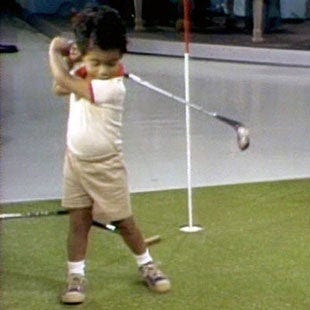
I assume most readers of this Substack have a fairly complete image of Tiger’s upbringing. The cornerstones were early specialization (hitting balls on national television aged two), single-minded focus on golf, competitive dominance at all stages of junior golf, immediate success as a pro.
Although I would consider myself a casual Roger Federer fan, I’d actually never read about his background before. In the book, Epstein describes how Federer tried several different sports in his youth. He was into skateboarding and soccer. His mother was a tennis coach, but didn’t push him into early specialization. In fact, she found it frustrating to coach Roger as he was stubborn and wouldn’t adapt correct technique and form. Roger made the switch to focus on tennis during his teens, at which point he was behind his peers.
During the chapter, Epstein introduces the terms wicked- and kind learning environments. Kind learning environments are clear-cut and predictable. They have consistent rules, patterns repeat, and feedback is immediate and accurate. It makes it easy to engage in deliberate practice - where each iteration of the skill acquisition is focused on error correction from the previous iteration. Chess is the classic example of a kind learning environment.
Wicked learning environments are messy and unpredictable. The rules are unclear, and the feedback loop can be misleading and/or delayed. Think investing.
In describing the differences of Roger Federer and Tiger Woods, Epstein labels tennis a wicked learning environment, and golf a kind learning environment.
Epstein argues that Federer’s diverse background in different sports helped his development once he focused on tennis, as the breadth of his skills at that point set him up for fast learning in such a wicked learning environment.
On the kind learning environment side, he writes extensively about the Polgár sisters who specialized in chess. Their father, László Polgár, believed that “geniuses are made, not born” and set out to prove it using chess. The three Hungarian sisters were put into an early specialization training regime, which proved fruitful in the game of chess. Susan became the first woman to earn the Grandmaster title. Sofia reached International Master, and Judit is widely regarded as the greatest female chess player of all time. She achieved the Grandmaster title at age 15.
In addition to writing extensively on the fascinating story of the Polgár sisters, Epstein further demonstrates his point of chess as a kind learning environment by pointing out how computers beat humans as early as the 90’s - demonstrating the repeatability and error-detecting nature of the game - perfect for a computer.
On the golf side, Epstein argues that golf is another kind learning environment.
This is where I disagree. Yes, I understand the label as a kind learning environment when you’re first introduced to the game. After all, the ball lays still on the ground, and it flies exactly according to the laws of physics. During the first couple of years of playing golf, beginners will instinctively get a feel for their path and clubface, as the dynamics of these components causes contact and ball-flight. Hit ball, watch ball, hit again.
So yes, the two-year old Tiger who hit golf balls on the Mike Douglas show in 1978 was the product of a kind learning environment. Simply repetition through early specialization.
Rory McIlroy also famously chipped balls into a washing machine on national television at age 9. The two biggest golf stars of the last 30 years both hit golf balls on national tv before aged 10.
Kind learning environment indeed, right?
Well… At the highest level of golf, I’d label golf as quite the wicked learning environment.
Scott Fawcett of DECADE was the first to highlight the delayed effect of learning in golf for me. Golf is the sport in the world where the ball is in the air the longest, making it subject to the elements. That in and of itself creates variability in outcome and by definition, a wicked learning environment.
Scott pointed out to me that proper strategy takes years (as his acronym decade alludes to) to learn proper strategy through experience. This is because feedback from target selection is such a delayed feedback loop.
You could choose the optimal target for an approach shot, execute a “good” swing, and still end up with a plugged lie in a bunker. This gives you negative feedback to a correct process.
On the next iteration (approach shot), you could choose a sub-optimal target. Let’s say right at a tucked pin. You go through a distracted process as you’re trying to “force” a certain outcome. Despite your distracted state, the shot comes off as you envisioned and you tap it in for birdie. This iteration gives you positive feedback to a poor decision and process.
Scott argues it takes years to learn proper targets through the trial and error method as you need a super-large sample size.
Learning on-course strategy at a high level has obviously become easier with data, visualizations, and tools created by Scott and others (such as the shot dispersion framework), but it’s still very much a wicked learning environment in 2025.
Peeling the onion one more layer, skill acquisition and player development at an internationally competitive level is even more wicked than on-course strategy. From both my personal playing- and coaching experiences, knowing what to interpret as signal and noise in your player journey is extremely wicked. To illustrate what I mean, here are all of Ludvig Aberg’s college scores. Ludvig was arguably the best and most consistent collegiate player over the past 5-10 years. I covered this in depth in a previous post.
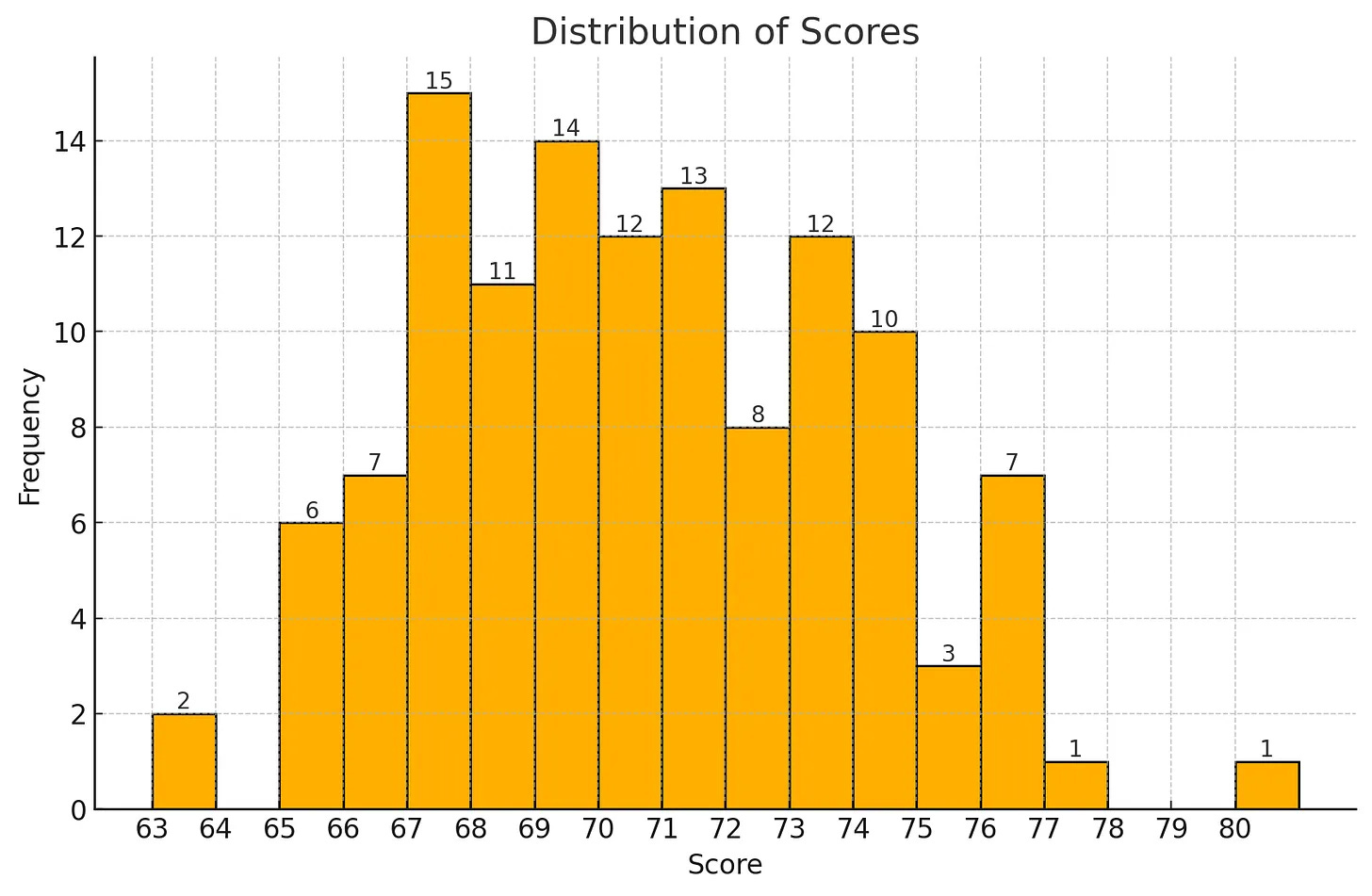
The level of golf displayed over four years here is absolutely incredible. This averages out to 70.21. The most common score for Ludvig in college was 67 (which he shot 15 times). Just incredible.
However, there’s a significant range in scores - from 63 to 80. That means anything in a 17-stroke gap can happen any given day for the best collegiate player of the last decade. That’s pretty wicked if you ask me.
Further, let’s look at his scores plotted:
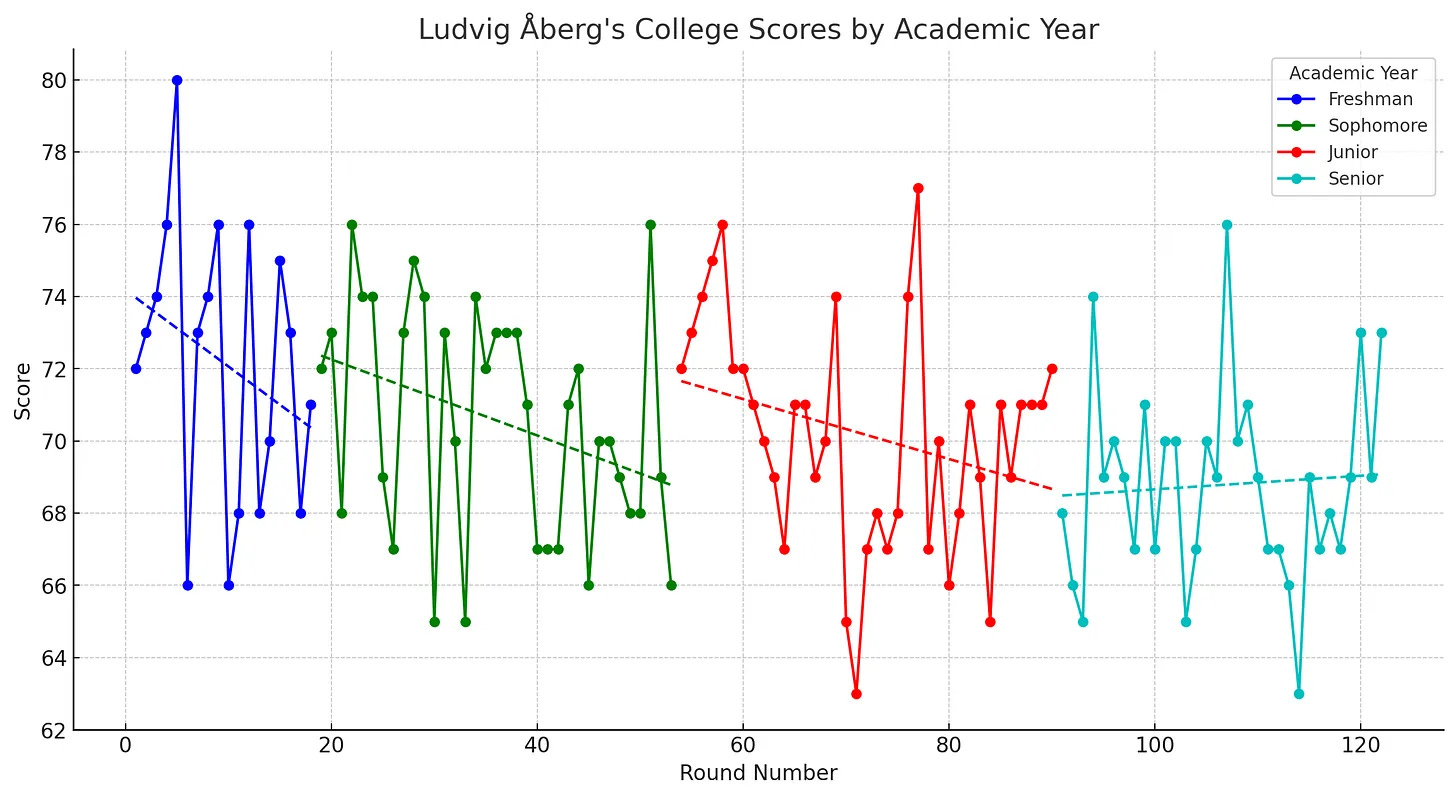
We clearly see progress, but it’s far from linear. What we get day-to-day is borderline potluck, and the overall graph resembles the movements of bitcoin.
The outcome of any given round is wicked at a high level in golf. One of the trickiest parts for golfers at a high level is deciphering what is signal (what truly needs fixing) and what is noise (just variance going against you). Should you switch putter after a round where you missed most of your short-putts? When analyzing your stats your strokes gained putting was a negative 4 compared to the PGA Tour… Does that warrant a change? Well, you tell me when you look at this graph of strokes gained putting from the at-the-time best putter on the PGA Tour, Aaron Baddeley:
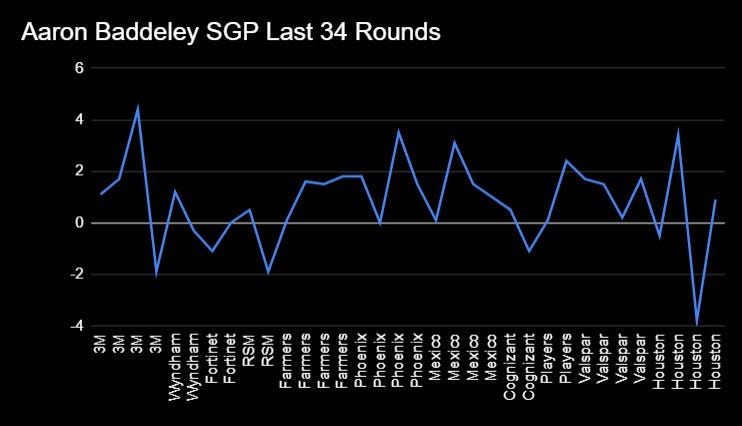
The best putter in the world can lose four strokes in a given round - so was your poor putting performance signal or noise from a performance within the range of performances we can expect from your level? This is the hardest part in our illogical game when we all carry strong recency biases (we are as good as our last performance).
What I coach players to do is increase the sample size in order to decrease the noise. We look at 15+ rounds at a time to look for trends in scoring and underlying stats. From there we steer training.
However, it’s not perfect, as there’s still noise left in the data we use to inform our decisions. For example, you could play an easy course in calm conditions with perfect greens one week, only to play a hallway-tight golf course in crosswinds the next. What’s signal and what’s noise. Are you truly getting better?
One more layer - once you’ve decided on what’s signal, which direction you chose to go with your player development is ultra-wicked. If competitive golf environments were truly kind, you’d be able to identify areas of your game which need improvement, and then just go do more of that thing. “Oh, my greens in regulation percentage over the past month is too low, I need to hit more balls.” Hit ball, see ball, hit ball again. Iteration is the engine for improvement in that scenario. In fact, one of the most common errors I see from high-level players is doing too much (at least in a “fixing” state.)
However, at a high level, it’s much more complicated than that “do more, get better”-environment. Is your greens in regulation low because of your tee shots being worse? Have you been playing harder golf courses with smaller greens? Have conditions been more challenging? Is it a target selection/strategic issue? Is it a technical issue? Is it a playing-focus issue?
If the answer to any of these questions is “yes”, it’s usually not a “100% yes”, it’s a “I think so?”. You just don’t have perfect information.
Further, choosing how to correct can be a leap of faith. It becomes an experiment where the effect is uncertain.

If the issue is missing greens to the left, and we’ve eliminated target selection and playing focus as a cause, we hunker down on the technical components. The ball starts too far left and doesn’t curve back enough on average. OK, we drill down further to the clubface. We decide the clubface needs to be less closed at impact.
The question now is how do we do this technically? This is the leap of faith part where hopefully the player and coach knows the player’s game and has experience forming a hunch of what works.
We could change things at set-up such as weakening the grip or creating a more vertical swing plane by standing closer to the ball. We could change components in the backswing to create a less closed face at the top - things like adding clubface rotation or altering the hand-path somewhere. Finally, we can change the downswing in an effort to return a more open clubface on average. We could do this by focusing on the exit, we could move our balance towards our toes to affect the swing plane, or we can add more shaft-lean at impact.
Instead of intrinsic technical cues we can use external cues. We can align an alignment stick slightly open as a cue to return the face at that angle, we can put constraints in the way to eliminate left ball-starts, etc.
You get the idea. There are simply a million ways to Rome here, and what we do will always be an experiment to some degree - regardless of experience.
Basically, improvement and error correction at a high level in golf means:
decipher signals in a wicked environment, take an educated guess for the best course of action, stick to it for a long time without wavering, check the result.
Oh, and add to the mix: “tie my entire identity to every golf score I post, make a living off paychecks I get only when I play well, score well every round to keep travelling on my golf team…” All these emotional factors muddying the water. As wicked as it gets if you ask me.

Epstein argues professional athletes are much more likely to be the products of a range of sports in their youths, than early specialization. So why do we obsess over the early specialization stories? Why do we almost exclusively hear about the Tiger Woods’ of the world - not the Roger Federers. When discussing this with Malcom Gladwell on a run, Gladwell described it to Epstein as the human cat video.
- It’s fascinating seeing someone that young master something most adults can’t do. It’s entertaining, and intriguing at the same time. “How?” And so the story gets told and retold, the videos get shared, etc. On the contrary, seeing Roger Federer at the peak of his rate of development - likely in his late teens - is impressive, but no defying the laws of human ability. Less of a fascinating story.
Did Rory and Tiger have head-starts that mattered? Yes, I think so. However, were they predictive of their global success? I highly doubt it.
The learning environment they transitioned into as teens, as they were reaching a high international level, was incredibly muddy to navigate. This is the phase of development where they probably made their most impactful decisions. The right technical plans, the right competitive plans, consistent work over time, etc. I would argue this time of their lives was much more important for their future athletic success than chipping golf balls in diapers. They likely navigated the wicked parts beautifully for the most part.
I won’t go into his chapter on the 10,000 hour rule here, although it’s fascinating. However, on a podcast, Epstein said he was the type of person inclined to believe the 10,000 hour rule narrative. He was a walk-on in college who ended up being part of a record-setting relay team. He improved a lot through his hard work.
I would put myself in that boat. I was introduced to the game of golf early, but mainly participated in other sports (soccer, skiing, and biathlon) until I was 14. I then fell in love with golf and dedicated myself to it. I was a 26 handicap at the time and had never broken 100.
Fast forward 5 years and I was on a scholarship at a top US-school (Baylor University). I had been a Team Norway player for almost two years and had been a part of the team who earned Silver at the European Championships. My quantity of practice had been consistently high and I regarded my work ethic as my strongest asset compared to my peers.
However, after reading Range, my view of my own development during the teen years has slightly altered. Of course, my deliberate practice hours were the engine for my progress those years - I still believe that. However, my varied sports background probably propelled my learning immensely once I dedicated myself to golf.
I had a high work capacity thanks to competing in three other sports all those years. My strength and coordination was probably decent. When it comes to intangible things, I probably transferred some notions about how to compete. Reading wind is important in biathlon, for example. The list goes on…

If I could re-create myself as a super-range golf-monster, I would probably have had some more golf than what I had early on. In my playing-career, I never thought I quite caught up to my peers around the green. Wedges and short-game never reached the level I needed to excel in professional golf. I wasn’t exposed to the hours and hours of play around a chipping green at a country club in my youth. Further, I didn't replace that void with another hand-eye heavy activity. I didn’t really throw anything in my youth. No basketball, baseball, volleyball. Just a bit of tennis and some snowball-wars in the school yard was the extent of hand-eye transfer. For example, I think the transfer to short-game would have been more applicable had I played table tennis all those years instead of skiing.
Table tennis is a larger sport in Sweden than Norway. Although anecdotal, I have seen multiple Swedes with “pingis” backgrounds who have excellent touch around the greens. That’s a transferred skill that seems to negate some of the Scandinavian issues of shorter seasons and a tendency to specialize in golf later than Americans.
I would also have done gymnastics and played hockey. Gymnastics for body- and coordination development. This would help with future injury prevention and technical adaptability. Hockey for strength, hand-eye, and speed generation. Those are my current thoughts - subject to change…
There are so many other interesting aspects to this book. A ton of great research is referenced. Some of my favorite topics were the 10,000 hour rule deep-dive, the insight on forecasting from the Good Judgement Project, and the analysis on InnoCentive and NASA. Pick up the book!
Did you like this golfed post? Let me know!
Mikkel Bjerch-Andresen
Golf coach, data analyst, writer