
"During college, what's something specific that improved your game?" - 133 answers
College Golf report Chapter 5
An incredible amount of short game with few balls, creativity around the greens. I went from being one of the poorest players from 100 yards in to top-20 in D1.
I asked 133 former college golfers:
"During college, what's something specific that improved your game?"
In this particular question, I was on the hunt for all the ultra-specific, niche, detailed ways that players uniquely improved. I wanted to get the accounts of the players themselves, and point to something very specific which improved their game during their college years.
The Five Most Common Improvements
When we analyzed all 133 responses, five themes dominated:
1. Short Game/Chipping (25 mentions)
"An incredible amount of short game with few balls, creativity around the greens (choose the right club, the LLC system: read lie first, then landing spot and then club to fit those parameters), basics and putting with pressure, speed and green reading. I went from being one of the poorest players from 100yds and in to be top-20 in D1. 6 random spots around the green (and bunker shots) 3 balls and all three had to be within a club length. If you holed one you were done with that spot. All three balls had to be within a club length to complete that spot, and you could not leave the spot until you had completed it. If you were unable to finish before the practice were done, you had to complete it on the next opportunity."
"After transferring the first time, we had access to a par 3 course in Portland where I really got good with my wedges. We had so much fun out there as a team and we all got really good at wedges."
"Seeing James Sieckmann for short game."
"Tons of short game competition during team practice."
"Short game work with the coaches."
"Spending a lot of time working on my short game. Coaches introducing new methods and ways of practicing also helped. A good short game helped both my scores and my confidence."
"Setting 18-54 up/downs up around the green and keeping score of how many I did each day."
"Spent a semester dialling in my short game. Became maybe the best part of my game for the rest of my college career and really noticed the importance of this when in match play. The foundation I built my freshman year was solid for the next 3 with 'minimal' maintenance."
"My coach taught me how to use a wider variety of clubs around the green. Before that, I relied almost entirely on wedges, and learning to use different clubs completely changed my game."
"As a team we played a ton of short game competitions. This was super helpful."
"Seeing a new short game coach."
"improving my chipping by completely changing my technique."
"Short game, variety of shots I could hit and also consistency in results of shots around the green."
"I played a lot of 'up and down' challenges (chip and put competitions with teammates) which helped me focusing on getting the ball in the hole."
"Wedges for sure. Our team goal my freshman year was to be the BEST wedge team in the country. There wasn't one drill that sticks out but we got creative and did wedges A LOT."
"Access to good practice areas. I was able to elevate my short game and putting."
2. Putting (16 mentions)
"A putting mirror I used daily."
"Found a few go to putting drills for stroke, aim, and starting the ball on line that really built my confidence on the short to mid range putts."
"I struggled with putting inside 5 feet. Getting help from a putting coach really helped."
"7-10 minutes a day on putting set up and start line. Meant I didn't have to make every putt but it eliminated three putts (went a semester without a 3 putt when before I was averaging 2 a round) and my percentage inside 5 feet skyrocketed."
"Blast golf tool really improved my putting where I was able to get my scoring average down 2-3 strokes. Seeing the data on my stroke/tempo helped me make improvements."
"Aim point training."
"I learned more about grip pressure with putting. In jr golf, my short game was horrific. Once I learned about grip pressure, it really changed my short game."
"I was struggling with my putting and then I changed my grip to claw and it became a strength of mine."
"I changed my eyelines while putting and how I traced the line, helped me see the line much better over the ball and become a great putter."
Putting improvements came from specific technical changes (grip, setup, aim) and consistent practice with pressure.

3. Wedges (14 mentions)
"After transferring the first time, we had access to a par 3 course in Portland where I really got good with my wedges."
"Creating a wedge chart. Knowing wedges distances and creating a clock system."
"Distance Control with wedges and irons."
"Using TrackMan for distance control on short game."
"Learning how to hit controlled iron shots. For example, hitting my 170 yd club to a 150 yd target. I felt like this is when my game took a turn for the better when I learned ball flight control."
"'Wedges, attitude, trajectory.'"
"Controlling wedge shots/spin control. Stopped hitting every wedge 100%."
"Access to radar (trackman), prov1 balls, and hitting off grass improved my wedges and short irons a lot."
"Trackman wedges."
"Wedges on TrackMan and wedge combines. Playing against teammates and getting competitive."
"Consistent wedge work on trackman."
"I had use of trackman a lot so working on 50-130 yard shots drastically improved my game."
Wedge improvement came from distance control, TrackMan practice, and competitive drills.
4. Competition/Playing More (12 mentions for competition, 10 for playing more)
"Playing more. As I mentioned earlier the years before college I spent most of my time on the range or on a putting green. Didn't value the course as much as I should've. This is something I figured out my freshman year and realized that could make me better. Hitting it straight on the range is something that a lot of people can do but to do it on the course while being under pressure and a lot of other factors playing into the shot is not always that easy."
"Playing against the seniors / experienced players."
"Coach was incredible at getting his guys to practice with pressure. That meant instead of hitting 20 drivers out into the range, maybe you forced yourself to achieve a certain score in a driver TrackMan combine before leaving or making yourself hit it between a certain target on a certain percentage."
"Started playing a lot on the course. We had limited access to practice facilities so I just played a lot of rounds."
"Feel like repeating myself but… on course play… I actually learned how to score, and that scores matter, and I felt more prepared in tournament because I played so much."
"I really benefited from all the playing, being from Norway you get stuck in these periods where all you do is practice. During these times it is easy to swing it well and play bad. Where during college you play constantly and learn to get better as you go."
"Playing a lot."
"When I was in high school, I mostly stayed at the practice facility and only played on the course once or twice a week. Once I started playing on the golf course five to six times a week, it helped me a lot."
"The team competition."
"Practicing with teammates."
"Being around better players and knowing that I had to get better."
"Putting in the hours and being in a competitive environment."
Playing more on the course beats range practice. Competition drives improvement.
5. Mental Game (11 mentions)
"[Instrctor] taught me how to filter my thoughts and how to deal with the immense anxiety I had for tee shots."
"Understand that you are not meant to hole every putt."
"Attitude is a skill that can be trained."
"Reading Bob Rotella's book; Golf is not a game of perfect."
"Working with a mental coach available at school."
"Working more on my mental game, and knowing my tendencies."
"I implemented many of Pia and Lynn's teachings for on course play. How to use your mindset to play with what you have and get the ball to go where you want regardless of how you swing it that day."
"Short game and mental perspective."
"Working with a mental coach."
"Sports psychologist."
"Having a mental coach available at school."
Mental game coaching made real differences. But fewer players mentioned it than short game or putting.
The Specific Technical Improvements
Beyond broad themes, players identified specific technical changes that transformed their games.
Swing Changes
"Changed my swing coach after the first semester. My new coach is available for me to FaceTime and stay in touch with close to 24/7."
"Hired Robert McMillan as a swing coach."
"I got a new swing coach my 4th year of school and he made my ball striking significantly better."
"Started working with Donal Scott."
"We got a new assistant coach who was great at technique. He helped me correct some things that made a massive difference my senior year."
"Working with my own coach, shifting a little bit away from the team stuff helped me. He taught me how to play golf, hit different shots, adjust tempo, expand upon my creativity, putting and short game."
Finding the right coach at the right time changed trajectories.
Course Management
"Learning course management and how to adapt to my game was incredible."
"Learning how to think my way around a course. You rarely have your A game, so learning how to manage my game had a huge impact."
"Course Management, a new swing coach, and detailed stats tracking allowed me to become more consistent in my own game and work on the right things."
"Course management and strategy. My college coach was very good at the preparation and execution of course management."
"Decade system for approach game (thanks to Mikel). Takes big numbers out of play and sets realistic expectations on proximity and score."
"Understanding of how to play to my strengths."
"Guidance from my teammate on how to score, not just hitting 'good shots.'"
"Taking the pins out on the course and realizing all I need to do is hit the middle of the green and I will find a flow on the course."
"Being conservative."
Learning to score beats learning perfect technique.
Technology and Data
"Dialing in how far the ball carried with each club. Adjusting for elevation and temperature."
"Getting custom fitting at TPI was a big game changer."
"Blast golf tool really improved my putting where I was able to get my scoring average down 2-3 strokes."
"Trackman wedges."
"Using swing analysing app."
"I had use of trackman a lot so working on 50-130 yard shots drastically improved my game."
TrackMan and other technology helped distance control more than anything else.
Practice Method Changes
"Learning to own your golf swing."
"Always practice with a specific goal or goals each day. Never just 'go hit balls.'"
"Coaches teaching me how to practice. Drills and structure to get the most out of my practice time."
"Not relying on hours of practice, that burned me out mentally and physically my freshman year. After that I have gotten much better at practicing. Less hours with more focus."
"I started to quantify my performance with certain performance drills that I could set goals on to achieve and take confidence from that into the course."
"Long hours. You can only get so good by playing/practicing 3 hours per day. Specific is that I started practicing 7-8 hours every day in the summer in college."
Quality over quantity. But also: sometimes quantity matters.
The Perspective Shifts
Several players identified perspective changes that unlocked improvement.
Confidence and Self-Belief
"As a junior golfer, there were coaches and others who suggested that my game was too 'one-dimensional' as I mainly stuck to the same shot. When I got to college, the team captain pointed out after some qualifying rounds that I 'hit the same shot every time, it's absolutely brilliant'. That changed my perspective and gave me some much needed confidence."
"I compared my golf swing to those around me and those on social media. I was convinced that I needed a perfect golf swing to compete, but it wasn't until I decided to play golf and not golf swing that I took the leap that I did. I saw my coach over the winter and he told me that I needed something consistent, not perfect, and that's where I began to understand."
"Coach would always say, if your swing feels off, keep the ball low until you find it again. And also my second coach would say as well that it doesn't have to look pretty, just get it done. Pin left, water left..don't have to hit a perfect draw because it 'fits'..hit your fade and be comfortable rather than make it look 'nice.'"
"A coach who believed in me and winning. I was a big fish in a small pond and learned to win."
Permission to be yourself unlocks improvement.
Playing to Strengths
"Learning how to analyze data correctly. I wasn't the best putter, but I was a high-level ball striker. My stats couldn't be compared to someone hitting nine greens a round. When they were, it made me feel like the worst putter on earth and that belief carried into competition. Once I learned to analyze my statistics against my strengths, everything shifted. I knew I could compete and win. I did—twice—while averaging 32 putts a round."
"My mental game and working with what I have and focusing on strengths and not trying to look what's missing, more working with what's actually working in my game and trusting that."
"Understanding of how to play to my strengths."
Understanding your game beats trying to fix every weakness.
Doing What's Best for You
"Doing what's best for yourself. You're going to get influenced by coaches, club reps, teammates etc. You need to do what's best for your golf game, and have a deep understanding of what helps you achieve that. Workouts, sleep, eating, practicing."
"Working with my own coach, shifting a little bit away from the team stuff helped me."
Ownership of your development matters.
The Physical Game
"The weight training and the summer programs that they would send us home with. Although my back was injured, and I had a great fitness guy at LA Tech, the workouts were terrific and helped my golf game tremendously."
"Discovering the gym. Learning to apply my body as an engine to my swing during the summer after sophomore year after learning the game focusing on my arms and hands for 10 years."
"I didn't hit the ball very far and after my first year my coach told me I needed to stop doing long distance running and change it up. Work out differently, put on muscle and gain distance off the tee."
"Changing my swing after a back injury & using a push cart to help manage endurance."
Physical development unlocked distance and consistency for some players.
The Unusual or Specific Changes
Some improvements were highly individual:
"Tripod." (No further explanation given)
"Tiger Driving Decade video. Helped my driving overnight."
"In my 4 years only missed one event. I was able to compete a lot which I believe led to my excitement to play professionally after graduation."
"Buying a car made me able to increase practice times by a lot. The other guys on the team with car didn't practice outside of team practice. This helped me a lot."
"Playing with friends to remember what it was like when golf was fun and not a job."
"I struggled with the driver yips starting at [two universities] - I started hitting driver off the deck with a grass tee which freed up my swing and had a few good tournaments using this."
"My short game was always my strength but in the US, I started using different wedges (grind) depending on the type of grass I was playing on."
"Practicing on grass year around."
"Increasing the numbers of reps in practice (compared to Norway). I had spent too much time focusing on quality, which led to lower quantity."
This section of answers might be what I find the most interesting. Sometimes the solution is unconventional. Do any of these apply to you?
The Team Environment Factor
"After practice our coach would take myself, [and two teammates] to the short game area and we would hit different shots and learn from each other. I learned a lot from those 2 players and vice versa."
"Playing with other good players on a consistent basis. I grew up playing by myself a lot on the golf course so I wasn't able to learn from others during high school."
"I would say seeing my teammates play well or even better than me. That became a motivation that I never thought would be the main drive for me to do better."
"Being around better players and knowing that I had to get better."
Teammates drive improvement through competition and learning.
What Didn't Improve
A few honest responses:
"Honestly not much in college improved with my game."
"Honestly, not a lot about my game got better during college. I tried to change things (equipment, gadgets and seeing a new coach), but it never yielded the results I was looking for. The only thing that got better was my short-game and putting. I missed so many greens that I was forced to make it up somehow, but I would say that was intentional."
"I should've worked more on my weaknesses rather than hide it. For me it was chipping higher shots around the greens."
"I had a weird college experience where I tried to change my strong grip my sophomore year after a promising freshman year and it derailed my game. I spent the rest of my college time trying to get back to where I was my freshman year."
Not everyone improved. Bad swing changes can derail years of development.
We will dig further into what hurt players' games in the next chapter.
The full College Golf Report - all 16 chapters, 47,000 words, with charts and data breakdowns - is available at (https://mikkelgolf.com/resources) for $29.95.
—
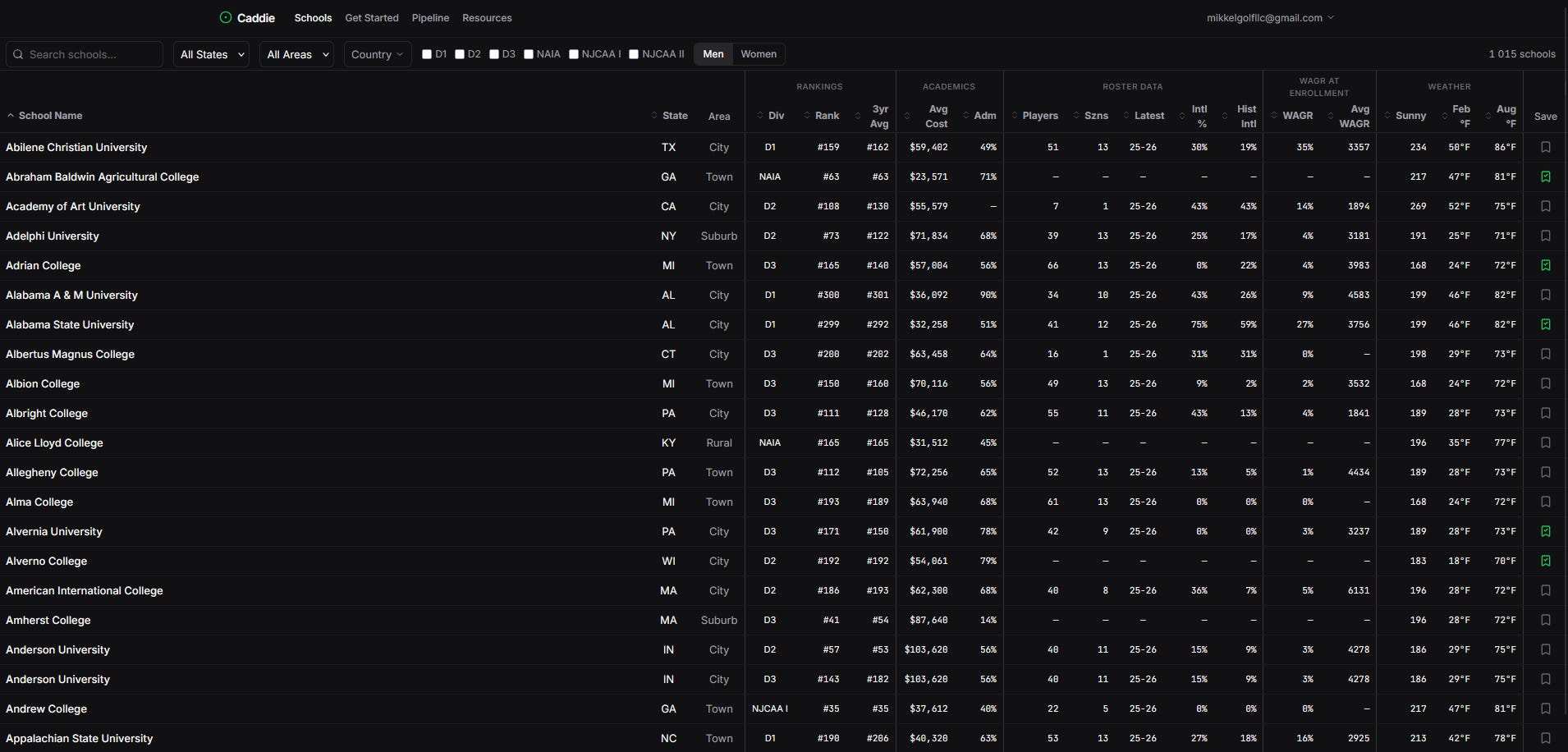
If you’re a family navigating the recruiting process right now, I also built CADDIE:
https://caddie.mikkelgolf.com
A complete recruiting system for you to own your recruitment - reviewed by me.
Mikkel Bjerch-Andresen
Golf coach, data analyst, writer