
7.9 Out of 10 Satisfied With Their Choice. What They Would Do Differently
College Golf Report Chapter 4
Three questions in the survey went straight at whether former college golfers were happy with their choice. I asked them to rate their overall satisfaction on a scale of 1-10. I asked if they would pick the same school again. And I asked them to rate nine specific aspects of their college golf experience on a 1-5 scale.
Then I asked the open-ended question: “What were some things you could have done differently in the recruiting process in order to find a better fit?”
The numbers tell a story of general satisfaction with significant cracks. The open-ended responses tell you exactly where those cracks are.
Overall Satisfaction: 7.9 Out of 10
On a scale of 1-10, the 133 respondents rated their overall satisfaction with their college golf choice at 7.9.
A third of respondents gave a perfect 10. Nearly half rated their experience 9 or 10. But one in five rated it 6 or below.
The full distribution:
10: 45 respondents (33.8%)
9: 17 respondents (12.8%)
8: 21 respondents (15.8%)
7: 20 respondents (15.0%)
6: 14 respondents (10.5%)
5: 6 respondents (4.5%)
4: 5 respondents (3.8%)
3: 2 respondents (1.5%)
2: 1 respondents (0.8%)
1: 2 respondents (1.5%)
Men rated their satisfaction slightly higher at 8.0 (n=108), women at 7.7 (n=25). Not a dramatic difference, but consistent with the pattern we see in other questions.

Would They Choose the Same School Again?
Yes: 61.4% (81 players)
Not sure/depends: 21.2% (28 players)
No: 17.4% (23 players)
So 38.6% have doubts or outright regret. More than one in three former college golfers would either choose differently or aren’t sure they made the right call.
The gender split is notable. 62.6% of men said yes, compared to 56.0% of women. That means 44.0% of women have doubts or regret, compared to 37.4% of men.
The Nine Fit Components, Ranked
We asked respondents to rate how strong their “fit” was across nine specific areas, on a scale of 1 (poor fit) to 5 (excellent fit). Here’s how they ranked, from highest to lowest average.
1. Your scholarship: 4.30 average (n=133)
Rated 4 or 5 (good/excellent fit): 79.7%
Rated 1 or 2 (poor fit): 6.0%
Scholarship tops the list. Nearly 80% rated their scholarship fit 4 or 5, and only 6.0% rated it 1 or 2. Most players felt the financial piece worked out.
2. Tournament schedule: 4.18 average (n=133)
Rated 4 or 5 (good/excellent fit): 80.5%
Rated 1 or 2 (poor fit): 5.3%
Tournament schedule tied for second. Players were largely happy with the events they played. This is one of the more visible parts of a program before you commit - you can look up the schedule online.
3. Competitiveness on the team: 4.18 average (n=133)
Rated 4 or 5 (good/excellent fit): 79.7%
Rated 1 or 2 (poor fit): 5.3%
Competitiveness also tied for second. Players want to be pushed by their teammates. This is harder to evaluate from the outside, but talking to current players helps.
4. Facilities/Courses: 3.99 average (n=133)
Rated 4 or 5 (good/excellent fit): 71.4%
Rated 1 or 2 (poor fit): 12.0%
Facilities rated well. This is another area you can evaluate during a campus visit. But as we’ll see, the things that are easy to evaluate tend to rate higher than the things that aren’t.
5. Team culture: 3.89 average (n=133)
Rated 4 or 5 (good/excellent fit): 67.7%
Rated 1 or 2 (poor fit): 9.0%
Team culture sits in the middle - not bad, but not great either. Given how much time you spend with your teammates, a 3.89 average suggests many players ended up on teams where the culture was just okay.
6. Assistant coach(es): 3.84 average (n=131)
Rated 4 or 5 (good/excellent fit): 66.4%
Rated 1 or 2 (poor fit): 10.7%
Assistants rated higher than the head coach. In many programs, the assistant is the day-to-day coach - the one at the range, the one traveling with the team, the one you see most.
7. Strength & conditioning: 3.67 average (n=133)
Rated 4 or 5 (good/excellent fit): 60.2%
Rated 1 or 2 (poor fit): 18.8%
S&C drops below 4.0 with 18.8% rating it 1 or 2. Nearly one in five players felt their strength and conditioning program was a poor fit.
8. Head Coach: 3.65 average (n=133)
Rated 4 or 5 (good/excellent fit): 60.9%
Rated 1 or 2 (poor fit): 20.3%
The head coach - the person who recruited you, who you probably chose the school for - rates second to last. Only 60.9% rated head coach fit 4 or 5, while 20.3% rated it 1 or 2. One in five players felt their head coach was a poor fit.
The full distribution tells the story:
5: 43 respondents (32.3%)
4: 38 respondents (28.6%)
3: 25 respondents (18.8%)
2: 17 respondents (12.8%)
1: 10 respondents (7.5%)
This is the most polarized distribution of any fit component. Some players loved their head coach. Others had a terrible experience. There’s very little middle ground.
9. Player development: 3.48 average (n=133)
Rated 4 or 5 (good/excellent fit): 51.9%
Rated 1 or 2 (poor fit): 15.8%
Player development comes in last. The thing that arguably matters most for your golf career - whether the program actually made you better - has the lowest satisfaction rating.
The distribution:
5: 23 respondents (17.3%)
4: 46 respondents (34.6%)
3: 43 respondents (32.3%)
2: 14 respondents (10.5%)
1: 7 respondents (5.3%)
Only 51.9% rated their player development fit 4 or 5. Nearly half the respondents rated it 3 or below.
What the Rankings Reveal
Look at the top three and bottom three. The pattern is clear.
The top three are structural
Scholarship (4.30), tournament schedule (4.18), and competitiveness (4.18). These are things you can evaluate before you commit. You know your scholarship number. You can look up the tournament schedule. You can check team rosters and results to gauge competitiveness.
The bottom three are people and development
Strength & conditioning (3.67), head coach (3.65), and player development (3.48). These are harder to evaluate from the outside. You can’t know what a coach is really like from a recruiting visit. You can’t evaluate a development program from a brochure.
The scholarship-development gap
The highest-rated component (scholarship, 4.30) and the lowest (player development, 3.48) are separated by 0.82 points. Players got the money. They didn’t always get the improvement.
The head coach problem
The head coach rates 8th out of 9 fit components at 3.65. The person who recruited you, the person many players choose the school for, is rated second-to-last for fit.
Only 52.6% of respondents said their recruiting coaches were transparent and truthful. Another 40.6% said it was a “mixed bag.” And 6.8% said no.
When asked directly, 60.9% said they were happy with their coaches, but 25.6% said “maybe” and 13.5% said no. The coaching staff scored 3.44/5 for helping their golf game and 3.39/5 for understanding what they needed.
These numbers paint a consistent picture: coaching is the biggest risk factor in the college golf decision. When it works, it’s transformative. When it doesn’t, it drags everything else down.
What They Would Do Differently: The Hindsight Lessons
We asked: “What were some things you could have done differently in the recruiting process in order to find a better fit?” 87 respondents gave a substantive answer. Clear themes emerged.
Theme 1: Start Earlier (Most Common)
The single most common answer. Players who started the recruiting process late felt they ran out of options and rushed into decisions.
“I should have started the process of looking for school a lot earlier. I started too late, so I didn’t have that many options to choose from.”
“Start earlier. Not in the sense that I think I could’ve achieved a better scholarship offer or an offer from a better school. But the more time you give yourself in the recruiting process, the most informed decision you can make.”
“Start earlier and prepare better. I think having better resources in the beginning to understand what is required and what the process is would be helpful.”
“Start earlier. I started late and just found a college. I was lucky that it was a good fit.”
Theme 2: Visit More Schools
Many players committed after seeing only one or two schools. They wish they’d had comparison points.
“Go on visits. Its easy for a coach to make their program sound awesome but its obviously important to visit the place if stuff like facilities is importantly to you.”
“Visit more schools… found one early that I liked, but still wonder if I had visited others if I might have preferred somewhere else.”
“Went on more visits and made more phone calls. I was scared to talk to coaches…”
“More visits and more questions understanding how the program was set up, facilities used and comradery within the team.”
Theme 3: Talk to Current and Former Players
Coaches sell. Players tell the truth. Several respondents wished they had gone straight to the source.
“Going into the recruitment process I knew very little about how different the programs could be. I could have done more research online, hit up more current players on the teams of the schools I was thinking about.”
“Speak to the current players about the culture.”
“Research, talk to current and former players.”
“I could have researched more schools and contacted more “current college golfers” to chat with them. About other teams but also what they would recommend to do.”
Theme 4: Cast a Wider Net
Players who only looked at schools in their region, or only at D1, wished they’d explored more options.
“Way more emails and look at D2s.”
“Apply to more schools. There’s a lot of D1 programs everywhere and I limited myself to just schools in Texas.”
“I would’ve been more open to more schools. Playing in a mid major I found out about so many schools I had never heard of.”
“Reached out to schools not only on the west coast but east coast as well.”
“I would have contacted a lot more schools a lot earlier.”
Theme 5: Don’t Rush
Fear of losing offers leads to rushed decisions. Several players committed before they were ready.
“Not rushed it. I was so worried about early signing that I was in a hurry to commit.”
“Waited longer before committing the first time.”
“Not be in a rush. Take your time and go on visits, learn about schools and if you can picture yourself being successful there.”
Theme 6: Better Self-Assessment
Some players were honest about having chosen the wrong level, or not being realistic about their own game.
“I would make sure I would be one of the top players and going to make the team rather than trying to qualify and be the 6th guy at tournaments. Going to a D2 school would’ve been a much better fit for me.”
“I was too stubborn on playing D1 and the money was also a big factor for me. Looking back, I would have taken some additional steps to ensure that I had a better match with the coaching staff.”
“Put less emphasis on how good or bad the program is. Find a school that has good facilities, a good tournament schedule, and a quality education.”
“I got lucky. But I would’ve made sure there was a clear path to playing time in the first two years.”
Theme 7: The International Perspective
International players face an extra layer of complexity. Many didn’t understand the American system at all.
“As an international recruit, I wasn’t familiar with the recruiting timeline/process. I would have just started the process earlier and pursued campus visits.”
“Understand better how American college sport and scholarships works.”
“Coming from Thailand, I didn’t think too deeply when I first committed. I was fortunate to end up in a great place, but looking back, I would have done more research on the school, the area, and the overall fit.”
“I was recruited during Covid so I wasn’t able to travel and meet the people. I think a lot of Norwegians have the mentality that as long as you travel to the US and start playing college golf there will be opportunities everywhere.”
Theme 8: The Lucky Ones
A meaningful number of respondents said they wouldn’t change a thing. But look at the language - even the satisfied ones often attribute it to luck, not to a good process.
“I think I found a very good fit for my playing ability during time of recruitment. That was mainly luck.”
“I did not spend much time in the recruiting process, but I was lucky to end up where I did.”
“None. Went to my dream school.”
“I love where I went to college.”
The Bottom Line
The satisfaction picture is mostly positive - 7.9 out of 10, with a third giving a perfect score. But beneath the overall number, the details matter.
The things that are easiest to evaluate before committing - scholarship, tournament schedule, competitiveness - rate highest. The things that are hardest to evaluate - head coach fit, player development, S&C programs - rate lowest. This isn’t a coincidence. It means the recruiting process is good at matching players on the visible stuff, but poor at matching them on the stuff that actually determines whether you’ll get better.
The practical takeaway is straightforward. Before you commit:
Start early. The most common regret is not having enough time.
Visit. One visit isn’t enough. You need comparison points.
Talk to current and former players privately. Not on an official visit. Not with the coach in the room.
Ask hard questions about development. What does practice look like day to day? How has the coach helped specific players improve?
Don’t rush. Fear of losing an offer is not a good reason to commit.
Be honest about your level. Playing time matters more than the name on the jersey.
The data is clear: most former college golfers are satisfied with their choice. But the ones who aren’t almost always point to the same things - coaching fit, development, and a process that was too rushed. Those are the things you can control.
This is Chapter 3 of 16. New chapter next week.
The full College Golf Report - all 16 chapters, 47,000 words, with charts and data breakdowns - is available at (https://mikkelgolf.com/resources) for $29.95.
—
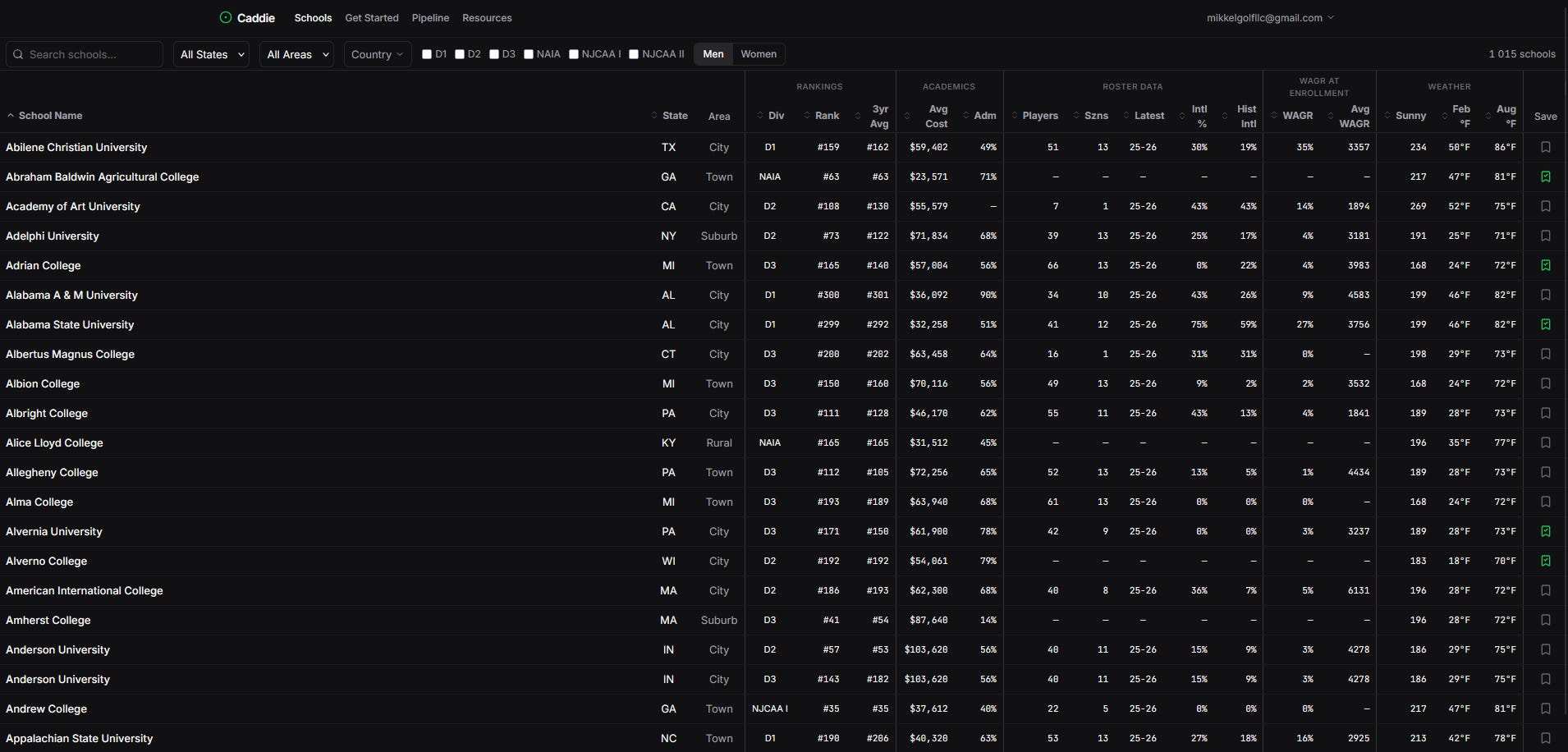
If you’re a family navigating the recruiting process right now, I also built CADDIE:
A complete recruiting system for you to own your recruitment - reviewed by me.
Mikkel Bjerch-Andresen
Golf coach, data analyst, writer